Mutual Sensitivity Between Caregivers Predicts Infant Affective State During Video Chat
Ellen C. Roche, Douglas J. Piper, Gabrielle A. Strouse, Lauren J. Myers, Jennifer M. Zosh, Georgene L. Troseth, Rachel Barr

TL;DR
This study shows that when caregivers are mutually sensitive during video chats, infants tend to show more positive emotions, but not necessarily more joint attention.
Contribution
The study introduces 'mutual sensitivity' as a novel variable to understand infant affective states in multi-caregiver settings via video chat.
Findings
Mutual caregiver sensitivity is linked to infants' positive, alert affective states during video chats.
No association was found between mutual sensitivity and infants' joint attention across the video chat screen.
Abstract
Infancy is an extraordinary period of human development, in which babies turn sensory and environmental information into meaning in the cradle of their caregivers' affective and attentional cues. Babies express what they are thinking and feeling through smiles and gazes long before they develop expressive language. Most developmental research focuses on mother‐infant dyads within a controlled lab environment, despite the complexity of young children's caregiving ecosystems, which range far beyond the mother‐child dyad and include caregivers at a distance via technology like video chat. This study uses a novel state space approach to examine relations between the sensitivity of two caregivers—what we call “mutual sensitivity”—and infants' real‐time affective and attentional states during video chat sessions. In this analysis of recorded semi‐naturalistic video chat interactions from 47…
Genes, proteins, chemicals, diseases, species, mutations and cell lines named across the full text — each resolved to its canonical identifier and authoritative record.
Click any figure to enlarge with its caption.
 Figure 1
 Figure 2
 Figure 3
 Figure 4
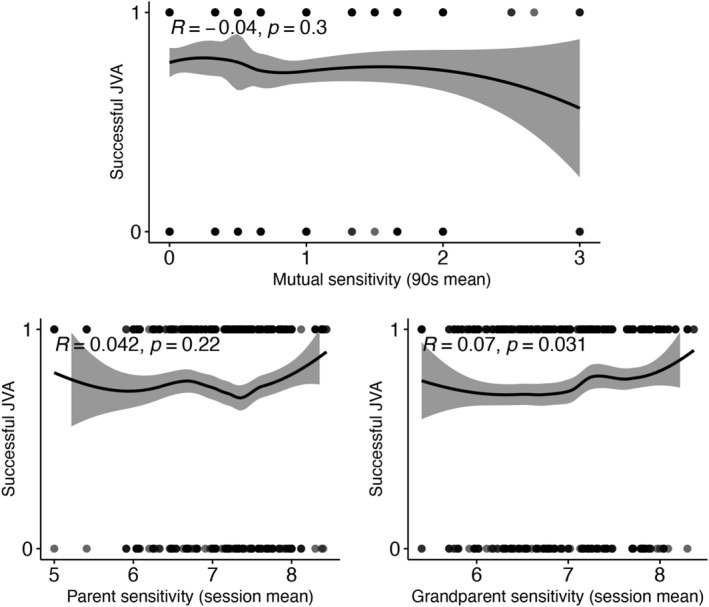 Figure 5
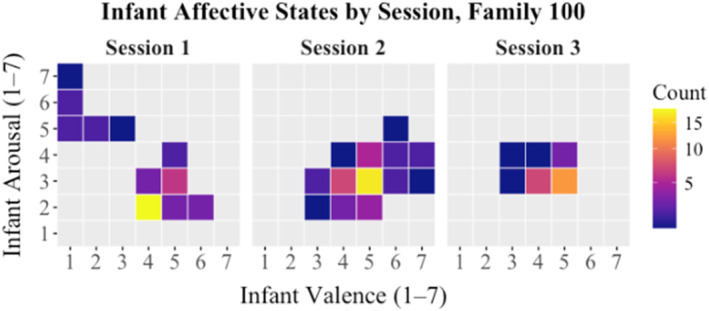 Figure 6
Peer Reviews
No public reviews on file for this paper yet. If you reviewed it on a platform where reviews are public (OpenReview, ICLR, NeurIPS, ICML), you can paste yours below so the community can read it here.
Videos
No videos yet. Explain this paper in a talk, walkthrough, or lecture? Add one.
Taxonomy
TopicsChild and Animal Learning Development · Attachment and Relationship Dynamics · Child Development and Digital Technology