Epidemiological and characteristic differences of hypervirulent and classical Klebsiella pneumoniae: a clinical and genomic study in Southern China during the COVID-19 pandemic
Yushan Jiang, Nianqing Kong, Zhuolin Li, Weiling Wu, Yifei Xie, Zhujun Zeng, Tingting Peng, Chenguang Shen, Shi Ouyang

TL;DR
This study examines the differences between hypervirulent and classical Klebsiella pneumoniae in Southern China during the COVID-19 pandemic, finding that hypervirulent strains cause more severe infections and show distinct genomic and clinical features.
Contribution
The study identifies a rise in hypervirulent K. pneumoniae during the pandemic and reports the emergence of a multidrug-resistant hypervirulent strain in Southern China.
Findings
Hypervirulent Klebsiella pneumoniae (hvKp) was more likely to cause bacteraemia and less likely to cause urinary tract infections compared to classical K. pneumoniae (cKp).
The K20 capsular serotype was significantly associated with hvKp isolates, and hvKp showed lower multidrug resistance rates compared to cKp.
Abstract
Hypervirulent Klebsiella pneumoniae (hvKp) has emerged as a significant public health threat owing to its ability to cause invasive infections. This study aimed to investigate the clinical characteristics and epidemiological associations of hypervirulent Klebsiella pneumoniae (hvKp) and classical K. pneumoniae (cKp) among patients treated at a tertiary hospital in Zhuhai City, Guangdong Province, China, during the period from January to December 2022, in the context of the ongoing COVID-19 pandemic. A total of 97 non-duplicated K. pneumoniae isolates and corresponding clinical data were collected. Antimicrobial susceptibility testing, hypermucoviscosity phenotyping, sequence typing, capsular serotyping, and whole-genome sequencing were performed. Hypervirulent strains were identified by the presence of the rmpA, rmpA2, iucA, iroB, peg-344, and peg-589 genes. Among the 97 isolates, 40…
Genes, proteins, chemicals, diseases, species, mutations and cell lines named across the full text — each resolved to its canonical identifier and authoritative record.
Click any figure to enlarge with its caption.
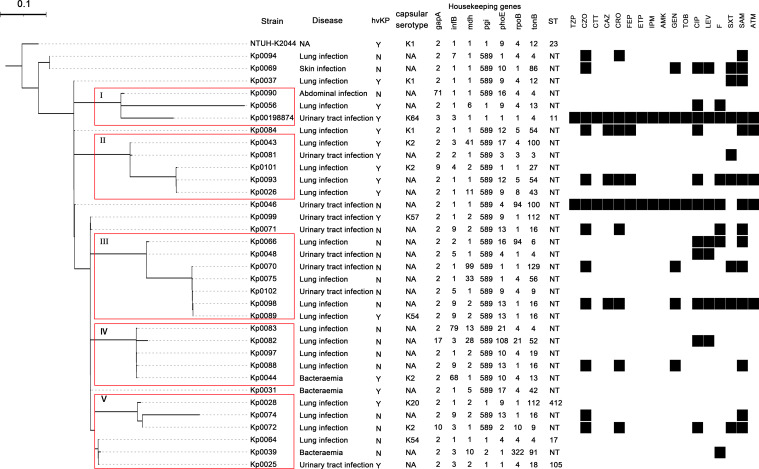 Figure 1
 Figure 2
 Figure 3
 Figure 4
Peer Reviews
No public reviews on file for this paper yet. If you reviewed it on a platform where reviews are public (OpenReview, ICLR, NeurIPS, ICML), you can paste yours below so the community can read it here.
Videos
No videos yet. Explain this paper in a talk, walkthrough, or lecture? Add one.
Taxonomy
TopicsAntibiotic Resistance in Bacteria · Antibiotic Use and Resistance · Nosocomial Infections in ICU