Empirical evidence for structural balance theory in functional brain networks
Majid Saberi, Abolfazl HaqiqiFar, AmirHussein Abdolalizadeh, Bratislav Misic, Ali Khatibi

TL;DR
This paper provides empirical evidence that structural balance theory applies to brain networks, showing that balanced triads are more stable and persistent than imbalanced ones.
Contribution
The study introduces dynamic metrics for triadic interactions and validates structural balance theory in brain networks using fMRI data.
Findings
Balanced triads in brain networks have longer lifetimes and higher peak energy than imbalanced triads.
Imbalanced triads are more transient and weaker, indicating structural conflict.
Triadic states show non-uniform prevalence shaped by transition patterns and lifetime profiles.
Abstract
Structural balance theory, widely used in social network research, has recently been applied to brain network studies to explore how higher-order interactions relate to neural function and dysfunction. The theory is founded on the core assumption that balanced triads, representing internally consistent relationships, are intrinsically stable, while imbalanced triads, which introduce structural tension, are unstable and tend to reconfigure toward balance. Despite its promising application, these foundational assumptions have not been empirically validated in the brain. Here, we address this gap using resting-state fMRI data from the Human Connectome Project to analyze the temporal dynamics of triadic configurations. We defined two metrics: triad lifetime, the duration a triad persists, and absolute peak energy, the maximum triadic interaction strength during that time. Balanced triads…
Genes, proteins, chemicals, diseases, species, mutations and cell lines named across the full text — each resolved to its canonical identifier and authoritative record.
Click any figure to enlarge with its caption.
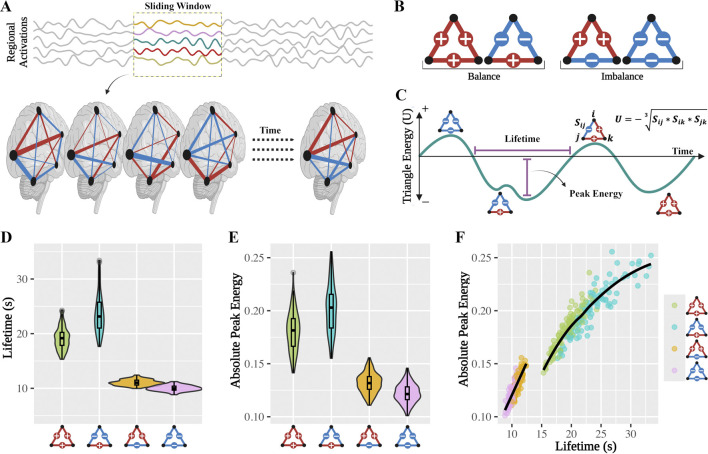 Figure 1
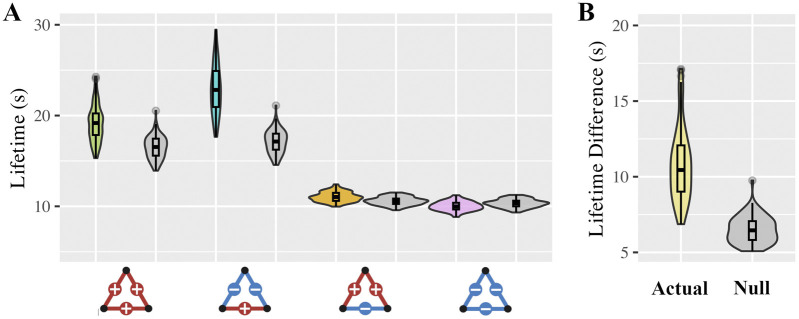 Figure 2
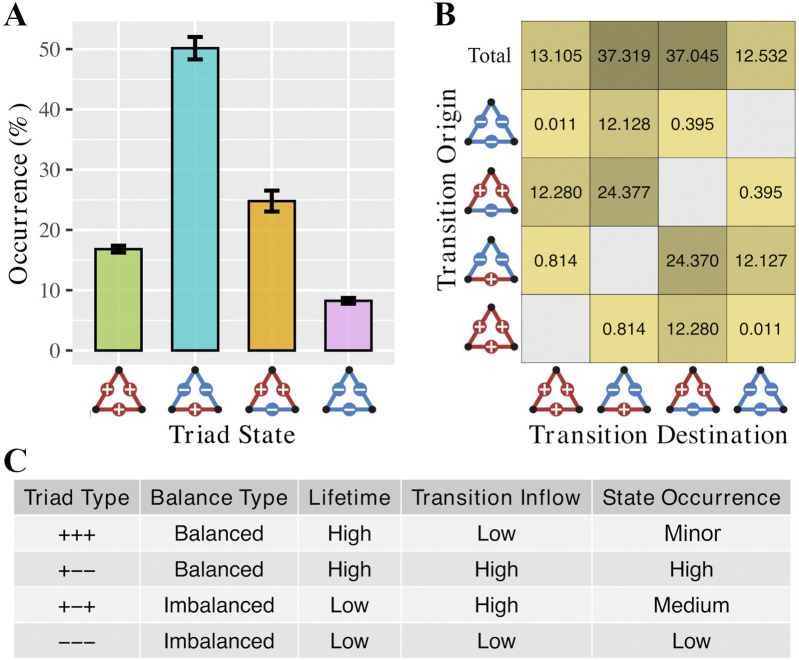 Figure 3
Peer Reviews
No public reviews on file for this paper yet. If you reviewed it on a platform where reviews are public (OpenReview, ICLR, NeurIPS, ICML), you can paste yours below so the community can read it here.
Videos
No videos yet. Explain this paper in a talk, walkthrough, or lecture? Add one.
Taxonomy
TopicsFunctional Brain Connectivity Studies · Neural dynamics and brain function · Mental Health Research Topics