Agreement Between 2D and 3D Echocardiography in Measuring Dimensions of the Patent Ductus Arteriosus in Infants
Stephan Juergensen, Christine Springston, Michael J. Bunker, Phillip Moore, Shafkat Anwar

TL;DR
This study compares 2D and 3D echocardiography for measuring patent ductus arteriosus in infants and finds strong agreement between the two methods.
Contribution
The study provides new evidence on the reliability of 3DE for PDA assessment in infants, a population previously understudied.
Findings
2D and 3D echocardiography showed strong agreement with low bias and narrow limits of agreement.
There was no statistically significant difference in PDA size measurements between 2D and 3D methods.
The findings support the potential use of 3DE for anatomic assessment and interventional planning in infants with PDAs.
Abstract
The patent ductus arteriosus (PDA) is a common cardiac lesion in neonates, which may require intervention for patency, or closure in the neonatal period. Two-dimensional echocardiography (2DE) is standard for PDA imaging. Three-dimensional echocardiography (3DE) is increasingly used for assessing complex anatomy and pre-procedural planning; however, there are limited data on the value and accuracy of 3DE of the PDA in infants. We aimed to determine the degree of agreement between 2 and 3DE in measuring common dimensions of the PDA in infants. Infants < 1-year-old, > 32 weeks corrected gestational age (CGA), and > 1 kg with a known PDA were enrolled prospectively for imaging by 2DE and 3DE. Images were collected at the parasternal short axis (PSAX) and suprasternal notch (SSN). Dimensions were measured at the pulmonic (PA) and aortic (Ao) end. Interclass correlation (ICC), Bland–Altman…
Genes, proteins, chemicals, diseases, species, mutations and cell lines named across the full text — each resolved to its canonical identifier and authoritative record.
Click any figure to enlarge with its caption.
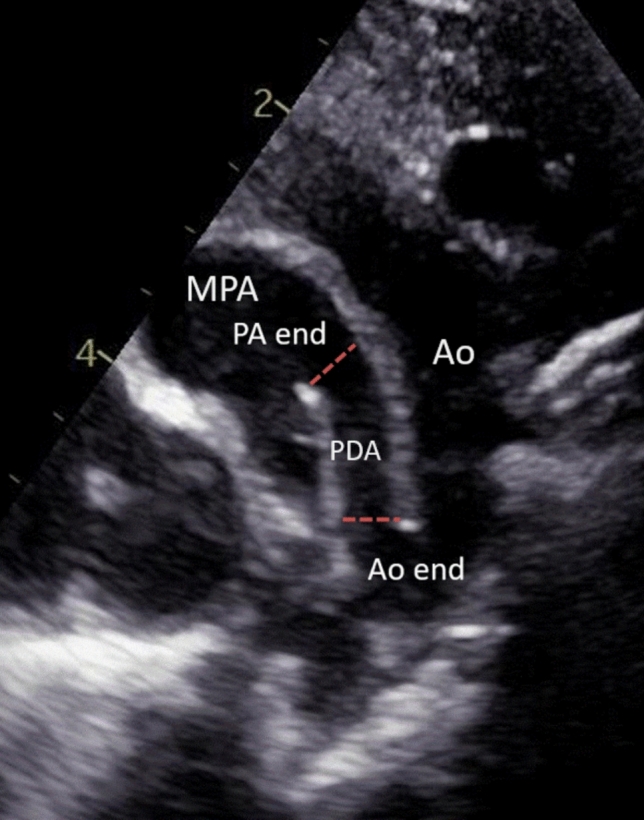 Figure 1
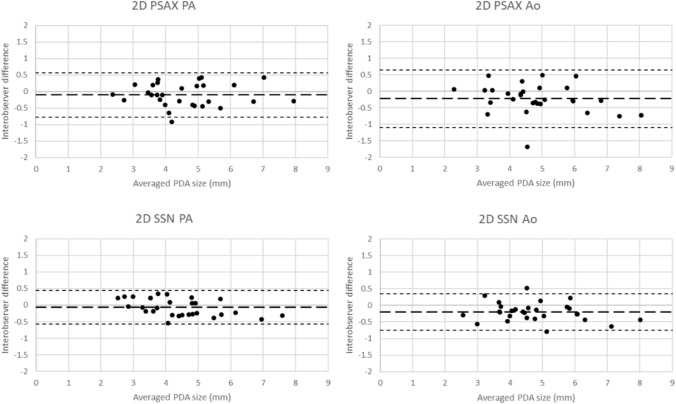 Figure 2
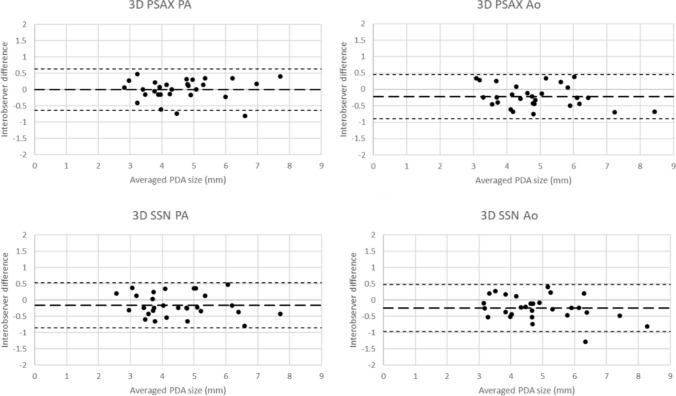 Figure 3
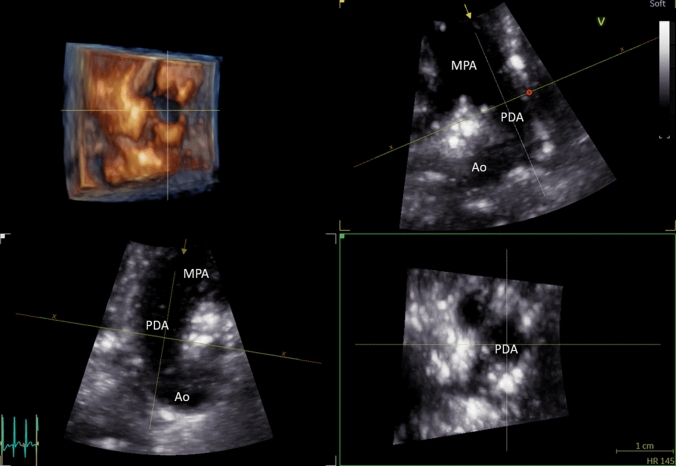 Figure 4
Peer Reviews
No public reviews on file for this paper yet. If you reviewed it on a platform where reviews are public (OpenReview, ICLR, NeurIPS, ICML), you can paste yours below so the community can read it here.
Videos
No videos yet. Explain this paper in a talk, walkthrough, or lecture? Add one.
Taxonomy
TopicsCardiovascular Conditions and Treatments · Congenital Heart Disease Studies · Mechanical Circulatory Support Devices