Evolutionary neuroeconomic adaptations of fast-spiking neurons in the human neocortex
Viktor Szegedi, Abdennour Douida, Gábor Hutóczki, László Novák, Karri Lamsa

TL;DR
This paper explores how fast-spiking neurons in the human neocortex evolved to balance energy efficiency and computational power.
Contribution
The paper identifies specific evolutionary adaptations in human fast-spiking neurons that reduce energy use while maintaining rapid signaling.
Findings
Human fast-spiking neurons have increased input resistance, reducing energy needed for ion gradients.
Adaptations like optimized ion channels and myelination help maintain rapid signaling despite energy constraints.
Abstract
Homo sapiens has evolved a large and complex neocortex that underlies advanced cognitive capabilities. Neural computation, however, is inherently energy-intensive, and evolutionary pressures have shaped mechanisms that optimize both computational performance and energy efficiency in the human brain. Fast-spiking interneurons, particularly basket cells, are among the most active neuron types in the neocortex, where they play a key role in coordinating time and space in the activity of neuronal networks, but their high activity levels require high metabolic resources. Because the human neocortex is significantly larger than that of rodents—and contains a higher proportion of inhibitory interneurons relative to pyramidal cells—this expansion may have created evolutionary pressure to reduce the energetic cost of fast-spiking neurons. Compared with rodents, human fast-spiking neurons exhibit…
Genes, proteins, chemicals, diseases, species, mutations and cell lines named across the full text — each resolved to its canonical identifier and authoritative record.
Click any figure to enlarge with its caption.
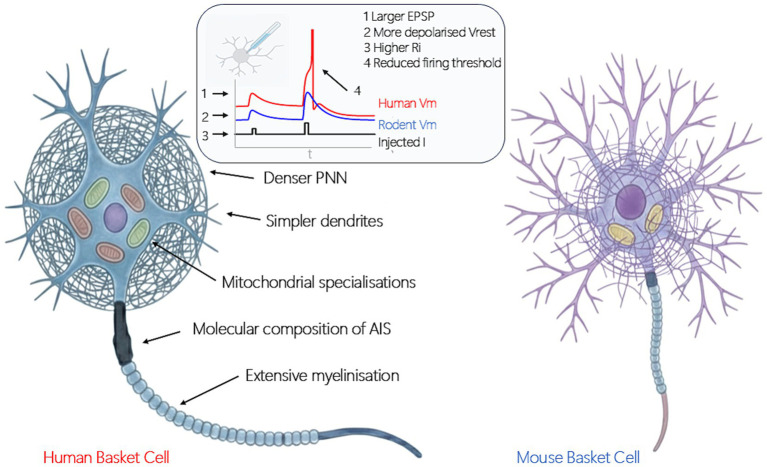 Figure 1
Peer Reviews
No public reviews on file for this paper yet. If you reviewed it on a platform where reviews are public (OpenReview, ICLR, NeurIPS, ICML), you can paste yours below so the community can read it here.
Videos
No videos yet. Explain this paper in a talk, walkthrough, or lecture? Add one.
Taxonomy
TopicsNeuroscience and Neuropharmacology Research · Neurogenesis and neuroplasticity mechanisms · Neural dynamics and brain function