Sedation level variability as an indicator for mortality in mechanically ventilated critically ill patients: a propensity score-weighted cohort study
Shu-Fen Liao, Chun-Jen Huang, Ru-Ping Lee, Tsung-Ying Chen, Hao-Chin Wang

TL;DR
This study finds that lower sedation level variability in ventilated ICU patients is linked to higher mortality risks, especially for those with poor sedation control.
Contribution
The study introduces a novel approach to assess sedation variability as a mortality predictor in critically ill ventilated patients.
Findings
Low sedation level variability is associated with increased 28-day and 90-day ICU mortality.
The negative effect of low variability is most pronounced in patients with less than 60% of RASS scores in the target range.
No significant differences were found in prolonged ventilation or ventilation-free days between the groups.
Abstract
To investigate the impact of low versus high sedation level variability (SLV), measured during the first 72-h intensive care unit (ICU) stay, on clinical outcomes in ventilated critically ill patients. Patients were identified from the Medical Information Mart for Intensive Care IV database from 2008 to 2019. The SLV was quantified by calculating the coefficient of variation (CV) using 18 time-series exponentially transformed Richmond Agitation-Sedation Scale (RASS) scores for each patient. Based on the median of the CV, patients were divided into the low and high SLV groups, which were subsequently balanced by a stabilized inverse probability of treatment weighting method. Compared to the high SLV group (n = 1749), the low SLV group (n = 1759) had a higher risk of 28-day [aHR (95% CI), 1.57 (1.36, 1.81); p < 0.001] and 90-day ICU mortality [aHR (95% CI), 1.51 (1.32, 1.71); p <…
Genes, proteins, chemicals, diseases, species, mutations and cell lines named across the full text — each resolved to its canonical identifier and authoritative record.
Click any figure to enlarge with its caption.
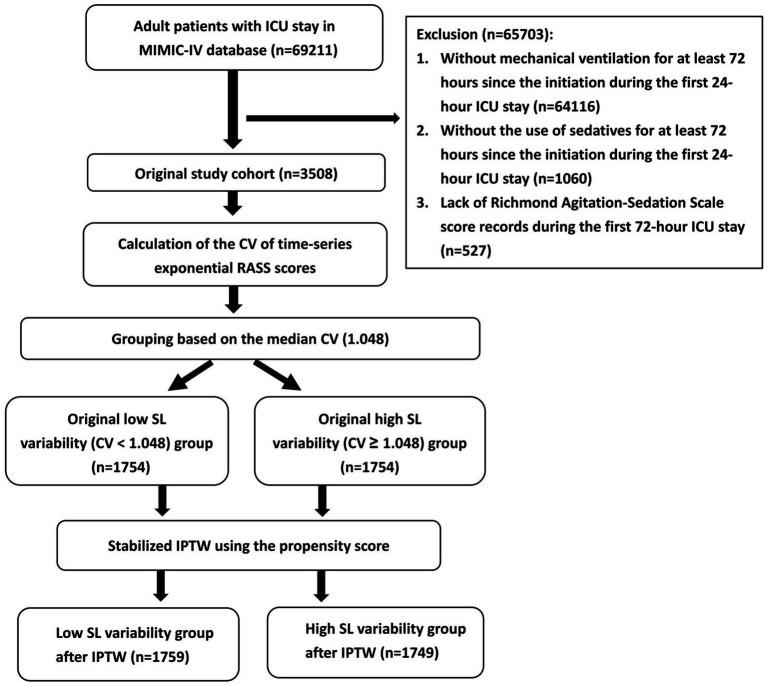 Figure 1
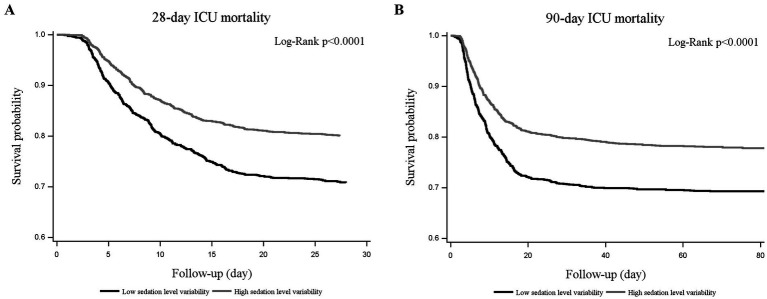 Figure 2
Peer Reviews
No public reviews on file for this paper yet. If you reviewed it on a platform where reviews are public (OpenReview, ICLR, NeurIPS, ICML), you can paste yours below so the community can read it here.
Videos
No videos yet. Explain this paper in a talk, walkthrough, or lecture? Add one.
Taxonomy
TopicsIntensive Care Unit Cognitive Disorders · Sepsis Diagnosis and Treatment · Anesthesia and Sedative Agents