Artificial intelligence in advanced endoscopic imaging: transforming optical diagnosis in gastroenterology
Sarah Bencardino, Ilaria Lodola, Lucia Centanni, Francesco Vito Mandarino, Jacopo Fanizza, Federica Furfaro, Ferdinando D’Amico, Lorenzo Fuccio, Angelo Bruni, Antonio Facciorusso, Sara Massironi, Vito Annese, Silvio Danese, Andrew A. Gumbs, Gianfranco Donatelli

TL;DR
Artificial intelligence is improving endoscopic imaging in gastroenterology by enhancing diagnosis and reducing unnecessary procedures.
Contribution
The paper highlights AI's novel role in real-time lesion detection and decision-making in both upper and lower GI endoscopy.
Findings
AI improves detection of dysplasia in Barrett’s esophagus and early gastric cancer.
AI-assisted colonoscopy increases adenoma detection rates and reduces interval colorectal cancer.
Multimodal AI approaches combine imaging with clinical data to enhance diagnostic precision.
Abstract
The term Artificial intelligence (AI) is revolutionizing gastrointestinal (GI) endoscopy by enhancing advanced imaging techniques such as Narrow Band Imaging (NBI), Linked Color Imaging (LCI), iSCAN, and Confocal Laser Endomicroscopy (CLE). AI-driven deep learning algorithms, particularly convolutional neural networks (CNNs) and transformer-based models, have demonstrated high accuracy in the real-time detection, classification, and risk stratification of premalignant and malignant lesions, thereby reducing unnecessary biopsies and improving diagnostic efficiency. In the upper GI tract, AI has shown superior performance in detecting dysplasia in Barrett’s esophagus, distinguishing early gastric cancer from benign alterations, and predicting submucosal invasion depth. This capability enhances decision-making regarding endoscopic resection, such as endoscopic submucosal dissection (ESD).…
Genes, proteins, chemicals, diseases, species, mutations and cell lines named across the full text — each resolved to its canonical identifier and authoritative record.
Click any figure to enlarge with its caption.
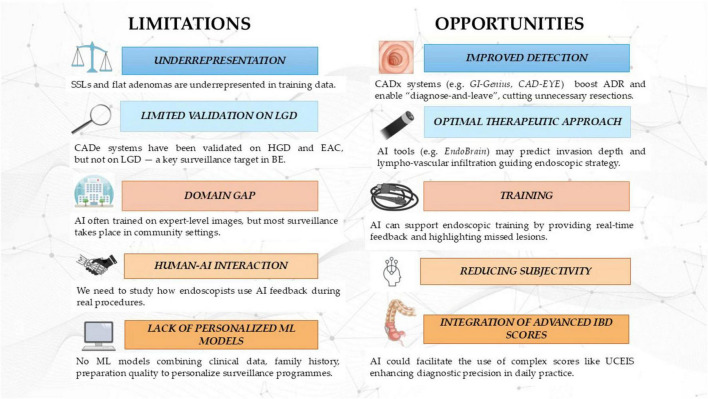 Figure 1
Peer Reviews
No public reviews on file for this paper yet. If you reviewed it on a platform where reviews are public (OpenReview, ICLR, NeurIPS, ICML), you can paste yours below so the community can read it here.
Videos
No videos yet. Explain this paper in a talk, walkthrough, or lecture? Add one.
Taxonomy
TopicsEsophageal Cancer Research and Treatment · Colorectal Cancer Screening and Detection · Optical Coherence Tomography Applications