Compositional complexity buffers free-volume sensitivity and serrated flow in metallic glasses
Anurag Bajpai, Jaemin Wang, Dierk Raabe

TL;DR
This study shows that increasing compositional complexity in metallic glasses reduces sensitivity to quench rate and improves mechanical performance.
Contribution
The paper quantifies how compositional complexity buffers free-volume sensitivity and serrated flow in Cu-Zr-based metallic glasses.
Findings
Higher compositional complexity narrows free-volume distributions and reduces quench-rate sensitivity.
Hardness, modulus, and elastic recovery increase with complexity, while serration density and plastic-zone volume decrease.
Radial-distribution metrics confirm enhanced short/medium-range stability with increased complexity.
Abstract
Processing history imprints metallic glasses (MGs), yet whether compositional complexity desensitizes structure and mechanics to quench rate remains unresolved. We use large-scale molecular dynamics along a controlled Cu-Zr complexity ladder, Cu50Zr50, Cu47.5Zr47.5Al5, and Cu45Zr45Al5Ti5, vitrified over 1011–1015 K·s−1 and probed by spherical nanoindentation. Additionally, composition-resolved CuxZr100−x sweep (x = 40–65 at.%) and a microalloying series Cu50-z/2Zr50-z/2Alz, (z = 1–5 at.%) disentangle configurational entropy-driven effects from enthalpic and structural covariates. Atomic free volume is obtained from radical-Voronoi tessellation; non-affine rearrangements are quantified by Falk–Langer \documentclass[12pt]{minimal} \usepackage{amsmath} \usepackage{wasysym} \usepackage{amsfonts} \usepackage{amssymb} \usepackage{amsbsy} \usepackage{mathrsfs}…
Genes, proteins, chemicals, diseases, species, mutations and cell lines named across the full text — each resolved to its canonical identifier and authoritative record.
Click any figure to enlarge with its caption.
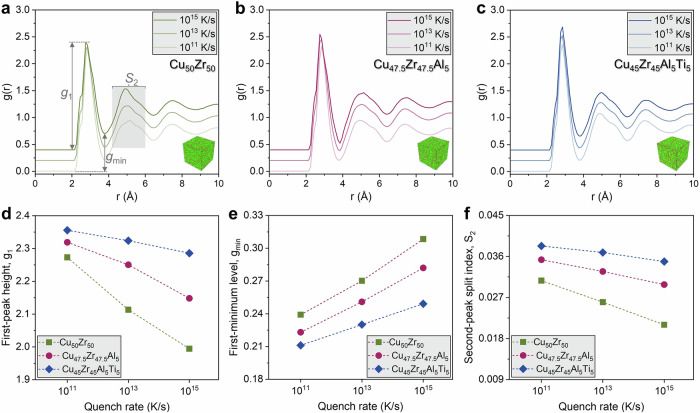 Figure 1
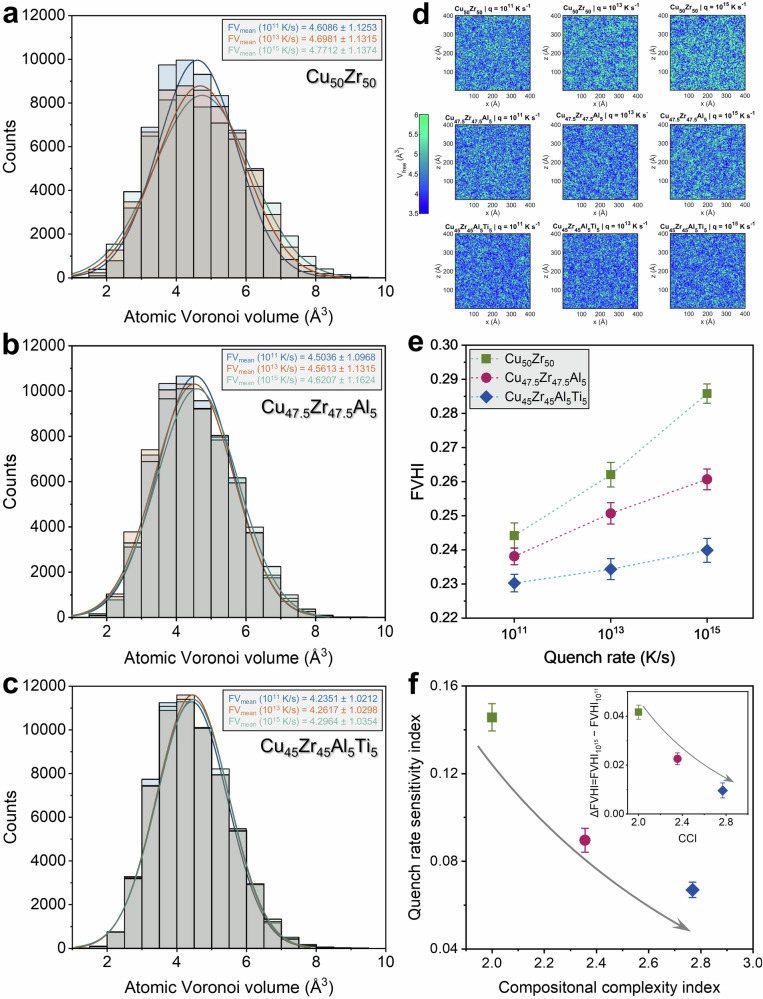 Figure 2
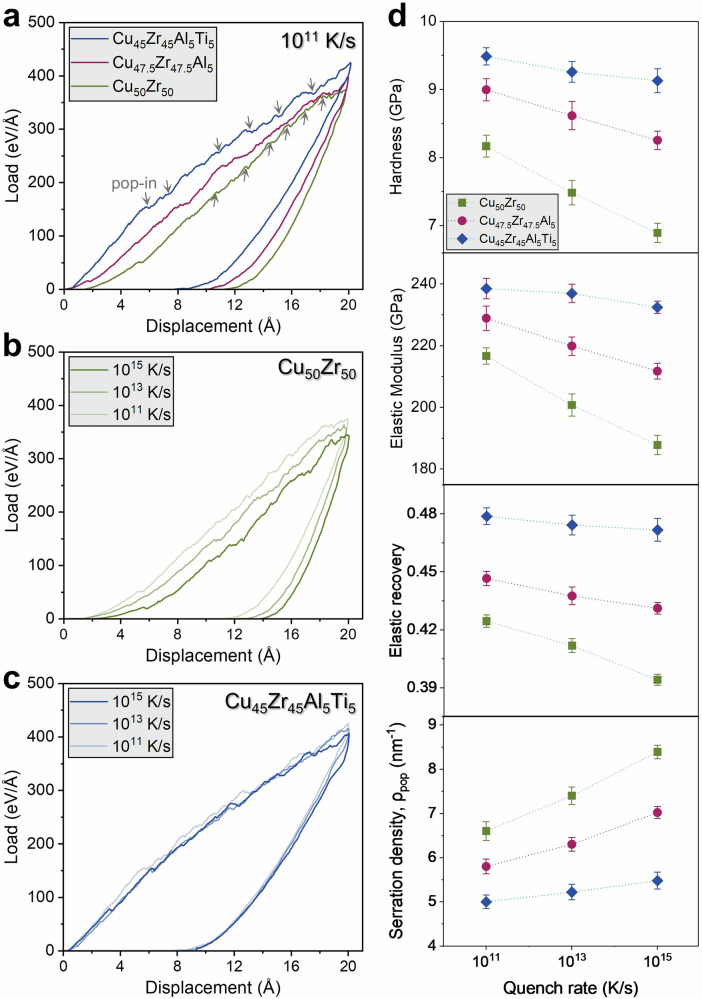 Figure 3
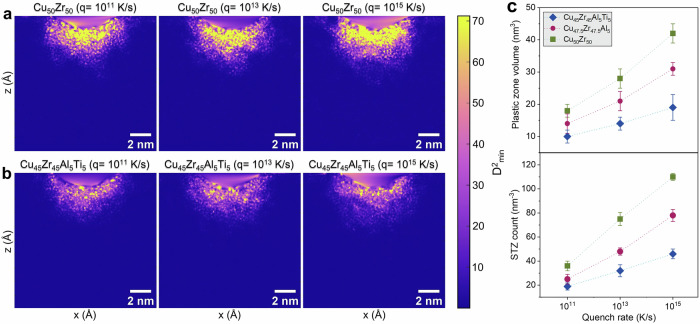 Figure 4
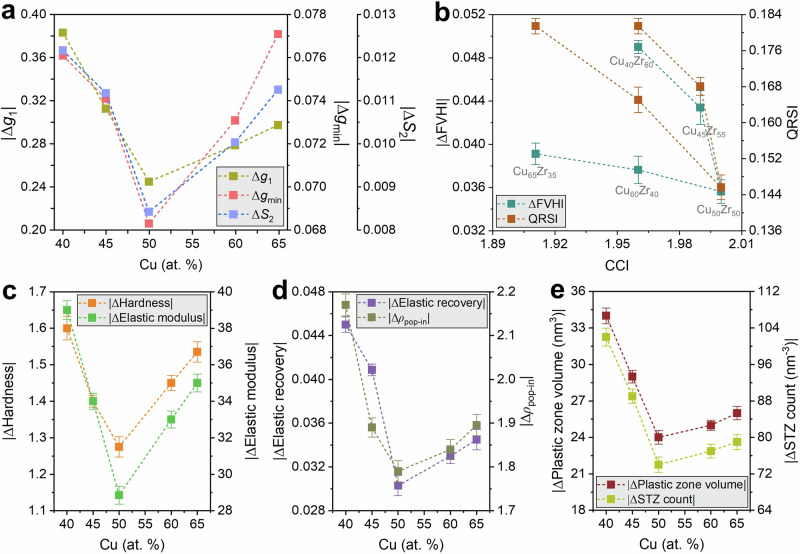 Figure 5
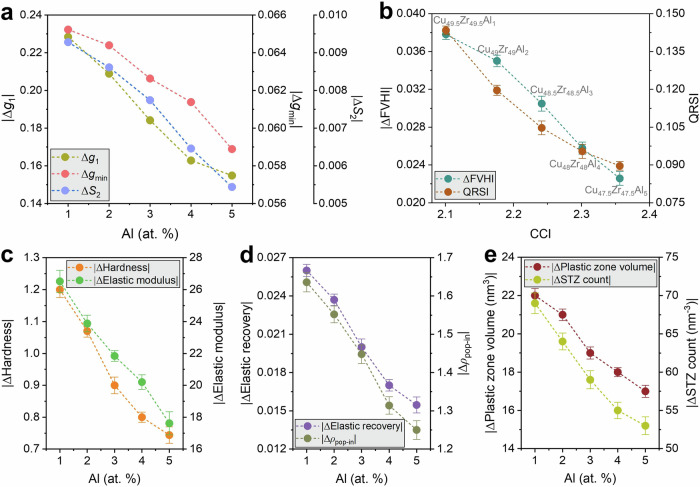 Figure 6
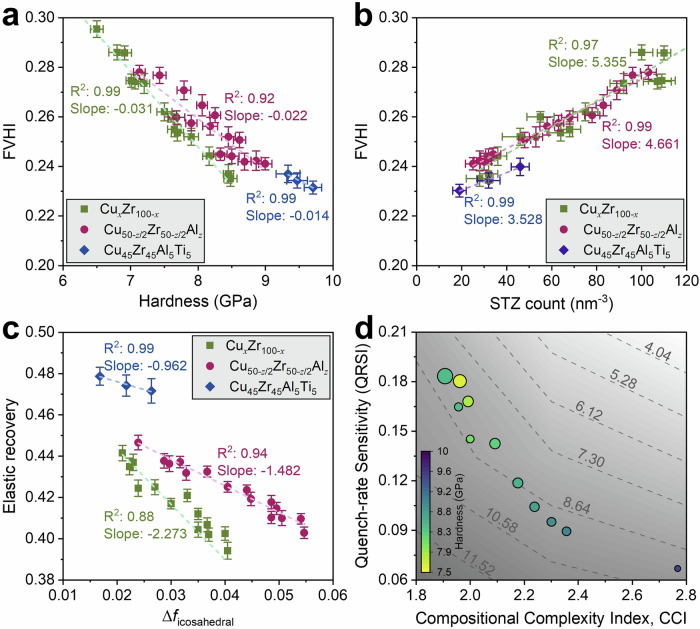 Figure 7
Peer Reviews
No public reviews on file for this paper yet. If you reviewed it on a platform where reviews are public (OpenReview, ICLR, NeurIPS, ICML), you can paste yours below so the community can read it here.
Videos
No videos yet. Explain this paper in a talk, walkthrough, or lecture? Add one.
Taxonomy
TopicsMetallic Glasses and Amorphous Alloys · Microstructure and mechanical properties · Material Dynamics and Properties