Effects of Molecular Weight Distribution on the Thermal–Mechanical Performance and Recycling of CO2‑Derived Poly(cyclopentene carbonate)
Balázs Striker, Alexander R. Craze, Kam C. Poon, Thomas M. McGuire, Kristian L. Mears, Charlotte K. Williams

TL;DR
This paper studies how the molecular weight distribution of a CO2-based plastic affects its strength, thermal properties, and recyclability.
Contribution
The study reveals how bimodal molecular weight distributions impact the performance and recycling of CO2-derived poly(cyclopentene carbonate).
Findings
PCPC samples with narrow-gap bimodal distributions retain high tensile strength and thermal properties.
Wide-gap bimodal PCPC samples show reduced performance unless low amounts of high molecular weight chains are added.
All high molecular weight PCPC samples can be rapidly depolymerized into cyclopentene oxide and CO2 within 15 minutes.
Abstract
Poly(cyclopentene carbonate) (PCPC) is a recyclable, CO2-derived thermoplastic with high tensile strength and low entanglement molecular weight. Such CO2-derived polycarbonates typically show bimodal molecular weight distributions, but how these distributions influence their properties is not yet understood. Here, the tensile, mechanical, thermal, and recycling properties are investigated for PCPC samples with different bimodal molecular weight distributions. Samples with high molecular weights (M n ∼ 81 kg mol–1) and narrow-gap bimodality, showing a relative 1:2 chain length distributions, are prepared using variable alcohol:diol ratios. These narrow-gap bimodality PCPC samples all show the same high tensile strength (σmax ∼ 60 MPa) and glass transition temperature (T g,∞ = 88 °C). A second series features different relative amounts of high molecular weight PCPC (M n = 76 kg mol–1)…
Genes, proteins, chemicals, diseases, species, mutations and cell lines named across the full text — each resolved to its canonical identifier and authoritative record.
Click any figure to enlarge with its caption.
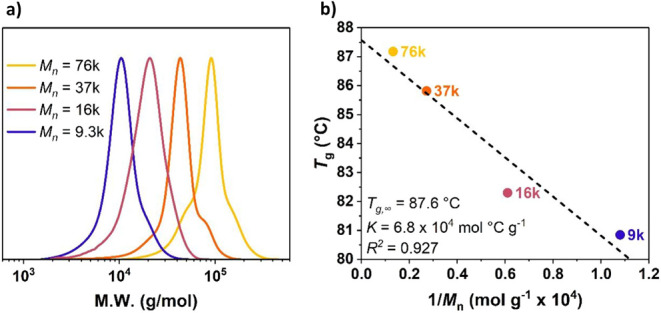 Figure 1
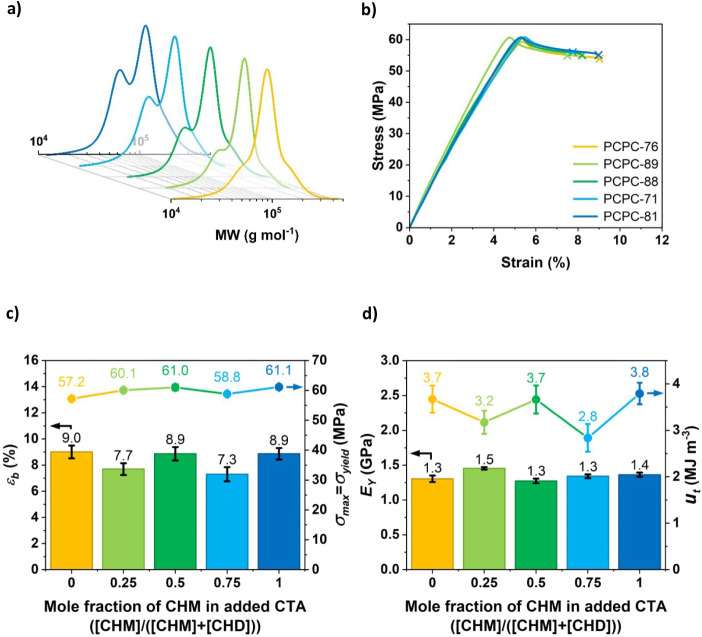 Figure 2
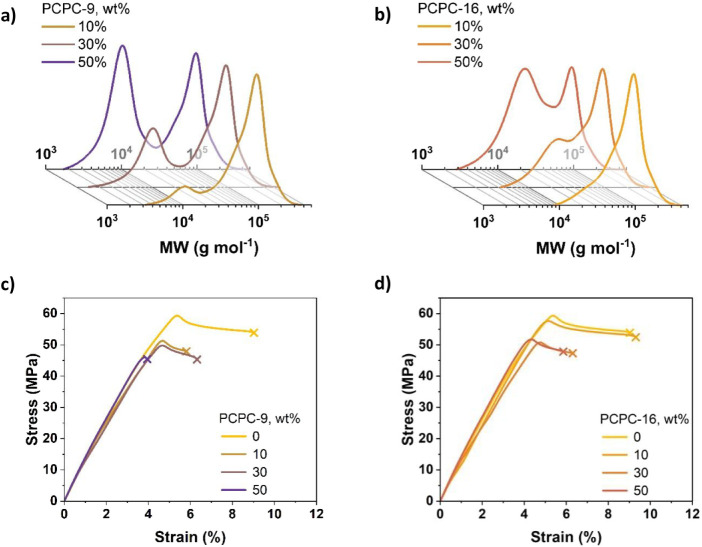 Figure 3
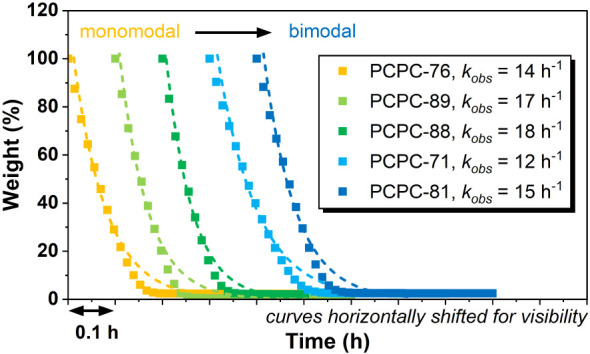 Figure 4
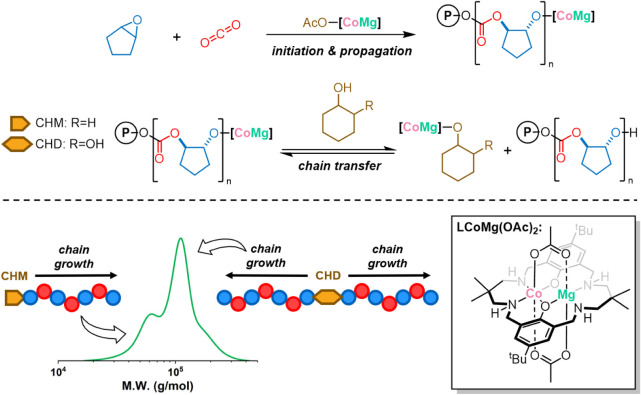 Figure 5
 Figure 6
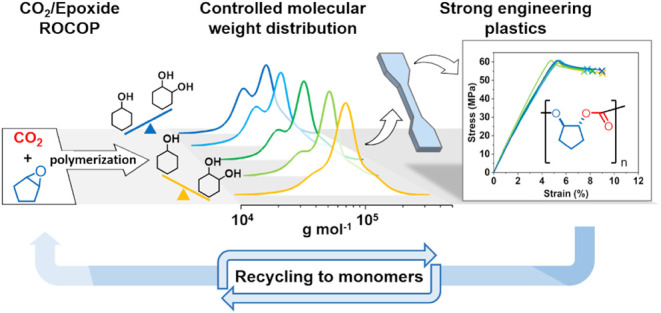 Figure 7
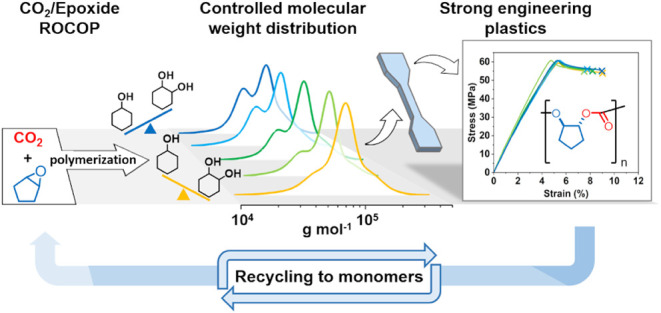 Figure 8
Peer Reviews
No public reviews on file for this paper yet. If you reviewed it on a platform where reviews are public (OpenReview, ICLR, NeurIPS, ICML), you can paste yours below so the community can read it here.
Videos
No videos yet. Explain this paper in a talk, walkthrough, or lecture? Add one.
Taxonomy
TopicsCarbon dioxide utilization in catalysis · biodegradable polymer synthesis and properties · Polymer Foaming and Composites