Combinatorial Synthesis of Protein–Polymer Conjugates by Postpolymerization Modification of Poly(pentafluorophenyl acrylate)s
Emily W. Kish, Thatcher M. Lee, Alexis M. Ziemba, Ama Boamah, Bianca Figueroa, Margherita Piccardi, Carey E. Dougan, Sarah J. Moore, Maren E. Buck

TL;DR
Scientists developed a method to quickly create protein-polymer combinations by modifying a polymer after it's made, which could be useful in various scientific and medical applications.
Contribution
A modular combinatorial method for preparing protein–polymer conjugates via postpolymerization modification of PPFPA.
Findings
Higher polymer:protein ratios improve conjugation efficiency for similarly soluble polymers.
Polymers with more reactive groups or shorter hydrophilic side chains enhance protein conjugation.
Smaller proteins conjugate more efficiently than larger ones.
Abstract
Combinatorial methods for preparing polymeric biomaterials enable the rapid identification of materials useful for many applications in science, medicine, and engineering. In the work described here, we demonstrate that side-chain reactive polymers can be used as templates for the rapid preparation of a small library of diversely functionalized protein–polymer conjugates. The activated ester polymer poly(pentafluorophenyl acrylate) (PPFPA) was modified postpolymerization with substoichiometric equivalents of three hydrophilic primary amines to yield a library of amphiphilic, side-chain reactive copolymers. These copolymers were then conjugated to two receptor-targeting proteins, holotransferrin (hTF) and an engineered fibronectin-based protein (Fn3), through amine-activated ester coupling. We investigated the influence of polymer:protein ratio, side-chain chemistry (i.e., hydrophilic…
Genes, proteins, chemicals, diseases, species, mutations and cell lines named across the full text — each resolved to its canonical identifier and authoritative record.
Click any figure to enlarge with its caption.
 Figure 1
 Figure 2
 Figure 3
 Figure 4
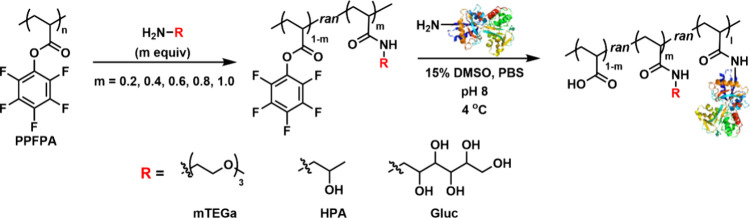 Figure 5
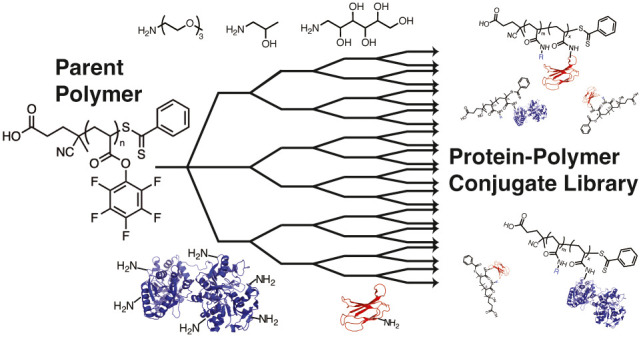 Figure 6
 Figure 7
Peer Reviews
No public reviews on file for this paper yet. If you reviewed it on a platform where reviews are public (OpenReview, ICLR, NeurIPS, ICML), you can paste yours below so the community can read it here.
Videos
No videos yet. Explain this paper in a talk, walkthrough, or lecture? Add one.
Taxonomy
TopicsAdvanced Polymer Synthesis and Characterization · Polymer Surface Interaction Studies · Nanofabrication and Lithography Techniques