Pilot-Scale Continuous Flow Synthesis of Capsaicinoids and Their Formulation with Cyclodextrins
Bettina Rávai, Dóra V. Ujj, Máté J. Orosz, Ecaterina Revenco, Szabolcs Béni, Ádám Tajti, Erika Bálint

TL;DR
This paper presents a scalable method to synthesize capsaicinoids and improve their water solubility using cyclodextrins, enabling broader use in food, pharmaceuticals, and agriculture.
Contribution
The first pilot-scale continuous flow synthesis of capsaicinoids and a formulation strategy using cyclodextrins to enhance solubility.
Findings
A continuous flow synthesis of capsaicinoids was successfully implemented at pilot scale.
Cyclodextrin derivatives effectively complexed with capsaicinoids, improving their aqueous solubility.
NMR spectroscopy confirmed a 1:1 host–guest stoichiometry and key intermolecular interactions.
Abstract
Capsaicinoids are the principal compounds responsible for the pungency of chili peppers and are widely used as food additives as well as in pharmaceutical and cosmetic formulations or potential agrochemicals. However, capsaicin and its derivatives have poor aqueous solubility, which limits their broader application. In this study, we report the first pilot-scale continuous flow synthesis of capsaicin, dihydrocapsaicin, and nonivamide, using sequential oxime formation, hydrogenation, and N-acylation steps. To increase the water solubility of these capsaicinoids, we systematically investigated their inclusion complex formation with various α- and β-cyclodextrin (CD) derivatives. Phase-solubility analyses and stability constant determinations were conducted to evaluate the complexation efficiency. Furthermore, 1D and 2D NMR spectroscopy confirmed 1:1 host–guest stoichiometry and revealed…
Genes, proteins, chemicals, diseases, species, mutations and cell lines named across the full text — each resolved to its canonical identifier and authoritative record.
Click any figure to enlarge with its caption.
 Figure 1
 Figure 2
 Figure 3
 Figure 4
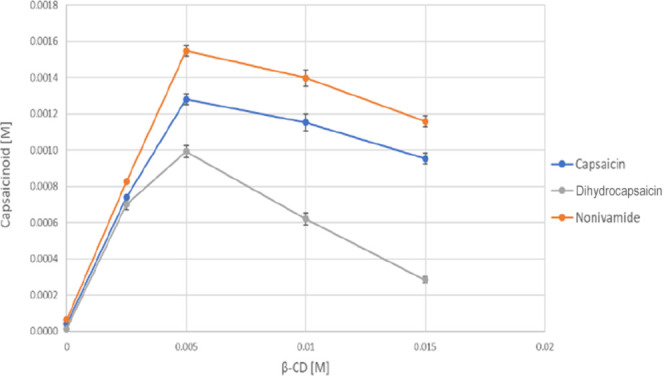 Figure 5
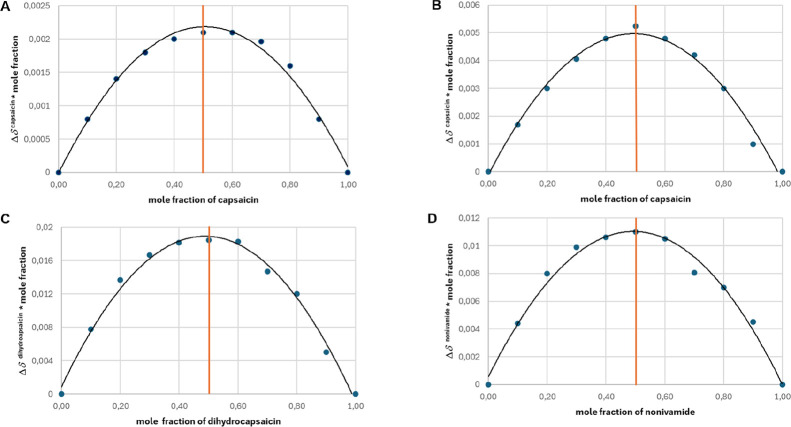 Figure 6
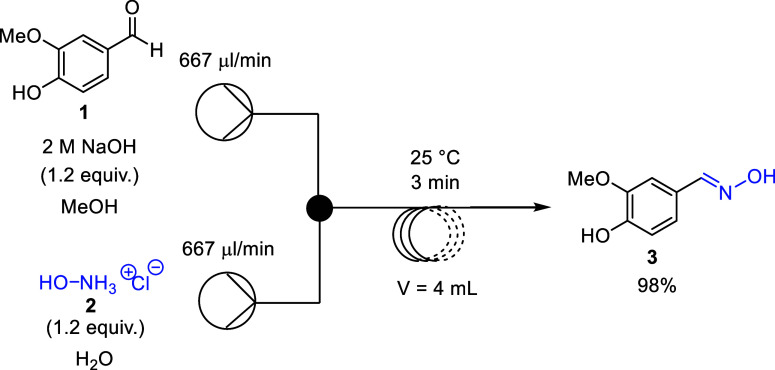 Figure 7
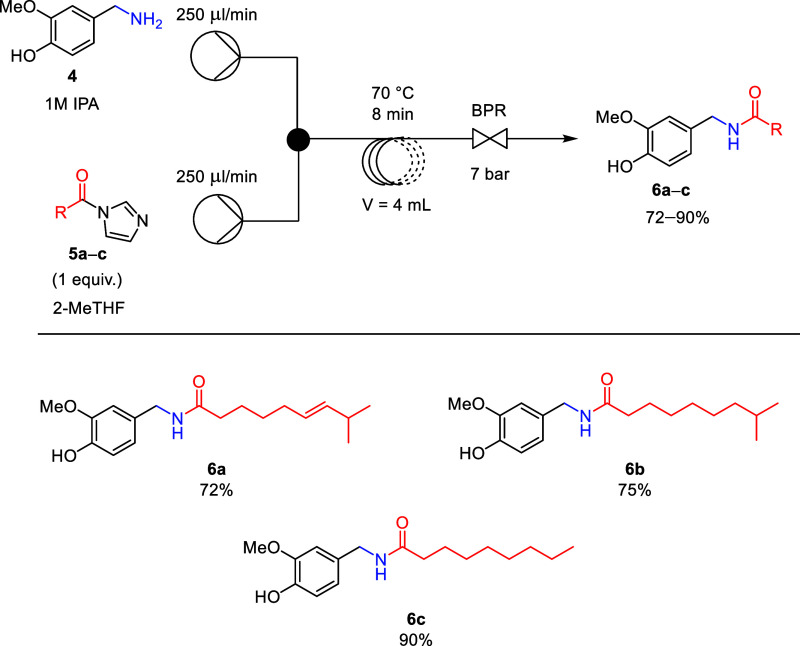 Figure 8
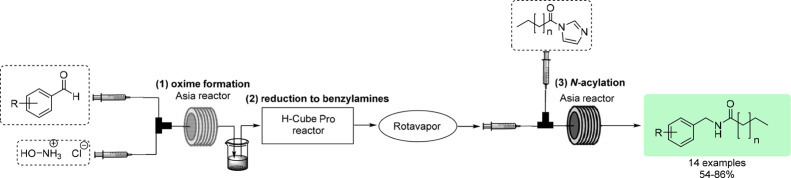 Figure 9
 Figure 10
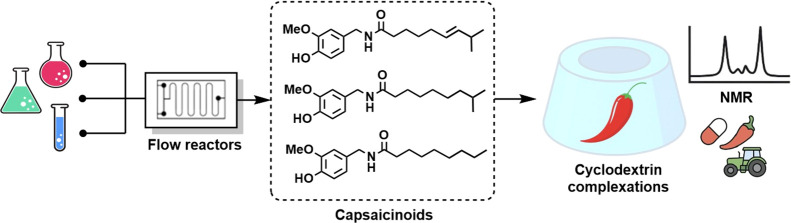 Figure 11
 Figure 12
 Figure 13
 Figure 14
Peer Reviews
No public reviews on file for this paper yet. If you reviewed it on a platform where reviews are public (OpenReview, ICLR, NeurIPS, ICML), you can paste yours below so the community can read it here.
Videos
No videos yet. Explain this paper in a talk, walkthrough, or lecture? Add one.
Taxonomy
TopicsIon Channels and Receptors · Microencapsulation and Drying Processes · Innovative Microfluidic and Catalytic Techniques Innovation