Patient Perspectives on AI-Powered Medical Robots in Breast and Prostate Cancer Care: Qualitative Study
Mahiya Habib, Janet Ellis, Aaron Palachi, Melissa B Korman, Tatjana Kay, Karen Barlow, Jordana DeSouza, Rosanna Macri, Abdullah Alabousi, Mehran Anvari

TL;DR
This study explores how patients with breast and prostate cancer feel about using AI-powered robots in their care, finding that they are cautiously open if the technology is safe, reliable, and complements human care.
Contribution
The study provides novel insights into patient perspectives on AI in cancer care, emphasizing the importance of transparency, education, and maintaining human involvement.
Findings
Patients are open to AI-assisted care if it improves accuracy, efficiency, and reduces wait times.
Key barriers include concerns about reliability, loss of human interaction, and technical failures.
Facilitators include timely results, education, and ensuring AI complements human expertise.
Abstract
Nearly 250,000 cancer cases are diagnosed annually in Canada, with breast and prostate cancer representing 25% and 22% of new cases, respectively. Artificial intelligence (AI) applications can potentially improve the accuracy, efficiency, and timeliness of cancer care, including screening, diagnostic imaging, and early treatment. However, patient acceptability of AI in cancer care remains underexplored. This study aimed to understand the feelings and perceptions of and acceptability to patients with breast and prostate cancer regarding the inclusion of AI-powered medical robots for cancer screening, diagnosis, and early treatment and to identify barriers and facilitators to implementation. In this qualitative study, semistructured interviews were conducted with 15 patients with breast (n=6) or prostate (n=9) cancer. Participants (mean [SD] age 67 [12] y; range 41‐88 y) were recruited…
Genes, proteins, chemicals, diseases, species, mutations and cell lines named across the full text — each resolved to its canonical identifier and authoritative record.
Click any figure to enlarge with its caption.
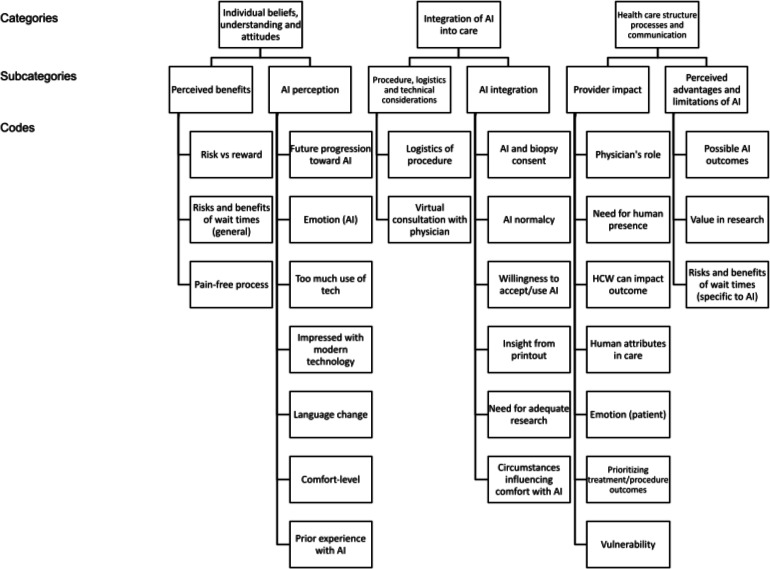 Figure 1
Peer Reviews
No public reviews on file for this paper yet. If you reviewed it on a platform where reviews are public (OpenReview, ICLR, NeurIPS, ICML), you can paste yours below so the community can read it here.
Videos
No videos yet. Explain this paper in a talk, walkthrough, or lecture? Add one.
Taxonomy
TopicsArtificial Intelligence in Healthcare and Education · Social Robot Interaction and HRI · AI in Service Interactions