Social support exchange and relationship satisfaction among couples living with HIV: Actor–partner effects of provided and received emotional support
Marcin Rzeszutek, Ewa Gruszczyńska, Magdalena Grabowska, Paula Malinowska

TL;DR
This study explores how emotional support affects relationship satisfaction in couples where at least one partner has HIV.
Contribution
The study reveals how provided and received emotional support influence relationship satisfaction differently at the individual and couple levels.
Findings
Provided emotional support acts as a couple-level resource for relationship satisfaction.
Received emotional support functions more as an individual-level resource.
The effects are consistent across HIV serostatus and sexual orientation in treated couples.
Abstract
This study aimed to examine the associations between both provided and received emotional social support and relationship satisfaction among romantic couples in which at least one partner was HIV positive. In addition, couples’ serostatus concordance and sexual orientation were tested as potential moderators of the effects of social support exchange. A total of 105 couples participated in the study, of whom 46.7% were seroconcordant and 73.3% were same-gender couples. Each partner independently evaluated provided and received emotional social support using the relevant subscales of the Berlin Social Support Scales. Relationship satisfaction was assessed individually using the Relationship Assessment Scale. In the actor–partner interdependence model (APIM), actor and partner effects were comparable for provided support, whereas for received support, the actor effect was slightly stronger…
Genes, proteins, chemicals, diseases, species, mutations and cell lines named across the full text — each resolved to its canonical identifier and authoritative record.
Click any figure to enlarge with its caption.
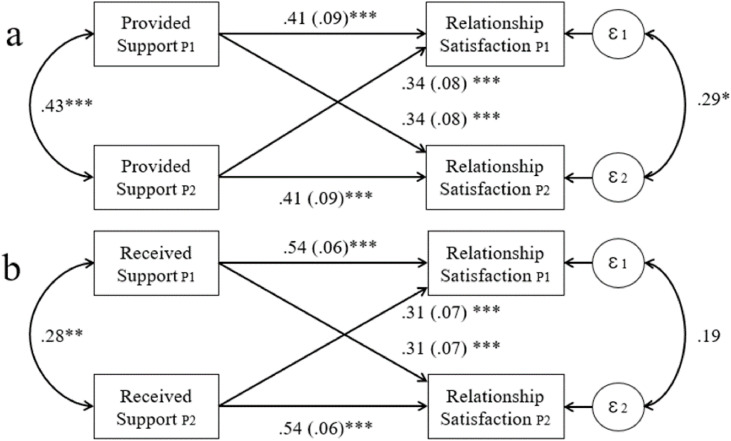 Figure 1
Peer Reviews
No public reviews on file for this paper yet. If you reviewed it on a platform where reviews are public (OpenReview, ICLR, NeurIPS, ICML), you can paste yours below so the community can read it here.
Videos
No videos yet. Explain this paper in a talk, walkthrough, or lecture? Add one.
Taxonomy
TopicsAttachment and Relationship Dynamics · HIV/AIDS Research and Interventions · Sexual function and dysfunction studies