Comparative Effectiveness of Abatacept Versus Adalimumab in Shared Epitope Positive and Negative Patients With Rheumatoid Arthritis
Chuan Fu Yap, Nisha Nair, Seema D. Sharma, John Bowes, Amirah Binti Mohammad Ariff, Ann W. Morgan, John D. Isaacs, Anthony G. Wilson, Kimme L. Hyrich, Suzan Verstappen, James Bluett, Andrew P. Morris, Anne Barton, Darren Plant, Sebastien Viatte

TL;DR
This study compares how well abatacept and adalimumab work in rheumatoid arthritis patients with or without specific genetic markers, finding no major differences in drug effectiveness.
Contribution
The study provides new evidence on the lack of differential effectiveness of abatacept and adalimumab based on shared epitope or Val11 genetic markers.
Findings
No significant difference in effectiveness was found between abatacept and adalimumab.
Weak evidence suggests Val11 is associated with treatment response, but not strongly enough to guide clinical decisions.
HLA typing does not appear clinically useful for prescribing these drugs.
Abstract
The effect of the shared epitope (SE) and valine at position 11 (Val11) of HLA–DRB1 on the activation of CD4+ T cells is expected to be diminished by abatacept, a costimulation blocker. However, published evidence on the value of genetic stratification for abatacept treatment is conflicting. We aimed to compare the difference in effectiveness of abatacept and adalimumab in patients carrying the SE (or Val11). The Biologics in Rheumatoid Arthritis Genetics and Genomics Study Syndicate is a nationwide observational cohort study recruiting patients from 53 centers across the United Kingdom before the initiation of biologic treatment and following them up prospectively for 12 months. Three hundred forty‐two patients starting either abatacept or adalimumab were eligible for this analysis. Serum drug levels for abatacept, adalimumab, and methotrexate were determined at multiple time points.…
Genes, proteins, chemicals, diseases, species, mutations and cell lines named across the full text — each resolved to its canonical identifier and authoritative record.
Click any figure to enlarge with its caption.
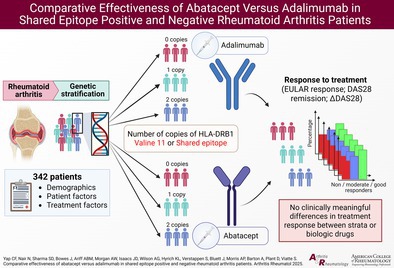 Figure 1
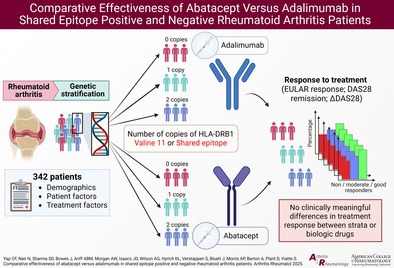 Figure 2
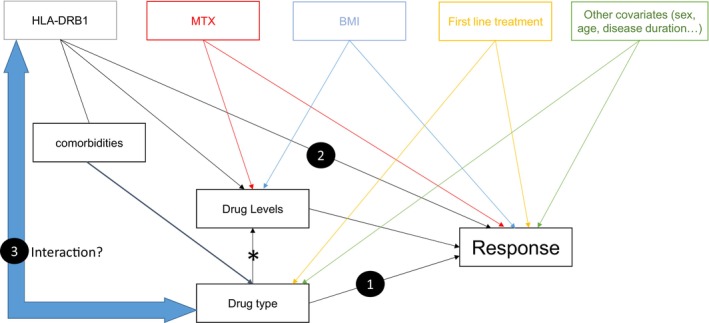 Figure 3
Peer Reviews
No public reviews on file for this paper yet. If you reviewed it on a platform where reviews are public (OpenReview, ICLR, NeurIPS, ICML), you can paste yours below so the community can read it here.
Videos
No videos yet. Explain this paper in a talk, walkthrough, or lecture? Add one.
Taxonomy
TopicsChronic Lymphocytic Leukemia Research · Monoclonal and Polyclonal Antibodies Research · Lymphoma Diagnosis and Treatment