The Anatomical Breast Burden Model: A Schnur Scale Alternative for Identifying Need for Therapeutic Reduction Mammaplasty
Eliana Jolkovsky, Meghan N Miller, Weston McClain, Samantha Rabinovich, Ainaz Dory Barkhordarzadeh, Derrick Lin, Stacy Piva, Addee Lerner, Ginger C Slack

TL;DR
This study introduces a new model to assess breast burden for insurance coverage decisions, aiming to be more equitable than the Schnur scale.
Contribution
The anatomical breast burden (ABB) model is proposed as a more accurate and equitable alternative to the Schnur scale for determining need for breast reduction surgery.
Findings
The ABB model showed stronger correlations with anatomical measurements and resection weight than the Schnur scale.
The Schnur scale had 47.5% sensitivity and 66.7% specificity in identifying patients with significant breast burden.
44% of patients with very severe breast burden were ineligible under the Schnur scale, while 33% of mild-to-moderate cases were eligible.
Abstract
The Schnur sliding scale is used by many insurance companies to determine eligibility for reduction mammaplasty. However, it overlooks anatomical features, symptoms, and physical findings, leading to inequities in coverage determinations. The aim of the study was to develop and validate the anatomical breast burden (ABB) model—a 0-6-point scoring system that quantifies the burden of breasts using breast measurements, physical findings, and symptoms—as an alternative tool to the Schnur scale. A retrospective chart review was conducted for 84 patients who underwent breast reduction at a single academic center. Resection weights, Schnur threshold weights, demographics, and preoperative breast measurements were recorded. ABB cutoff values for sternal notch-to-nipple, nipple-to-inframammary fold, and base width distances were determined statistically, and a score was assigned to each…
Genes, proteins, chemicals, diseases, species, mutations and cell lines named across the full text — each resolved to its canonical identifier and authoritative record.
Click any figure to enlarge with its caption.
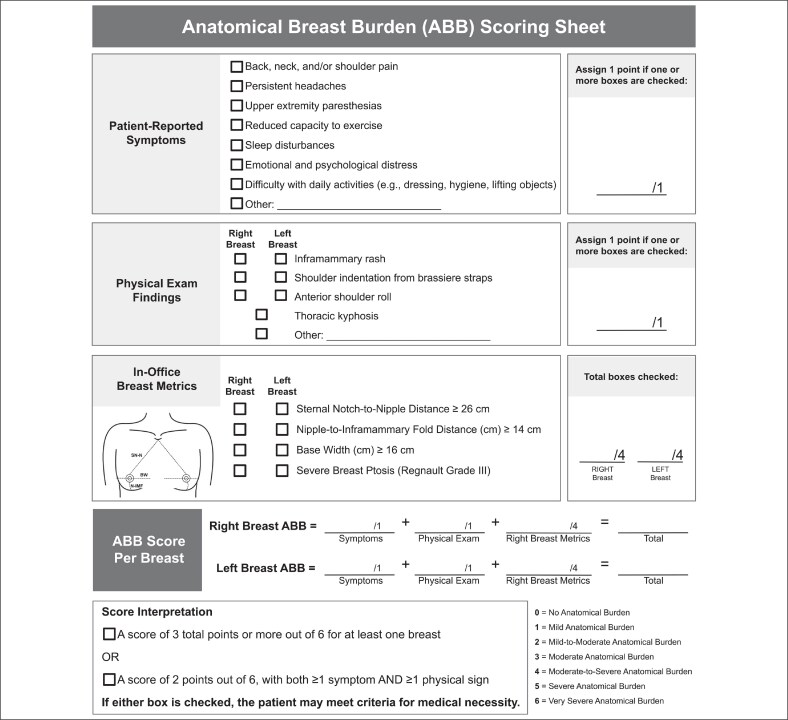 Figure 1
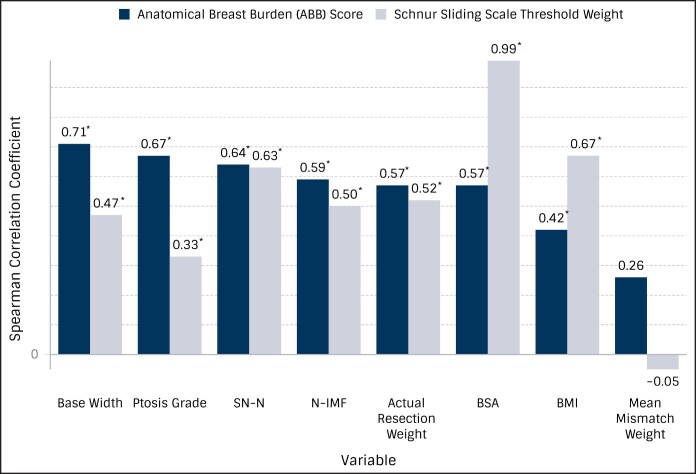 Figure 2
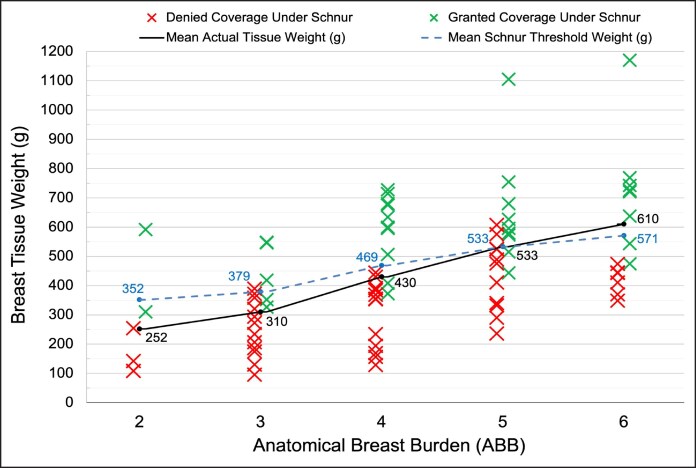 Figure 3
 Figure 4
Peer Reviews
No public reviews on file for this paper yet. If you reviewed it on a platform where reviews are public (OpenReview, ICLR, NeurIPS, ICML), you can paste yours below so the community can read it here.
Videos
No videos yet. Explain this paper in a talk, walkthrough, or lecture? Add one.
Taxonomy
TopicsBreast Implant and Reconstruction · Breast Cancer Treatment Studies · Reconstructive Surgery and Microvascular Techniques