“It is because we women do not have a voice to be heard” - perceptions of gender-based discrimination and its relevance to health: a qualitative study with women in Burkina Faso, Ghana and Tanzania
Verena Struckmann, Ruth Waitzberg, Clara Orduhan, Louise Charlotte Olimpia Junge, Sylvia Danso, Ali Sie, Peter Binyaruka, Daniel Opoku, Laurène Petifour, Swati Srivastava, Manuela De Allegri, Wilm Quentin

TL;DR
This study explores how women in Burkina Faso, Ghana, and Tanzania experience gender-based discrimination and how it affects their health and access to resources.
Contribution
The study provides new insights into the systemic and culturally embedded nature of gender-based discrimination in low- and middle-income countries.
Findings
Women perceive gender-based discrimination as a normalized, systemic structure in both public and private spheres.
Discrimination limits access to education, employment, healthcare, and financial autonomy, affecting maternal care and mental health.
Efforts to address health inequities must focus on dismantling gender norms and enhancing women's decision-making power.
Abstract
Gender-based discrimination (GBD) remains a pervasive determinant of health inequity for women globally, yet its systemic and culturally embedded forms in low- and middle-income countries are underexplored. This study explores women’s lived experiences of GBD in Burkina Faso, Ghana and Tanzania, highlighting how intersecting social and institutional norms influence access to health care, education, employment, financial resources and the resulting impacts on women’s health. Between February and May 2022, 17 focus group discussions and 32 in-depth interviews were conducted with 167 women across twelve regions in the three countries. Thematic analysis was employed to identify core patterns in how women perceive and navigate GBD in their daily lives. Across all sites, participants conceptualized GBD as a normalized, systemic structure embedded in both public and private spheres. Women…
Genes, proteins, chemicals, diseases, species, mutations and cell lines named across the full text — each resolved to its canonical identifier and authoritative record.
Click any figure to enlarge with its caption.
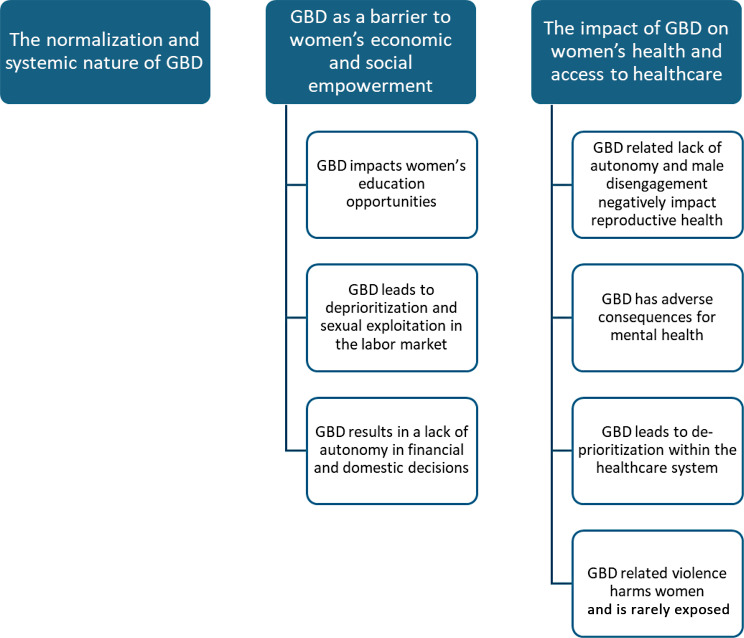 Figure 1
Peer Reviews
No public reviews on file for this paper yet. If you reviewed it on a platform where reviews are public (OpenReview, ICLR, NeurIPS, ICML), you can paste yours below so the community can read it here.
Videos
No videos yet. Explain this paper in a talk, walkthrough, or lecture? Add one.
Taxonomy
TopicsGlobal Maternal and Child Health · Sex and Gender in Healthcare · COVID-19 Impact on Reproduction