Breaking barriers: feasibility of a cluster randomised trial evaluating an instrument for identifying and ameliorating adverse drug reactions
Vera Logan, David Hughes, Adam Turner, Neil Carter, Sue Jordan

TL;DR
This study tested the feasibility of a trial using the ADRe Profile to identify and address adverse drug reactions in older patients in UK primary care.
Contribution
The study demonstrates the feasibility of using the ADRe Profile in a cluster randomized trial despite low clinician engagement.
Findings
Recruitment of GP practices was very low (0.94%), but patient recruitment and retention were successful.
The ADRe Profile identified numerous clinical issues not previously recorded in patient records.
Despite limited clinician engagement, the ADRe Profile showed potential for clinical impact and was cost-effective.
Abstract
We aimed to investigate the feasibility of a cluster randomised controlled trial (RCT) of the ADRe Profile in UK primary care. The ADRe Profile is a patient monitoring system to identify and address adverse drug reactions (ADR) and ADR-related issues to pre-empt clinical deterioration. A preliminary study to test the feasibility of an RCT. General practices (GPs) in South-West Wales, UK. 20 patients aged >64 and prescribed >4 long-term medicines. Participants reported their health-related problems using the ADRe-Profile. Participants completed the profile independently initially, then with researcher support, capturing vital signs, clinical observations and patient-reported symptoms. Feasibility was assessed based on recruitment, retention, adherence to protocols, potential for clinical impact and staff costs. We recruited two GP practices (0.94% of 213 contacted), and 20 patients…
Genes, proteins, chemicals, diseases, species, mutations and cell lines named across the full text — each resolved to its canonical identifier and authoritative record.
Click any figure to enlarge with its caption.
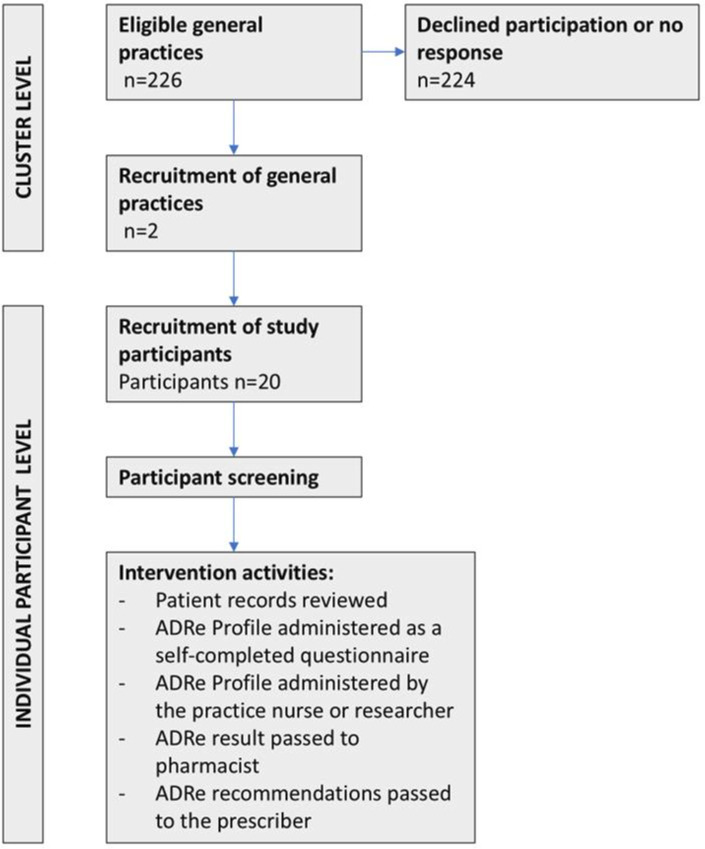 Figure 1
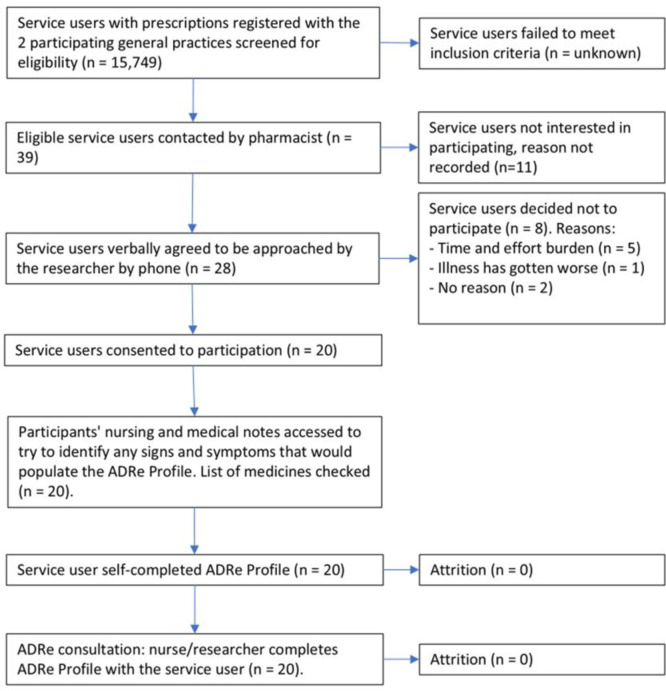 Figure 2
Peer Reviews
No public reviews on file for this paper yet. If you reviewed it on a platform where reviews are public (OpenReview, ICLR, NeurIPS, ICML), you can paste yours below so the community can read it here.
Videos
No videos yet. Explain this paper in a talk, walkthrough, or lecture? Add one.
Taxonomy
TopicsAdvanced Causal Inference Techniques · Statistical Methods in Clinical Trials · Pharmacovigilance and Adverse Drug Reactions