Phase II multicentre double-blind randomised controlled trial of a Bivalent VaccInation against Salmonella Typhi and Paratyphi A (BiVISTA) using a controlled human infection model of paratyphoid A infection: study protocol
Margarete Paganotti Vicentine, Naina McCann, Oisin Hennigan, Noshi Maria, Claudia I Juarez Molina, Stanislava Koleva, Mohammod K Islam, Elizabeth Jones, Amy Flaxman, Nicole Day, Allison MacDonald, Mehreen Adnan, Nisha Singh, Sophie Vernon, Eleanor Wilson

TL;DR
This study is testing a new bivalent vaccine against typhoid and paratyphoid A in UK adults using a controlled infection model to evaluate its effectiveness and immune response.
Contribution
The study introduces the first efficacy trial of a bivalent vaccine against both typhoid and paratyphoid A using a controlled human infection model.
Findings
The trial will assess the efficacy of SII-TCV(B) against paratyphoid A infection.
The study will compare the immune response of the bivalent vaccine to a licensed typhoid vaccine.
Abstract
Enteric fever, primarily caused by Salmonella enterica Typhi and Salmonella enterica Paratyphi A (SPA), is endemic mainly in South Asia, disproportionately affecting school-age children. Although typhoid conjugate vaccines (TCVs) are effective and implemented in many countries, no licensed vaccine exists against paratyphoid A. Bivalent vaccines targeting both S. Typhi and SPA may address this gap. Although field efficacy trials are not considered feasible, controlled human infection models (CHIMs) offer an alternative pathway for evaluating vaccine efficacy. This will be the first efficacy study of a bivalent vaccine against typhoid and paratyphoid A using a paratyphoid CHIM. This is a phase II multicentre, double-blind, randomised controlled trial assessing the efficacy and immunogenicity of a bivalent conjugate vaccine candidate, Serum Institute of India Typhoid Conjugate Vaccine…
Genes, proteins, chemicals, diseases, species, mutations and cell lines named across the full text — each resolved to its canonical identifier and authoritative record.
Click any figure to enlarge with its caption.
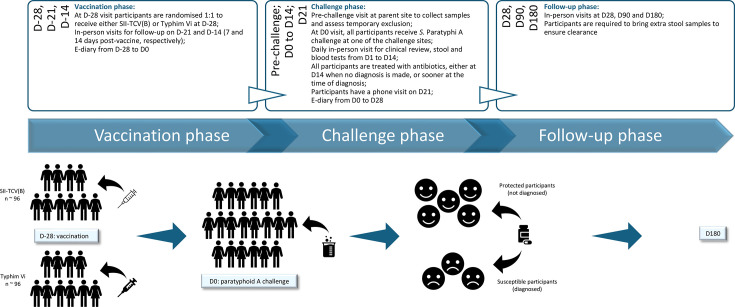 Figure 1
Peer Reviews
No public reviews on file for this paper yet. If you reviewed it on a platform where reviews are public (OpenReview, ICLR, NeurIPS, ICML), you can paste yours below so the community can read it here.
Videos
No videos yet. Explain this paper in a talk, walkthrough, or lecture? Add one.
Taxonomy
TopicsSalmonella and Campylobacter epidemiology · Aquaculture disease management and microbiota · Diphtheria, Corynebacterium, and Tetanus