Clinical Benefits and Risks of Haptoglobin Therapy in Hemolytic Disorders of Diverse Etiologies: A Systematic Review
Mohamed Eltayeb Abdelrahman Naiem, Ahmed M.S. Osman, Ahd Atiff Ahmed Abdelghani, Mohammed Elzaki Mohammed Mansoor, Islam Kanada Toto Korea, Ibrahim D Mohammedallayla, Tariq Alkhalifa Yousif Hassan, Mohamed Faisal Elzein Ali

TL;DR
This review examines how haptoglobin therapy affects patients with different types of hemolytic disorders, finding it protects kidneys in cardiac surgery but not in severe burns.
Contribution
The study provides the first systematic evaluation of haptoglobin therapy's clinical benefits and risks across diverse hemolytic conditions.
Findings
Haptoglobin therapy reduced postoperative acute kidney injury in cardiac surgery patients.
Low endogenous haptoglobin levels strongly predicted acute kidney injury across all studied conditions.
No clinical benefit of haptoglobin therapy was observed in severe burn patients.
Abstract
Hemolytic disorders release cell-free hemoglobin (CFH), a potent nephrotoxin and oxidant. Haptoglobin, an endogenous plasma protein, binds CFH to facilitate its clearance. While haptoglobin therapy is a promising strategy to mitigate CFH-induced organ injury, its clinical efficacy and safety across different hemolytic conditions remain unclear. This systematic review aims to evaluate the clinical benefits and risks of haptoglobin therapy in patients with hemolytic disorders of diverse etiologies. A systematic literature search was conducted in PubMed, Scopus, Web of Science, and Embase from 2015 to 2025, following PRISMA guidelines. Studies reporting on haptoglobin therapy (administered or endogenous) and clinical outcomes in patients with hemolysis were eligible. The risk of bias was assessed using the ROBINS-I tool. A narrative synthesis was performed due to study heterogeneity. Five…
Genes, proteins, chemicals, diseases, species, mutations and cell lines named across the full text — each resolved to its canonical identifier and authoritative record.
Click any figure to enlarge with its caption.
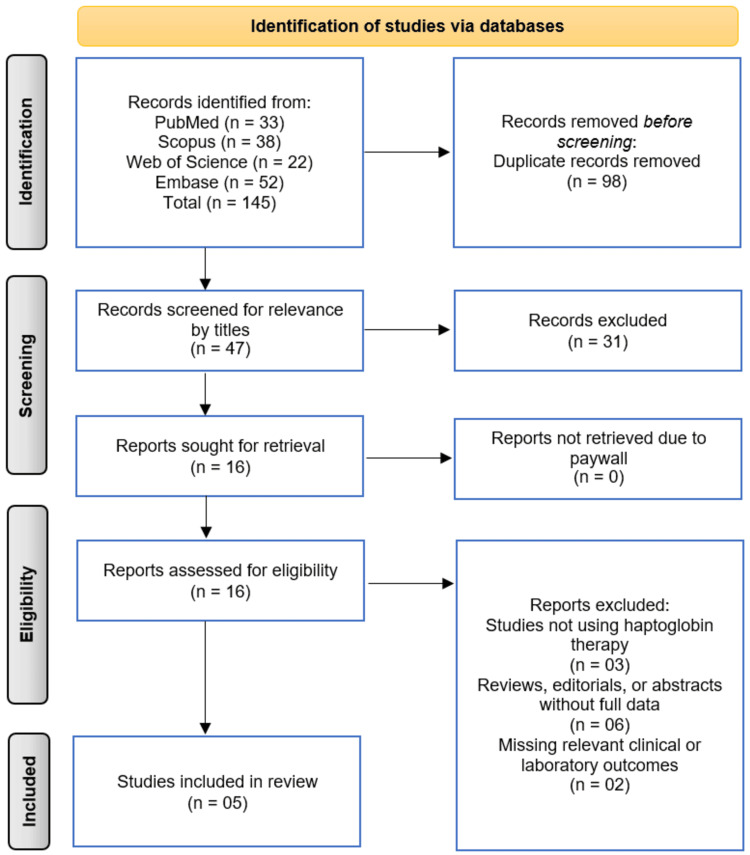 Figure 1
Peer Reviews
No public reviews on file for this paper yet. If you reviewed it on a platform where reviews are public (OpenReview, ICLR, NeurIPS, ICML), you can paste yours below so the community can read it here.
Videos
No videos yet. Explain this paper in a talk, walkthrough, or lecture? Add one.
Taxonomy
TopicsHemoglobin structure and function · Heme Oxygenase-1 and Carbon Monoxide · Blood transfusion and management