Excluding Ascites From the GEMA‐Na Score Does Not Impact Outcome Predictions in Liver Transplant Candidates
Manuel Luis Rodríguez‐Perálvarez, Antonio Manuel Gómez‐Orellana, Avik Majumdar, Geoffrey W. McCaughan, María Kalafateli, Rhiannon Taylor, Gloria de la Rosa, María Victoria Aguilera, Mikel Gastaca, Carmen Cepeda‐Franco, María Luisa Ortiz, Jordi Colmenero, Alejandra Otero

TL;DR
Excluding ascites from the GEMA-Na score doesn't hurt its ability to predict outcomes for liver transplant candidates, and it still performs better than other scores like MELD.
Contribution
The study shows that removing the subjective ascites component from GEMA-Na has minimal impact on outcome prediction accuracy.
Findings
Removing ascites from GEMA-Na only slightly reduced its predictive accuracy (Hc = 0.755 vs. 0.753) but still outperformed MELD scores.
Over 80% of patients retained the same score when ascites was excluded from GEMA-Na.
GEMA-Na without ascites outperformed MELD-3.0 and MELD-Na in predicting wait-list outcomes across multiple countries and subgroups.
Abstract
Although GEMA‐Na outperforms MELD 3.0 for liver allocation, concerns about the subjectivity of its ascites component persist. We compared the performance of a GEMA‐Na iteration that excludes ascites with other allocation scores. A multinational cohort study was conducted, including adult candidates for elective liver transplantation in the UK (2010–2020), Australia (1998–2020), and Spain (2016–2021). The primary outcome was mortality or delisting for sickness within 90 days. The prognostic impact of ascites was evaluated using multivariable Cox's regression. Discrimination was assessed using Harrell's c‐statistics (Hc). The study included 15 391 patients (28.5% women). The prevalence of the primary outcome was 5.8% in the UK, 5.3% in Australia, and 4.7% in Spain. The presence and severity of ascites was associated with an incremental risk of the primary outcome: 3.3% without ascites,…
Genes, proteins, chemicals, diseases, species, mutations and cell lines named across the full text — each resolved to its canonical identifier and authoritative record.
Click any figure to enlarge with its caption.
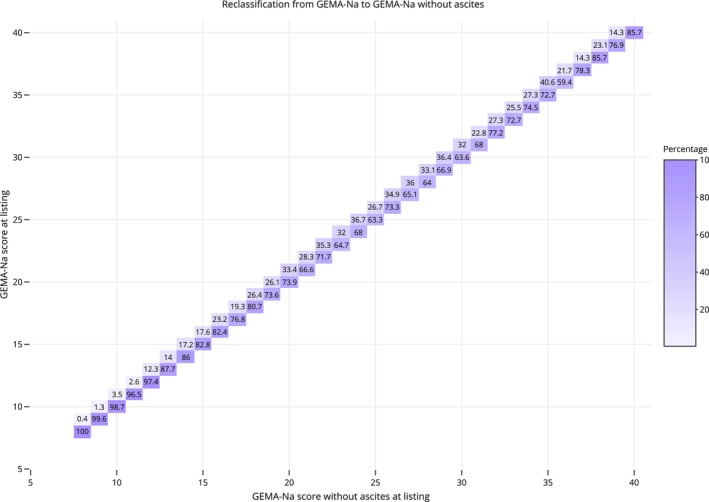 Figure 1
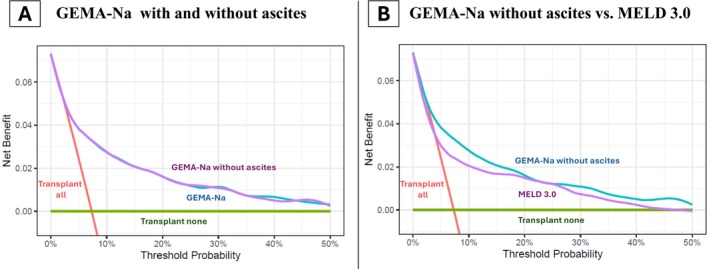 Figure 2
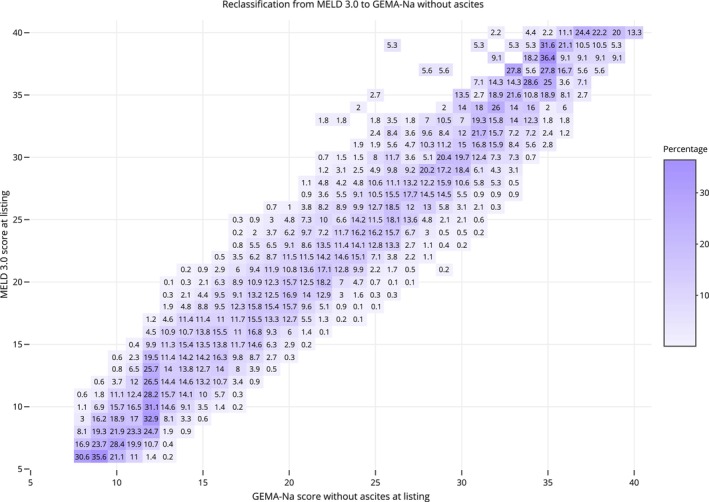 Figure 3
Peer Reviews
No public reviews on file for this paper yet. If you reviewed it on a platform where reviews are public (OpenReview, ICLR, NeurIPS, ICML), you can paste yours below so the community can read it here.
Videos
No videos yet. Explain this paper in a talk, walkthrough, or lecture? Add one.
Taxonomy
TopicsLiver Disease and Transplantation · Organ Transplantation Techniques and Outcomes · Hepatocellular Carcinoma Treatment and Prognosis