Accuracy of the phenotypic 1G test to detect Mycobacterium tuberculosis and drug resistance from sputa in the US-Mexico border
Mia Aguirre, Doris Ayala, Juan Ignacio Garcia, Yoscelina E. Martinez-Lopez, Amberlee D. Hicks, Nadine Chacon, Ashley Gay-Cobb, Alyssa Schami, Selena Zavala-Perez, Ilse A. Dominguez-Trejo, America M. Cruz-Gonzalez, Raul Loera-Salazar, Javier E. Rodríguez-Herrera

TL;DR
A new low-complexity test for tuberculosis detection and drug resistance shows high accuracy and faster results than traditional methods.
Contribution
The 1G test offers a practical, low-complexity alternative to culture-based TB diagnostics with high sensitivity and specificity.
Findings
The 1G test detected Mtb with ≥98% sensitivity and had high specificity for drug resistance testing.
The 1G test had lower contamination rates and a 17-day time to detection compared to MGIT's 21 days.
The study site had a 14% drug-resistant TB prevalence when testing all participants, higher than passive reporting.
Abstract
With >10 million new tuberculosis (TB) cases/year, a limitation to TB control is the lack of simple and accurate tests for TB diagnosis and drug-susceptibility testing (DST) in endemic regions. We evaluated the accuracy of the first-generation, low-complexity phenotypic TB test (1G test), designed for simultaneous Mtb detection and resistance to isoniazid, rifampicin and moxifloxacin, suitable for resource-limited settings. A cross-sectional study was conducted using sputa from 426 possible pulmonary TB subjects from two small Mexican cities bordering Texas. The 1G test was compared against phenotypic TB detection tests in the region [acid fast bacilli smear microscopy and Mycobacteria Growth Indicator Tube (MGIT) culture], and to MGIT-DST for resistance to isoniazid, rifampicin and moxifloxacin. The 1G test demonstrated ≥98% sensitivity for Mtb detection, 100% sensitivity and 91%…
Genes, proteins, chemicals, diseases, species, mutations and cell lines named across the full text — each resolved to its canonical identifier and authoritative record.
Click any figure to enlarge with its caption.
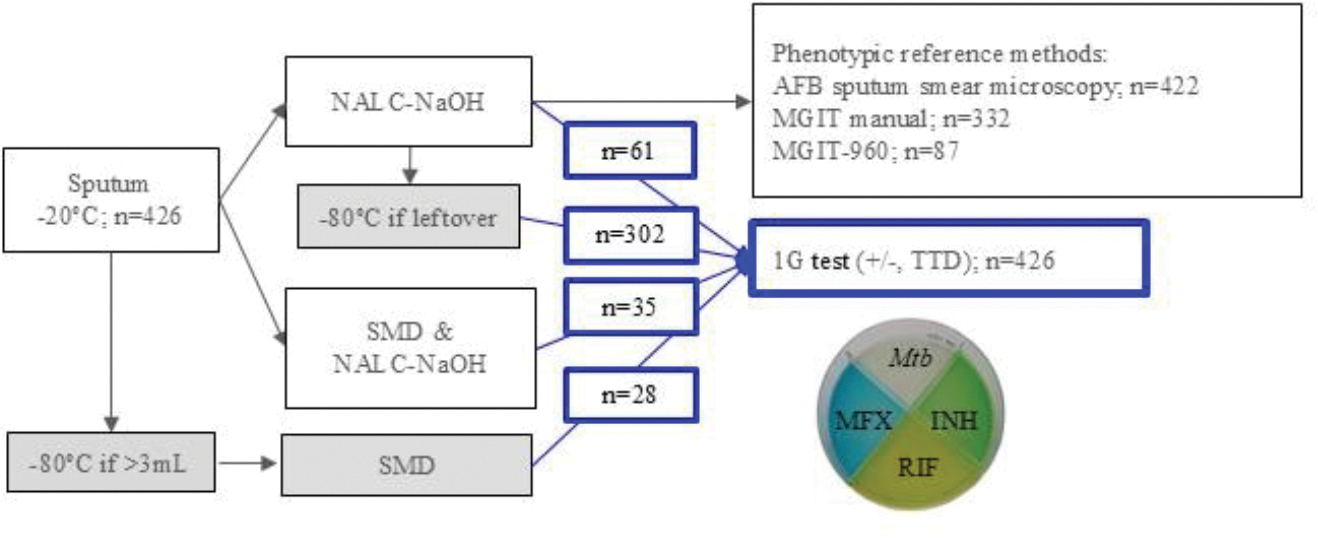 Figure 1
Peer Reviews
No public reviews on file for this paper yet. If you reviewed it on a platform where reviews are public (OpenReview, ICLR, NeurIPS, ICML), you can paste yours below so the community can read it here.
Videos
No videos yet. Explain this paper in a talk, walkthrough, or lecture? Add one.
Taxonomy
TopicsTuberculosis Research and Epidemiology · Mycobacterium research and diagnosis · Image Processing Techniques and Applications