Tree Biomass Sensitivity to Ozone Exposure: Insights From a Decade of Free‐Air Experiments
Annesha Ghosh, Andrea Viviano, Elena Paoletti, Yasutomo Hoshika, Elena Marra, Jacopo Manzini, Cesare Garosi, Matheus Casarini Siqueira, Barbara B. Moura

TL;DR
A decade of experiments shows that ozone exposure reduces tree biomass more in deciduous species than evergreens, with roots being most affected.
Contribution
The study provides new insights into how ozone affects biomass and carbon allocation strategies in different tree types using long-term free-air experiments.
Findings
Deciduous species show greater biomass reduction at lower ozone doses compared to evergreens.
Root biomass is the most vulnerable to ozone exposure in both deciduous and evergreen species.
Flux-based metrics effectively quantify ozone-induced biomass loss and reveal differences in carbon allocation strategies.
Abstract
Tropospheric ozone (O3) is a pervasive stressor that impairs forest biomass and alters carbon allocation strategies. This study assessed biomass responses across 17 woody taxa under free‐air controlled exposure (FACE), integrating a decade of experiments conducted with an analogous exposure regime applied to deciduous and evergreen species. The analysis provided a comparative evaluation of existing flux‐based metrics. Statistical analyses revealed consistent reductions in relative total (RTB), aboveground (RTAB), and belowground (RTBB) biomass with increasing O3 uptake in terms of phytotoxic ozone dose (POD1 mmol m−2). Deciduous species reached the 4% biomass reduction threshold (CL4) at lower POD1 levels for RTBB (10.21), RTAB (13.16), and RTB (10.77) and displayed relatively small △POD1 values for RTBB (2.75), RTAB (5.70), and RTB (3.31), where △POD1 represents the increment in O3…
Genes, proteins, chemicals, diseases, species, mutations and cell lines named across the full text — each resolved to its canonical identifier and authoritative record.
Click any figure to enlarge with its caption.
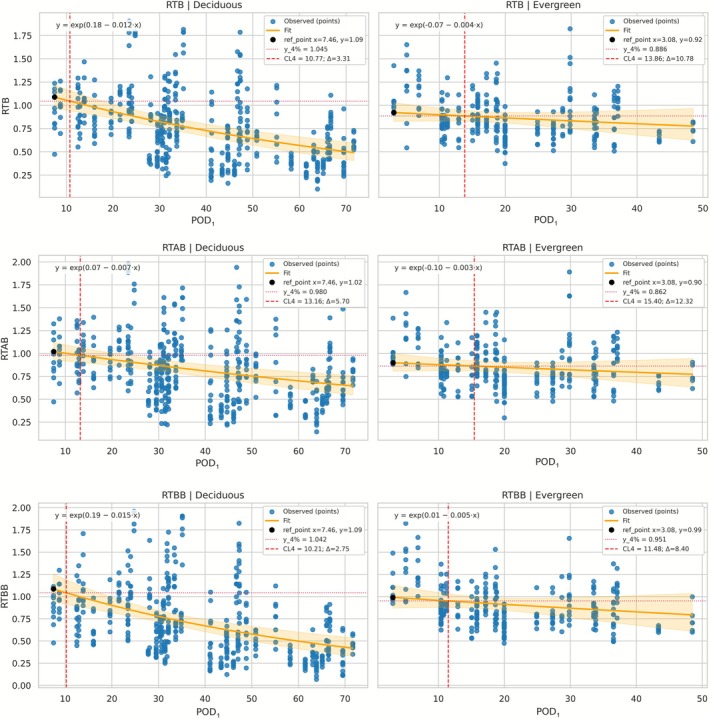 Figure 1
 Figure 2
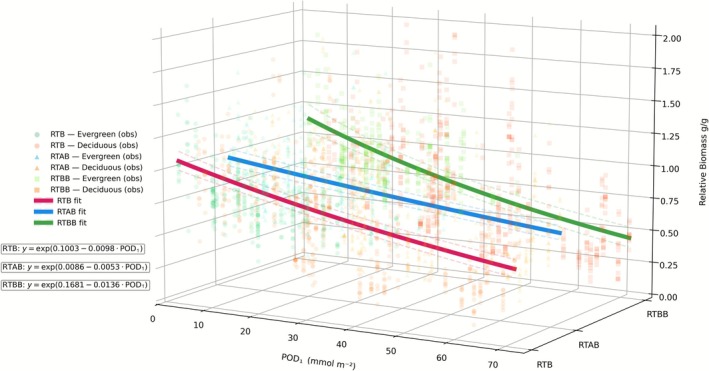 Figure 3
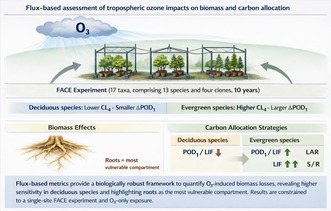 Figure 4
Peer Reviews
No public reviews on file for this paper yet. If you reviewed it on a platform where reviews are public (OpenReview, ICLR, NeurIPS, ICML), you can paste yours below so the community can read it here.
Videos
No videos yet. Explain this paper in a talk, walkthrough, or lecture? Add one.
Taxonomy
TopicsPlant responses to elevated CO2 · Plant Water Relations and Carbon Dynamics · Atmospheric chemistry and aerosols