Associations Between 40‐Year Trajectories of BMI and Proteomic and Epigenetic Aging Clocks: Deciphering Nonlinearity and Interactions
Gabin Drouard, M. Austin Argentieri, Aino Heikkinen, Miina Ollikainen, Jaakko Kaprio

TL;DR
This study explores how BMI changes over 40 years relate to biological aging, showing that these relationships are often nonlinear and that proteomic clocks could be useful in obesity research.
Contribution
The study reveals nonlinear associations between BMI trajectories and biological aging, emphasizing the potential of proteomic clocks in obesity research.
Findings
BMI at 18 and 60 years and BMI changes were associated with increased biological aging for most aging estimates.
Nonlinearity was observed in about one-third of significant associations, mostly in proteomic clocks.
Suggestive evidence of interactions between BMI at 18 and 60 years was found for two proteomic clocks.
Abstract
The potential of proteomic aging clocks for obesity research, and the extent of nonlinearity in longitudinal associations between body weight and biological aging, remain underexplored. We investigated how BMI at ages 18 and ~60, as well as changes in BMI from age 18 to ~60, relate to downstream epigenetic and proteomic aging. We also examined nonlinearity and interactions in these associations. Analyses were conducted in 401 Finnish twins with up to nine self‐reported or measured BMI values collected over 40 years. Olink proteomic and Illumina DNA methylation data were generated from blood drawn at the last BMI measurement. From these data, we derived four proteomic and five epigenetic age estimates and modeled BMI change over time using mixed‐effects models. Generalized additive models were then applied to examine (1) nonlinear associations between BMI trajectories and biological…
Genes, proteins, chemicals, diseases, species, mutations and cell lines named across the full text — each resolved to its canonical identifier and authoritative record.
Click any figure to enlarge with its caption.
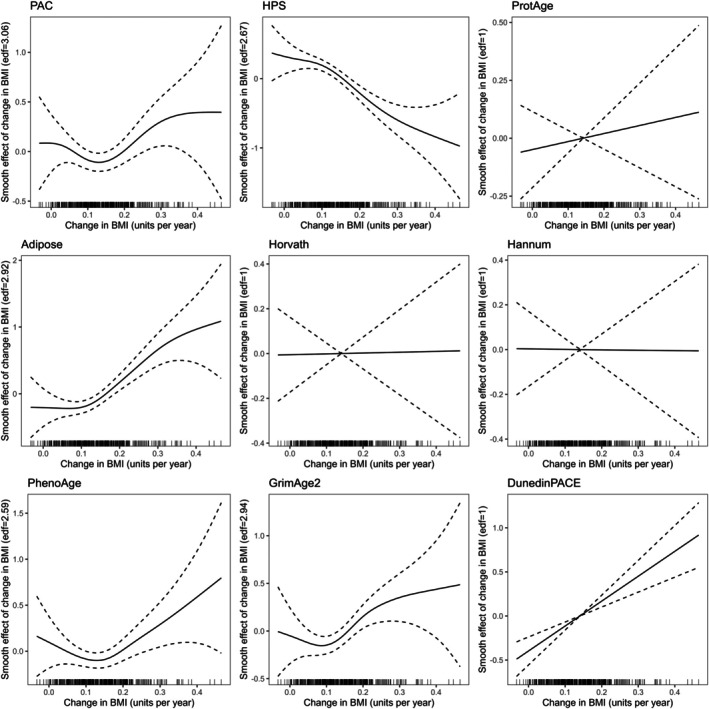 Figure 1
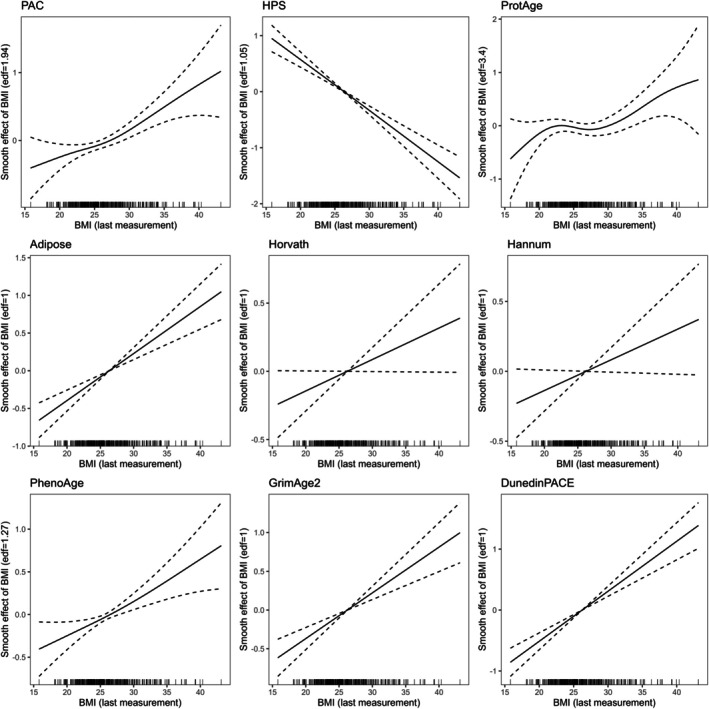 Figure 2
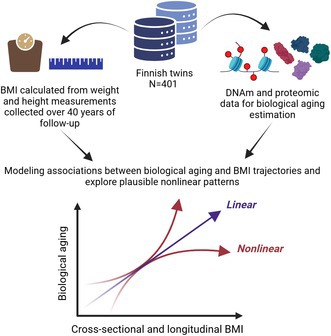 Figure 3
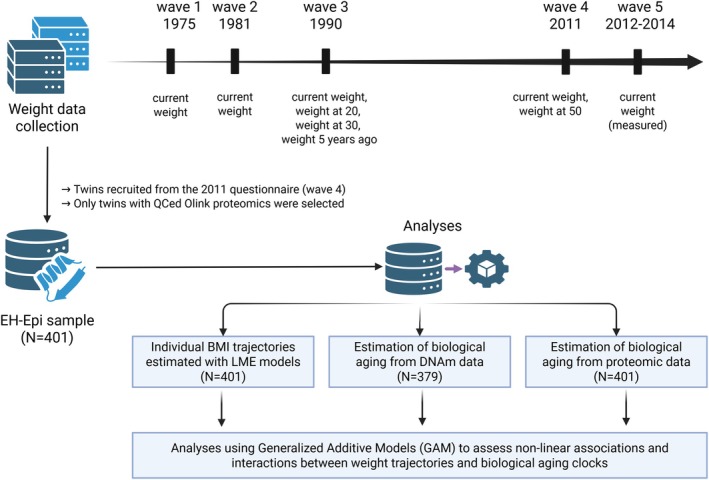 Figure 4
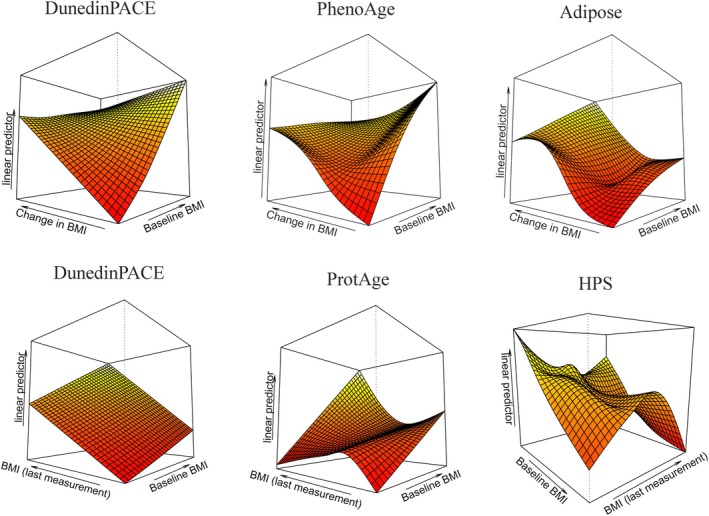 Figure 5
Peer Reviews
No public reviews on file for this paper yet. If you reviewed it on a platform where reviews are public (OpenReview, ICLR, NeurIPS, ICML), you can paste yours below so the community can read it here.
Videos
No videos yet. Explain this paper in a talk, walkthrough, or lecture? Add one.
Taxonomy
TopicsEpigenetics and DNA Methylation · Health, Environment, Cognitive Aging · Dietary Effects on Health