Characteristics of Pregnancy Course in an Infant With Cerebral Palsy Showing Decreased Fetal Movement
Shiho Nagayama, Hironori Takahashi, Hanako Ohtachi, Manabu Ogoyama, Rie Usui, Hirotada Suzuki, Yoshio Matsuda, Hiroyuki Fujiwara

TL;DR
This study examines the characteristics of pregnancies in infants with cerebral palsy who showed decreased fetal movement, identifying hypoxia and placental issues as common causes.
Contribution
The study identifies specific clinical patterns and risk factors in cerebral palsy cases associated with decreased fetal movement.
Findings
Hypoxia was the most common cause of cerebral palsy in cases with decreased fetal movement.
Fetomaternal hemorrhage cases had longer durations from decreased fetal movement to delivery compared to placental abruption.
Velamentous or marginal cord insertion was associated with increased risk of cerebral palsy.
Abstract
To clarify the characteristics of patients with cerebral palsy (CP) showing decreased fetal movement (DFM). Among patients with CP between January 2009 and February 2021, we collected cases of DFM from the causal analysis report. We retrieved the clinical course and the causes of CP. Of 2834 cases of CP, 225 (8%) patients were included in this study. Some form of hypoxia was the most common cause (117 cases, 52%) followed by placental abruption (45 cases, 20%) and fetomaternal hemorrhage (FMH) (32 cases, 14%). The duration from DFM to delivery was longer in cases of FMH than in placental abruption (p < 0.001). The duration less than 6 h was only observed in one (4%) case of FMH, whereas it was observed in 32 (73%) cases of placental abruption. In contrast, the cases with durations of more than 24 h accounted for 36% (10/28) in FMH cases. Next, we focused on hypoxia cases. Marginal or…
Genes, proteins, chemicals, diseases, species, mutations and cell lines named across the full text — each resolved to its canonical identifier and authoritative record.
Click any figure to enlarge with its caption.
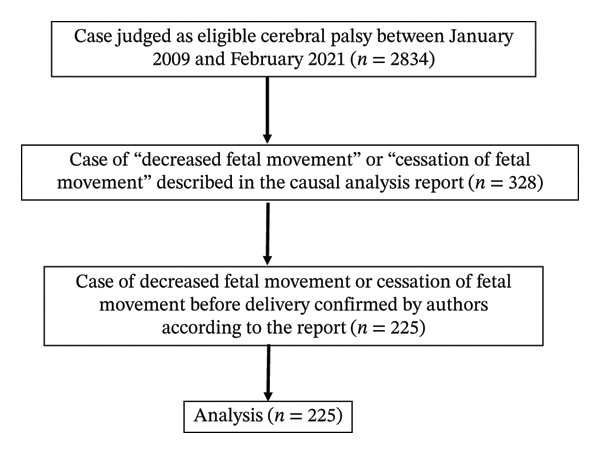 Figure 1
Peer Reviews
No public reviews on file for this paper yet. If you reviewed it on a platform where reviews are public (OpenReview, ICLR, NeurIPS, ICML), you can paste yours below so the community can read it here.
Videos
No videos yet. Explain this paper in a talk, walkthrough, or lecture? Add one.
Taxonomy
TopicsNeonatal and fetal brain pathology · Cerebral Palsy and Movement Disorders · Fetal and Pediatric Neurological Disorders