Effects of fattening strategies on carcass traits, meat quality, fatty acid composition, and oxidative stability of longissimus muscle in yaks (Bos grunniens)
Zhiyuan Ma, Hongshan Liu, Abraham Allan Degen, Lintong Zhang, Jiandui Mi, Jianwei Zhou

TL;DR
Different feeding methods affect yak meat quality, with grazing improving nutritional benefits and feedlot feeding boosting carcass traits.
Contribution
The study reveals how fattening strategies influence meat quality, fatty acid composition, and oxidative stability in yaks.
Findings
High-concentrate feeding improves carcass traits and meat tenderness but increases drip loss.
Grazing enhances n-3 PUFAs and oxidative stability in yak meat.
Diversified fattening strategies can meet consumer demands for both meat quality and nutrition.
Abstract
In the context of coexisting traditional and intensive yak production systems, clarifying the effects of different fattening strategies is crucial for optimizing meat quality and meeting consumer demands. This study compared three feeding regimes: traditional grazing (TG), low-concentrate (LC), and high-concentrate (HC) stall-feeding, in 18 yaks. The HC regimen enhanced carcass traits, average daily gain, dressing percentage, and marbling score, while also increasing myofiber size and drip loss. Shear force of meat from TG yak was greater than the two stall-fed groups and from LC yaks was greater than the HC yaks. Nutritionally, TG and HC meat had a higher polyunsaturated fatty acid (PUFA) content and PUFA:SFA ratio than LC meat. Importantly, grazing enriched n-3 PUFAs and improved oxidative stability, indicated by higher superoxide dismutase activity and lower malondialdehyde. The HC…
Genes, proteins, chemicals, diseases, species, mutations and cell lines named across the full text — each resolved to its canonical identifier and authoritative record.
Click any figure to enlarge with its caption.
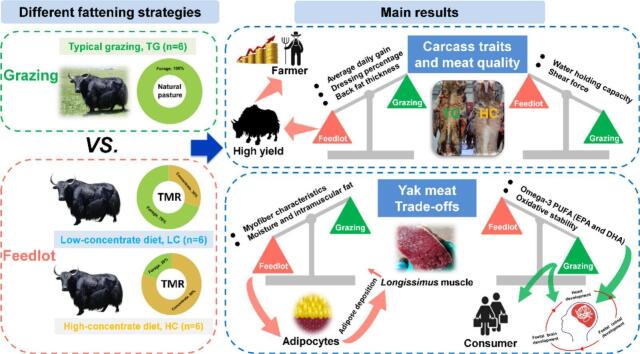 Figure 1
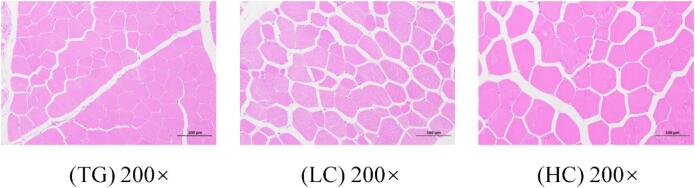 Figure 2
Peer Reviews
No public reviews on file for this paper yet. If you reviewed it on a platform where reviews are public (OpenReview, ICLR, NeurIPS, ICML), you can paste yours below so the community can read it here.
Videos
No videos yet. Explain this paper in a talk, walkthrough, or lecture? Add one.
Taxonomy
TopicsMeat and Animal Product Quality · Animal Nutrition and Physiology · Ruminant Nutrition and Digestive Physiology