Different prognosis for stage IIB cervical cancer patients with unilateral or bilateral parametrial invasion treated with concurrent chemoradiotherapy
Xi-Lin Yang, Li-Chun Wei, Jian-Li He, Tie-Jun Wang, Li Ran, Li-Juan Zou, Xiao-Ge Sun, Xiao-Mei Li, Zi Liu, Yong-Gang Shi, Sha Li, Feng-Ju Zhao, Kun Gao, Wei Zhong, Guang-Hui Cheng, Ya-Li Gao, Bao-Sheng Sun, Jun-Fang Yan, Fu-Quan Zhang

TL;DR
Stage IIB cervical cancer patients with bilateral parametrial invasion have worse survival than those with unilateral invasion, and parametrial invasion is a key predictor of prognosis.
Contribution
This study identifies parametrial invasion as the most significant prognostic factor in stage IIB cervical cancer patients treated with chemoradiotherapy.
Findings
Patients with unilateral parametrial invasion had significantly better 5-year overall survival than those with bilateral invasion.
Parametrial invasion was identified as the most important feature affecting survival outcomes using a random forest model and SHAP analysis.
Upper 2/3 vaginal invasion did not significantly impact survival in either group.
Abstract
To compare the survival difference between 2018 International Federation of Gynecology and Obstetrics (FIGO) stage IIB cervical cancer (CC) patients with unilateral parametrial invasion (UL) and bilateral parametrial invasion (BL) disease, and explore the significant role of parametrial invasion (PI) in prognosis prediction. A total of 506 stage IIB CC patients were identified from the multi-center study, and patients were divided into UL and BL groups according to gynecological and radiological examination. Survival outcomes were estimated and compared between 2 groups before and after propensity scoring matching (PSM). The role of upper 2/3 vaginal invasion (VI) in impacting survival probability was also assessed. The random forest (RF) model was constructed and validated to select important features related to survival outcomes and predict prognosis for these patients. The SHapley…
Genes, proteins, chemicals, diseases, species, mutations and cell lines named across the full text — each resolved to its canonical identifier and authoritative record.
Click any figure to enlarge with its caption.
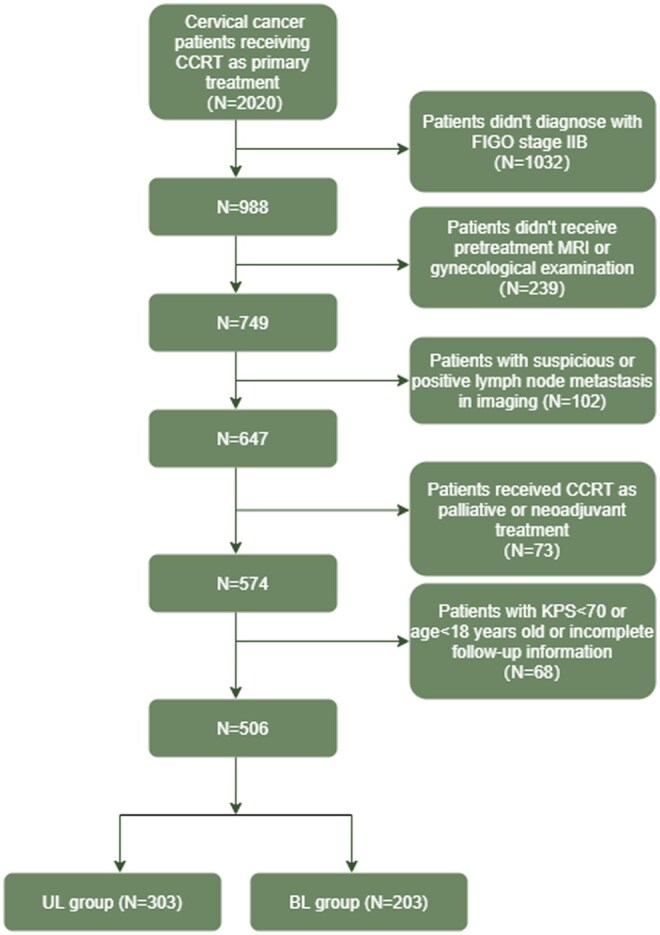 Figure 1
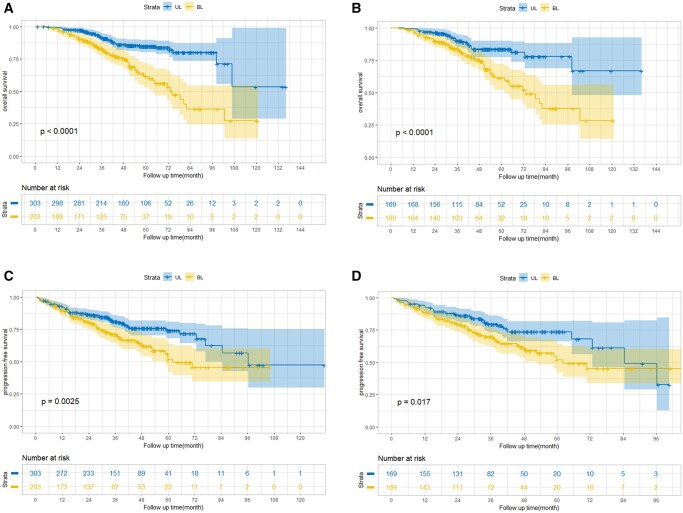 Figure 2
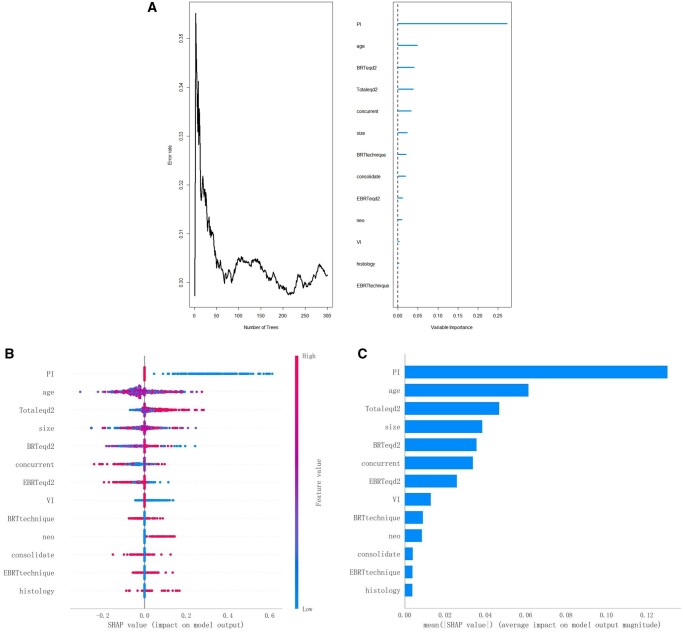 Figure 3
Peer Reviews
No public reviews on file for this paper yet. If you reviewed it on a platform where reviews are public (OpenReview, ICLR, NeurIPS, ICML), you can paste yours below so the community can read it here.
Videos
No videos yet. Explain this paper in a talk, walkthrough, or lecture? Add one.
Taxonomy
TopicsEndometrial and Cervical Cancer Treatments · Endometriosis Research and Treatment · Cervical Cancer and HPV Research