Nonlinear nanophotonics for high-dimensional quantum states
Liat Nemirovsky-Levy, Amit Kam, Meir Lederman, Meir Orenstein, Uzi Pereg, Guy Bartal, Mordechai Segev

TL;DR
This paper explores using nanophotonics to create high-dimensional quantum states, advancing on-chip quantum technologies.
Contribution
A novel method for generating qudits via nonlinear nanophotonic processes using pump field polarization.
Findings
Nonlinear nanophotonics can selectively create high-dimensional quantum states.
Pump field polarization controls angular momentum modes and their superpositions.
This approach enables compact and efficient quantum state manipulation on chips.
Abstract
Quantum nanophotonics merges the precision of nanoscale light manipulation with the capabilities of quantum technologies, offering a pathway for enhanced light-matter interaction and compact realization of quantum devices. Here, we show how a recently-demonstrated nonlinear nanophotonic process can be employed to selectively create photonic high-dimensional quantum states (qudits). We utilize the nonlinearity on the surface of the nanophotonic device to dress, through the polarization of the pump field, the near-field modes carrying angular momentum and their superpositions. This idea is an important step towards experimental realizations of quantum state generation and manipulation through nonlinearity within nanophotonic platforms, and enables new capabilities for on-chip quantum devices.
Genes, proteins, chemicals, diseases, species, mutations and cell lines named across the full text — each resolved to its canonical identifier and authoritative record.
Click any figure to enlarge with its caption.
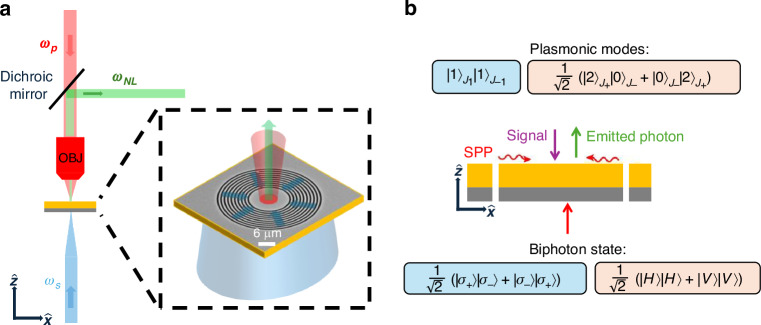 Figure 1
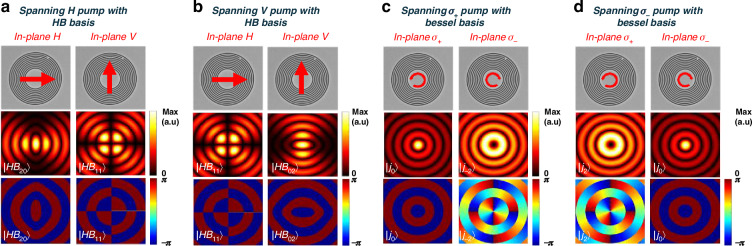 Figure 2
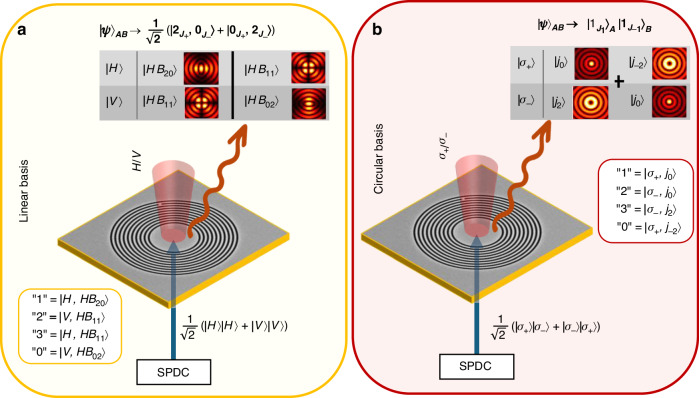 Figure 3
Peer Reviews
No public reviews on file for this paper yet. If you reviewed it on a platform where reviews are public (OpenReview, ICLR, NeurIPS, ICML), you can paste yours below so the community can read it here.
Videos
No videos yet. Explain this paper in a talk, walkthrough, or lecture? Add one.
Taxonomy
TopicsStrong Light-Matter Interactions · Mechanical and Optical Resonators · Plasmonic and Surface Plasmon Research