Realization of two-dimensional discrete time crystals with anisotropic Heisenberg coupling
Eric D. Switzer, Niall F. Robertson, Nathan Keenan, Ángel Rodríguez-Alcaraz, Andrea D’Urbano, Bibek Pokharel, Talat S. Rahman, Oles Shtanko, Sergiy Zhuk, Nicolás Lorente

TL;DR
The paper demonstrates a 2D discrete time crystal using anisotropic Heisenberg coupling on a quantum simulator, revealing new non-equilibrium phases.
Contribution
First realization of a 2D DTC with anisotropic Heisenberg coupling using quantum processors.
Findings
A 2D DTC phase is stabilized with anisotropic Heisenberg interactions.
The phase diagram includes spin-glass, ergodic, and time-crystalline phases.
Initialization and driving protocols influence the DTC stability.
Abstract
A discrete time crystal (DTC) is an out-of-equilibrium phase of matter that spontaneously breaks discrete time-translation symmetry. Previous studies have been limited to a set of models with Ising-like couplings - and mostly only in one dimension - thus precluding our understanding of the existence (or not) of DTCs in models with more realistic interactions. In this work, by combining the latest generation of IBM quantum processors with state-of-the-art tensor network methods, we demonstrate the existence of a DTC in a two-dimensional system governed by anisotropic Heisenberg interactions. We uncover a rich phase diagram encompassing spin-glass, ergodic, and time-crystalline phases, and identify the interplay of initialization, interaction anisotropy, and driving protocols in stabilizing the DTC phase. By extending the study of Floquet matter beyond simplified models, we lay the…
Genes, proteins, chemicals, diseases, species, mutations and cell lines named across the full text — each resolved to its canonical identifier and authoritative record.
Click any figure to enlarge with its caption.
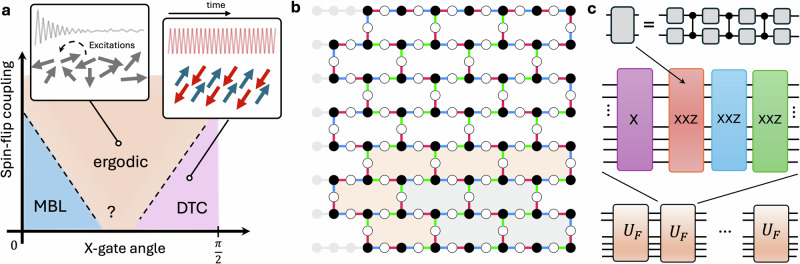 Figure 1
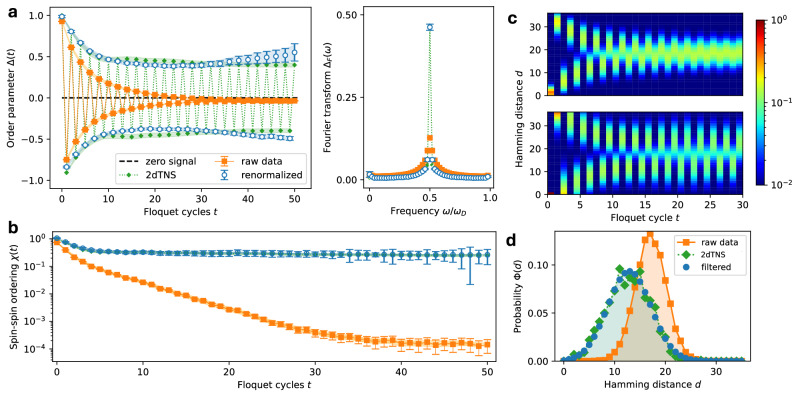 Figure 2
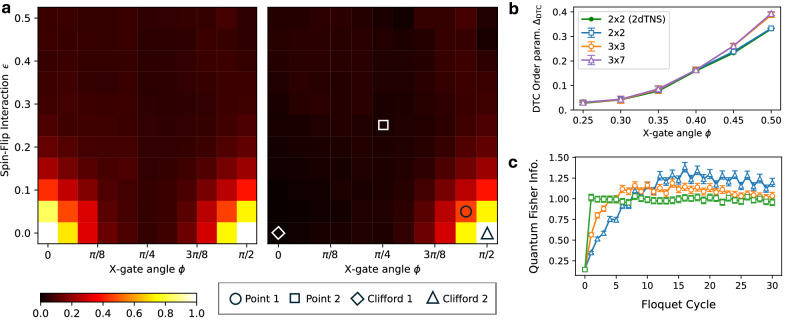 Figure 3
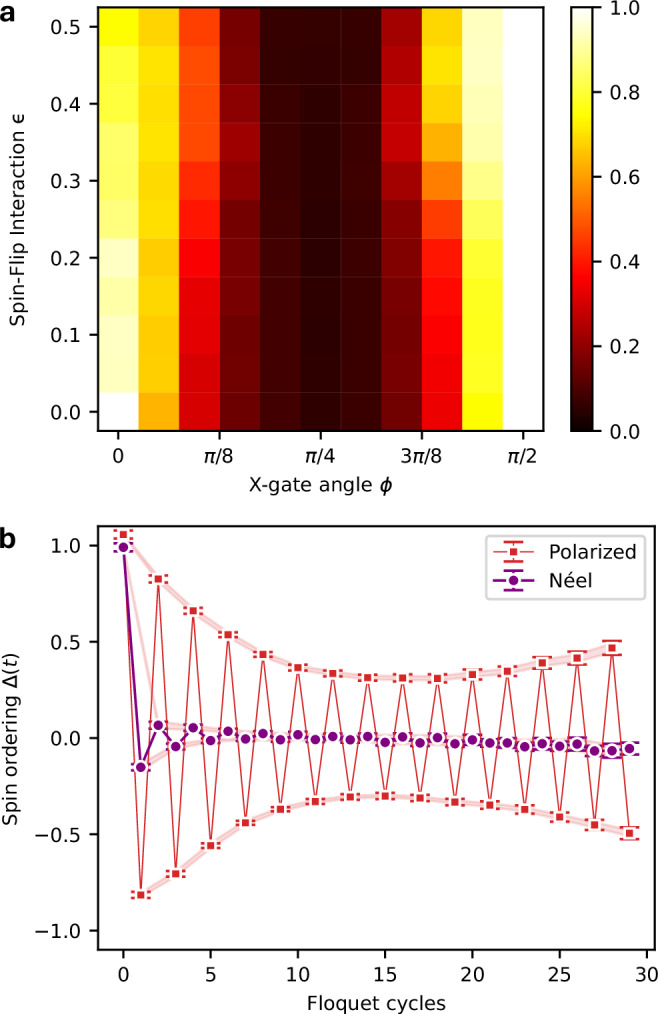 Figure 4
Peer Reviews
No public reviews on file for this paper yet. If you reviewed it on a platform where reviews are public (OpenReview, ICLR, NeurIPS, ICML), you can paste yours below so the community can read it here.
Videos
No videos yet. Explain this paper in a talk, walkthrough, or lecture? Add one.
Taxonomy
TopicsQuantum many-body systems · Topological Materials and Phenomena · Quantum Computing Algorithms and Architecture