Different Methodologies Result in Opposite Patterns of Diversification Rates in Flowering Plants Across Latitudes
Hong Qian, Michael Kessler

TL;DR
This study finds that diversification rates of flowering plants decrease with increasing latitude when using a phylogeny-free method, contradicting previous findings that used phylogeny-based methods.
Contribution
The study applies a non-phylogeny method to estimate diversification rates in angiosperms, revealing a trend opposite to prior phylogeny-based results.
Findings
Diversification rates of angiosperms decrease with increasing latitude using the method-of-moments estimator.
Results contradict previous studies that found increasing diversification rates with latitude in angiosperms.
More data from under-studied angiosperm groups are needed to improve phylogenetic resolution and method robustness.
Abstract
There are two major groups of methods estimating diversification rates: One group depends on well resolved phylogenies and the other is phylogeny‐free. Previous studies on angiosperms (flowering plants) have used phylogeny‐based methods to estimate diversification rates and concluded that diversification rates increase with increasing latitudes, a trend opposite to that of liverworts, mosses and ferns, for which diversification rates were estimated with the method‐of‐moments estimator, a nonphylogeny method. In this study, we use the method‐of‐moments estimator to estimate diversification rates of angiosperm species within genera worldwide. We find that diversification rates decrease with increasing latitudes. The result of our study is thus contrary to those of previous studies on angiosperms. We discuss the degree to which these differences are due to methodological limitations of…
Click any figure to enlarge with its caption.
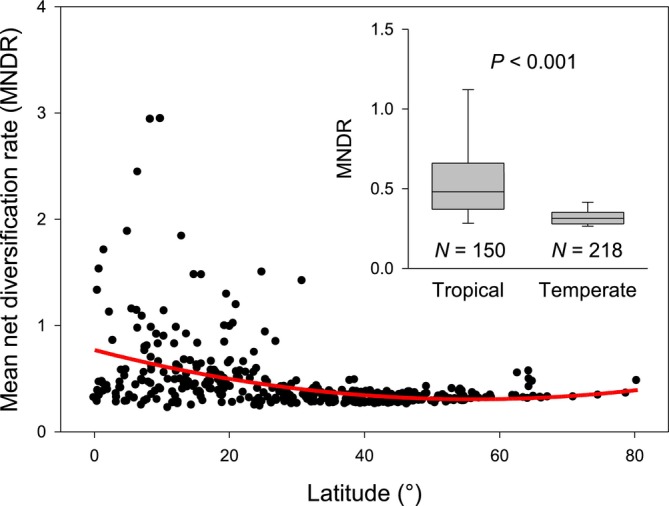 Figure 1
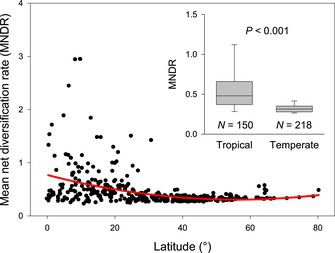 Figure 2
Peer Reviews
No public reviews on file for this paper yet. If you reviewed it on a platform where reviews are public (OpenReview, ICLR, NeurIPS, ICML), you can paste yours below so the community can read it here.
Videos
No videos yet. Explain this paper in a talk, walkthrough, or lecture? Add one.
Taxonomy
TopicsEvolution and Paleontology Studies · Genetic diversity and population structure · Ecology and Vegetation Dynamics Studies