Does “distance lend enchantment”? Public attitudes to deepfake technology in the United States
Elena Denia, John Durant

TL;DR
This study explores how familiarity with deepfake technology influences public attitudes in the United States.
Contribution
The study reveals that closer familiarity with deepfake technology leads to more positive and nuanced public attitudes.
Findings
Publics closer to deepfake technology have more positive attitudes.
Familiarity reduces the 'enchantment' effect typically associated with distance.
The study suggests a need for further research on technology familiarity and public perception.
Abstract
We describe a focus group study of public perceptions of “deepfake” technology, that is, digitally manipulated videos that show people saying or doing things they never really did. The study was designed to explore the relationship between degree of closeness to or familiarity with technology and attitudes toward it. We find that in this case, publics that are closer have more positive and nuanced attitudes. In such cases, at least, it appears that distance does not lend enchantment. We suggest why this may be the case and propose further related research designed to test the conclusions reached here.
Genes, proteins, chemicals, diseases, species, mutations and cell lines named across the full text — each resolved to its canonical identifier and authoritative record.
Click any figure to enlarge with its caption.
 Figure 1
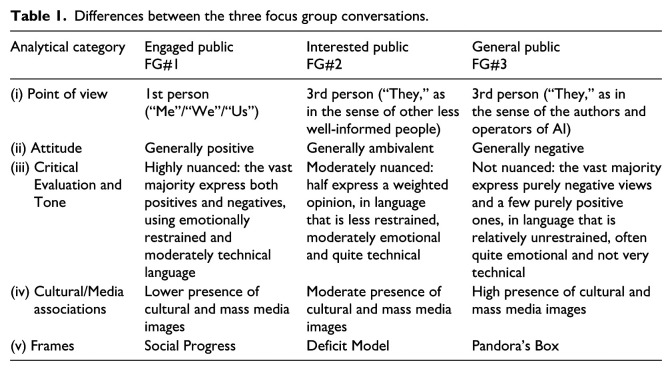 Figure 2
Peer Reviews
No public reviews on file for this paper yet. If you reviewed it on a platform where reviews are public (OpenReview, ICLR, NeurIPS, ICML), you can paste yours below so the community can read it here.
Videos
No videos yet. Explain this paper in a talk, walkthrough, or lecture? Add one.
Taxonomy
TopicsMedia Studies and Communication · Social Media and Politics · Climate Change Communication and Perception