Acute responses to low-intensity aerobic exercise with continuous and intermittent blood flow restriction
James Brown, Jakob D. Lauver, Timothy R. Rotarius, Justin P. Guilkey

TL;DR
This study compared how different blood flow restriction methods during light exercise affect muscle and heart responses, finding similar results between continuous and intermittent BFR.
Contribution
The study shows that continuous and intermittent BFR during low-intensity exercise produce similar hypoxic effects with less cardiac strain than high-intensity exercise.
Findings
StO2 responses were similar between continuous BFR, intermittent BFR, and high-intensity exercise.
RPP was lower in BFR conditions compared to high-intensity exercise but similar between continuous and intermittent BFR.
Low-intensity exercise without BFR showed the smallest hypoxic stimulus and lowest RPP.
Abstract
This study examined muscular and cardiovascular responses to light-intensity aerobic exercise with different blood flow restriction (BFR) protocols. Ten males performed four protocols on the cycle ergometer: low-intensity exercise with no BFR (LIE), LIE with continuous BFR (CONT-BFR), LIE with intermittent BFR (INT-BFR), and high-intensity exercise (HIE). Each protocol consisted of five 2-min work intervals (INT) at 35% of peak work rate for LIE, CONT-BFR, and INT-BFR and 70% of peak work rate for HIE. During CONT-BFR, cuffs were inflated to 60% of arterial occlusion pressure (AOP) at the start of INT 1 and remained inflated until the end of INT 5. During INT-BFR, cuffs were inflated to 60% of AOP during INTs and deflated during recovery intervals. Tissue oxygen saturation (StO2) and rate pressure product (RPP) were measured to assess hypoxic stimulus and myocardial work, respectively.…
Genes, proteins, chemicals, diseases, species, mutations and cell lines named across the full text — each resolved to its canonical identifier and authoritative record.
Click any figure to enlarge with its caption.
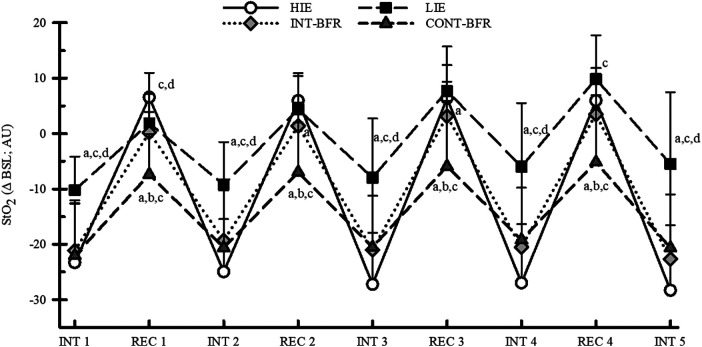 Figure 1
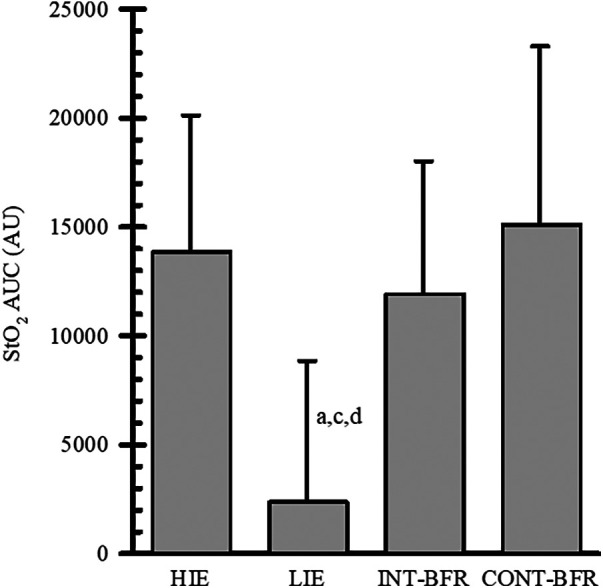 Figure 2
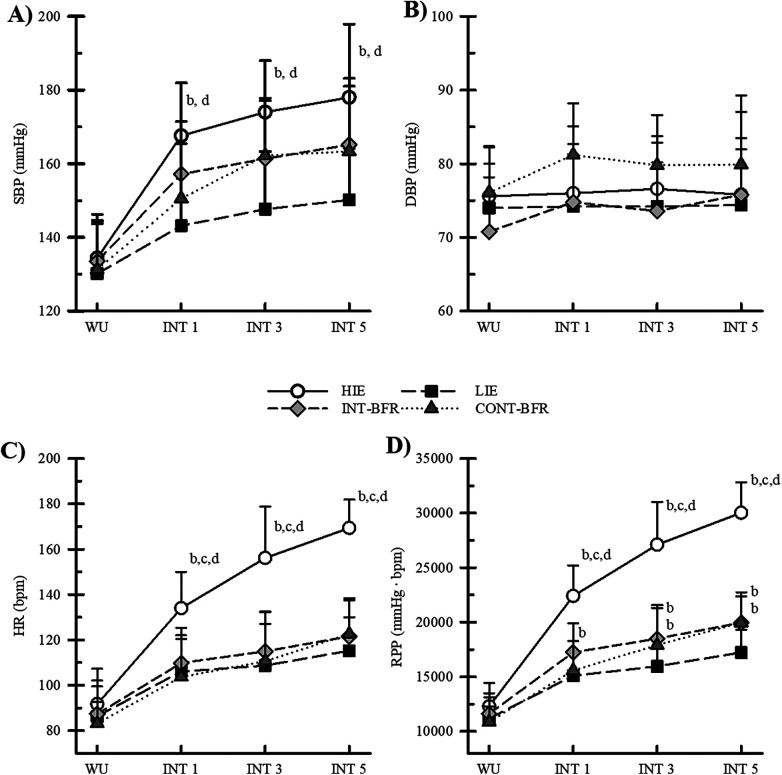 Figure 3
Peer Reviews
No public reviews on file for this paper yet. If you reviewed it on a platform where reviews are public (OpenReview, ICLR, NeurIPS, ICML), you can paste yours below so the community can read it here.
Videos
No videos yet. Explain this paper in a talk, walkthrough, or lecture? Add one.
Taxonomy
TopicsCardiovascular and exercise physiology · Heart Rate Variability and Autonomic Control · Thermoregulation and physiological responses