Relative contributions of upper-body muscular power and repeated sprint ability to 50-m freestyle swimming performance in competitive swimmers
Sofiene Amara, Anissa Bouassida, Roland van den Tillaar

TL;DR
This study shows that upper-body power is the strongest predictor of 50-meter freestyle swimming performance in competitive swimmers.
Contribution
The study identifies upper-body muscular power as the primary independent predictor of 50-m freestyle performance in swimmers.
Findings
Maximum muscular power had a very strong negative correlation with 50-m freestyle time (r = –0.86).
A multiple regression model explained 86% of the variance in 50-m performance, with maximum power as the only significant predictor.
Repeated sprint variables showed significant correlations but did not independently predict 50-m performance.
Abstract
Upper-body muscular power and repeated sprint ability are recognized as important contributors to sprint swimming performance. However, the relative and combined predictive value of dry-land power measures and in-water repeated sprint ability for 50-m freestyle performance remains insufficiently understood. This study aimed to examine the relationships between upper-body muscular power, repeated sprint swimming variables (RSS), and 50-m freestyle performance in competitive swimmers. Thirty-six national-level male swimmers (age: 16.4 ± 0.3 years) participated in this cross-sectional study. Each swimmer completed: (1) an upper-body load–velocity assessment using the bench press on a Smith machine equipped with a linear position transducer to determine peak power; (2) an in-water repeated sprint test (8 × 15 m, 30 s rest) to determine fastest time, mean time, fatigue index, and total time;…
Genes, proteins, chemicals, diseases, species, mutations and cell lines named across the full text — each resolved to its canonical identifier and authoritative record.
Click any figure to enlarge with its caption.
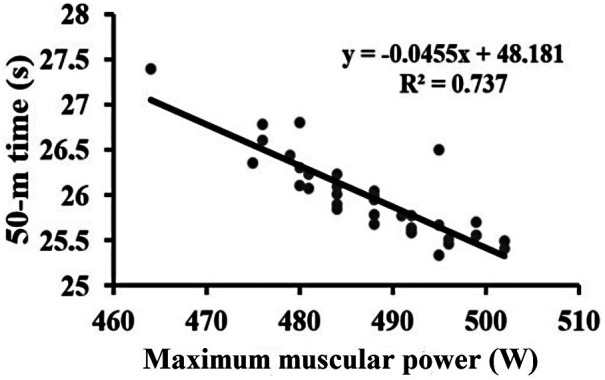 Figure 1
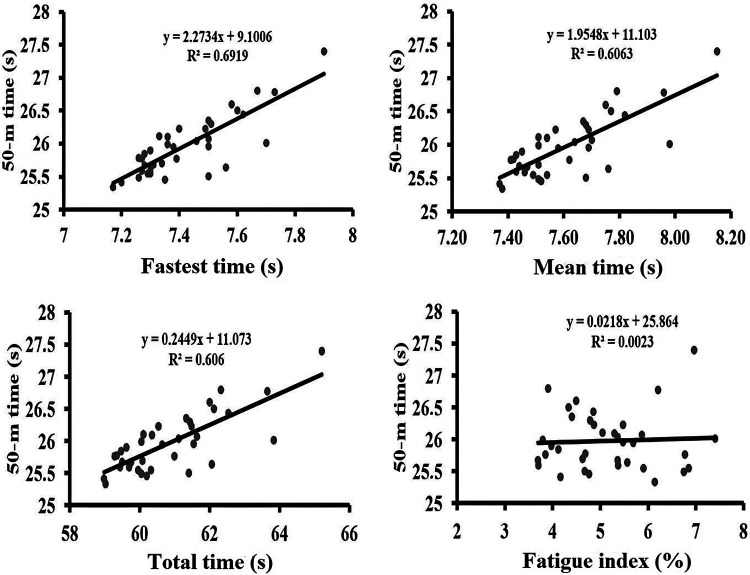 Figure 2
Peer Reviews
No public reviews on file for this paper yet. If you reviewed it on a platform where reviews are public (OpenReview, ICLR, NeurIPS, ICML), you can paste yours below so the community can read it here.
Videos
No videos yet. Explain this paper in a talk, walkthrough, or lecture? Add one.
Taxonomy
TopicsSports Performance and Training · Cardiovascular and exercise physiology · Sport Psychology and Performance