From NIL to real estate: strategic revenue adaptation in the post-house era of college athletics
Nikolas R. Webster, Jeffrey Carr

TL;DR
This paper explores how college athletic departments can adapt financially by developing real estate to cover athlete compensation costs after legal changes.
Contribution
The paper introduces real estate development as a novel revenue strategy for college athletics in response to new financial pressures.
Findings
Athletic departments now allocate 22% of revenue to athlete compensation due to legal reforms.
Real estate development is proposed as a strategic revenue hedge in the post-House financial environment.
New financial mandates require universities to seek alternative revenue or face long-term deficits.
Abstract
Recent legal and financial reforms have altered the business model of college sports. The erosion of the NCAA's amateurism defense (culminating in the House settlement) has formalized athlete compensation and introduced direct labor expenses into athletic departments finances for the first time. Concurrently, the transfer mobility of athletes, new federal oversight, and the continuing evolution of NIL markets has increased competition among schools for athlete talent while also constricting institutional margins. With approximately 22% of athletics revenue designated for athlete compensation, universities now encounter a new financial mandate to either generate new revenue streams or accept new deficits with long-term fiscal consequences. Drawing from professional sports, this paper examines sport-anchored, mixed-use real estate development as a strategic mechanism for college athletic…
Click any figure to enlarge with its caption.
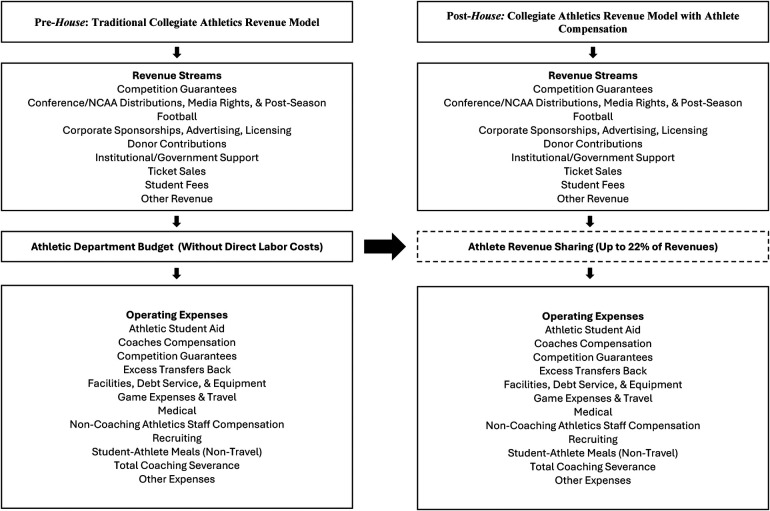 Figure 1
Peer Reviews
No public reviews on file for this paper yet. If you reviewed it on a platform where reviews are public (OpenReview, ICLR, NeurIPS, ICML), you can paste yours below so the community can read it here.
Videos
No videos yet. Explain this paper in a talk, walkthrough, or lecture? Add one.
Taxonomy
TopicsSports, Gender, and Society · Sports Analytics and Performance · Sport and Mega-Event Impacts