Phosphorylation-driven conformational switching of the ArnA–ArnB complex involved in archaeal motility regulation
Mohamed Watad, Lukas Korf, Wieland Steinchen, Filipp Bezold, Marian S. Vogt, Po Hsun Wang, Leon Selbach, Sebastian Hepp, Luis Gayermann, Marleen van Wolferen, Xing Ye, Sonja-Verena Albers, Lars-Oliver Essen

TL;DR
This study reveals how phosphorylation controls the structure and function of the ArnA–ArnB complex in archaea, influencing their ability to move in response to nutrients.
Contribution
The study provides structural and biochemical evidence for phosphorylation-driven conformational changes in the ArnA–ArnB complex.
Findings
The cocrystal structure of ArnA/ArnB shows interactions between the zinc finger domain of ArnA and domains of ArnB.
Phosphorylation of ArnB leads to a tight complex and exposes its C-terminal domain for binding to ArnA.
Deletion of arnA or arnB reduces the levels of the respective protein and affects downstream regulators.
Abstract
ArnA and ArnB serve as regulators within the Sulfolobus archaellum regulatory network by modulating the archaellum components ArlB and ArlX, which are essential for swimming motility. Together, they form a dynamic complex that, depending on nutrient availability, exists in either a loose, unphosphorylated or a tight, phosphorylated state. This transition is directed by phosphorylation via the kinase ArnC. To investigate this transition, we determined the cocrystal structure of the ArnA/ArnB complex, revealing that the zinc finger domain of ArnA interacts with both the β-sandwich and the C-terminal domains of ArnB. HDX data support the phosphorylation-dependent transition from a loose to a tight ArnAB complex driven by sequential phosphorylation of ArnB. This modification exposes the interaction surface of the C-terminal domain of ArnB, which then binds to the forkhead-associated domain…
Genes, proteins, chemicals, diseases, species, mutations and cell lines named across the full text — each resolved to its canonical identifier and authoritative record.
Click any figure to enlarge with its caption.
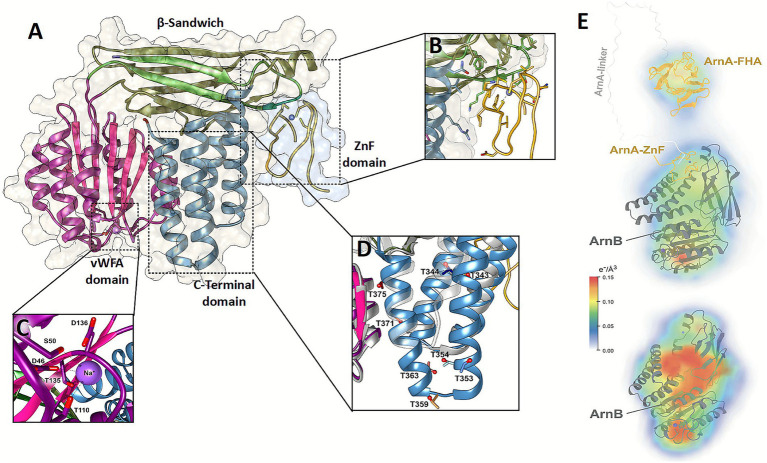 Figure 1
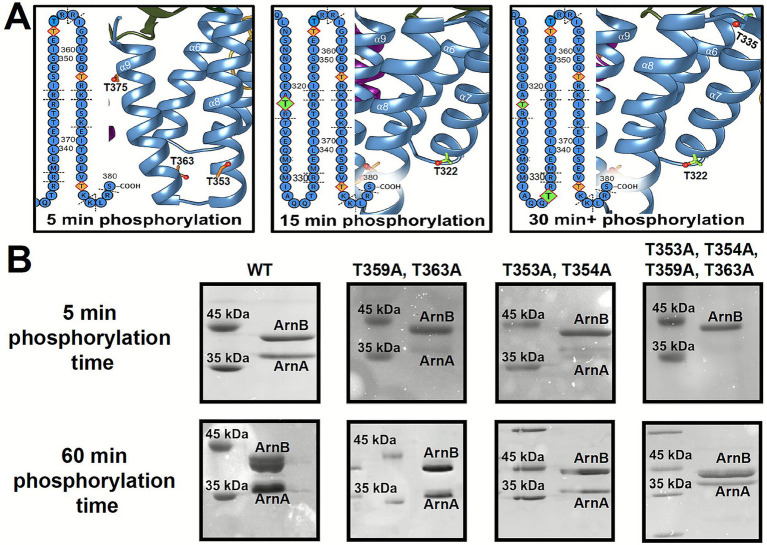 Figure 2
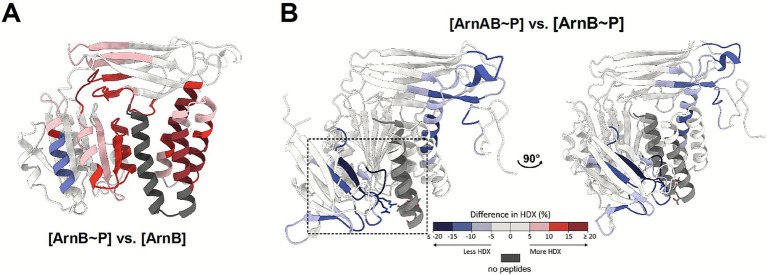 Figure 3
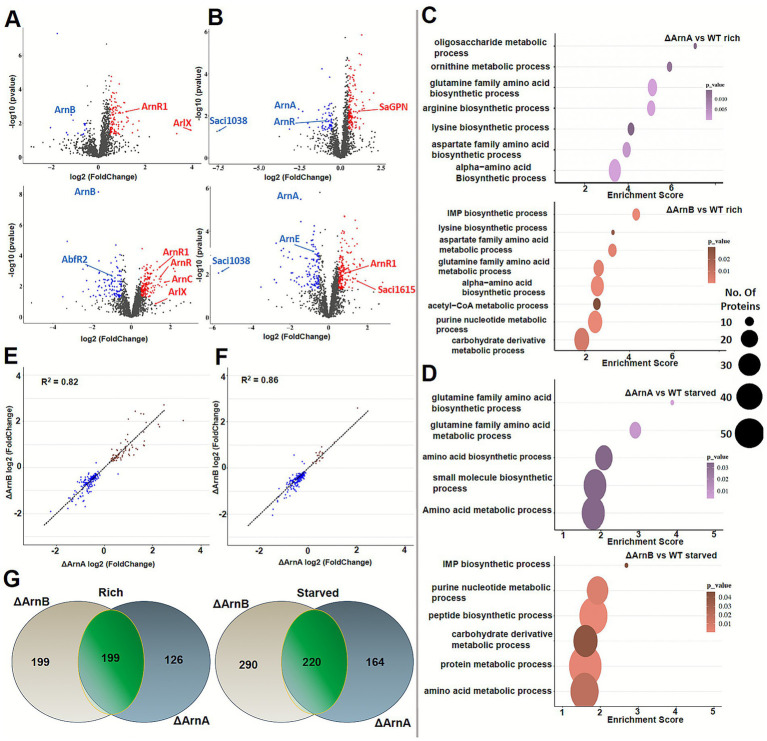 Figure 4
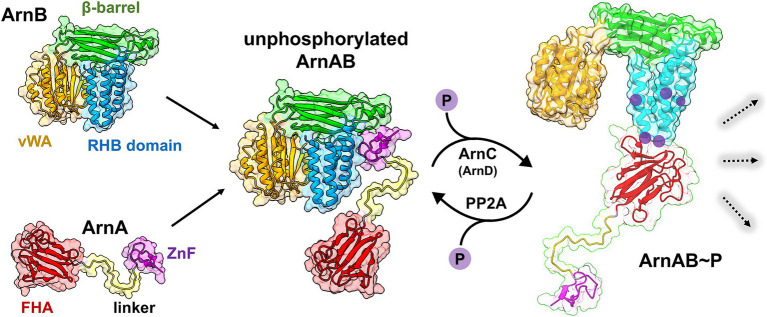 Figure 5
Peer Reviews
No public reviews on file for this paper yet. If you reviewed it on a platform where reviews are public (OpenReview, ICLR, NeurIPS, ICML), you can paste yours below so the community can read it here.
Videos
No videos yet. Explain this paper in a talk, walkthrough, or lecture? Add one.
Taxonomy
TopicsBacterial Genetics and Biotechnology · Photosynthetic Processes and Mechanisms · Protist diversity and phylogeny