Polarity-dependent modulation of sleep oscillations and cortical excitability in aging
Buse Dikici, Robert Malinowski, Jan-Bernhard Kordaß, Klaus Obermayer, Julia Ladenbauer, Agnes Flöel

TL;DR
This study shows that anodal tDCS improves sleep-related brain activity linked to memory in older adults, while cathodal tDCS does not, and that individual differences like chronotype matter.
Contribution
The study reveals that anodal tDCS enhances sleep oscillations more effectively than cathodal tDCS in older adults, challenging prior assumptions about polarity effects.
Findings
Anodal so-tDCS improved SO-spindle synchrony and spindle power in participants with intermediate or evening chronotypes.
Cathodal so-tDCS prolonged SO down-states but did not enhance oscillatory measures compared to sham.
Anodal so-tDCS increased cortical excitability, while cathodal so-tDCS did not shift the E/I balance as expected.
Abstract
During non-rapid eye movement (NREM) sleep, cortical slow oscillation (SO; <1 Hz) and thalamic sleep spindle activity (12–15 Hz) interact through precise phase coupling to support memory consolidation. Slow oscillatory transcranial direct current stimulation (so-tDCS) can modulate these oscillations. Traditionally, anodal so-tDCS is used to depolarize the cortex during SO up-states, thereby promoting SO activity and SO-spindle coupling. However, intracranial findings suggest that SO down-states, characterized by cortical hyperpolarization, can trigger thalamic spindle bursts. This raises the hypothesis that cathodal so-tDCS, by promoting hyperpolarization, could selectively enhance down-states and more effectively improve SO-spindle coupling. We tested this hypothesis in 22 healthy older adults, a population known to exhibit diminished NREM oscillatory activity. Each participant…
Genes, proteins, chemicals, diseases, species, mutations and cell lines named across the full text — each resolved to its canonical identifier and authoritative record.
Click any figure to enlarge with its caption.
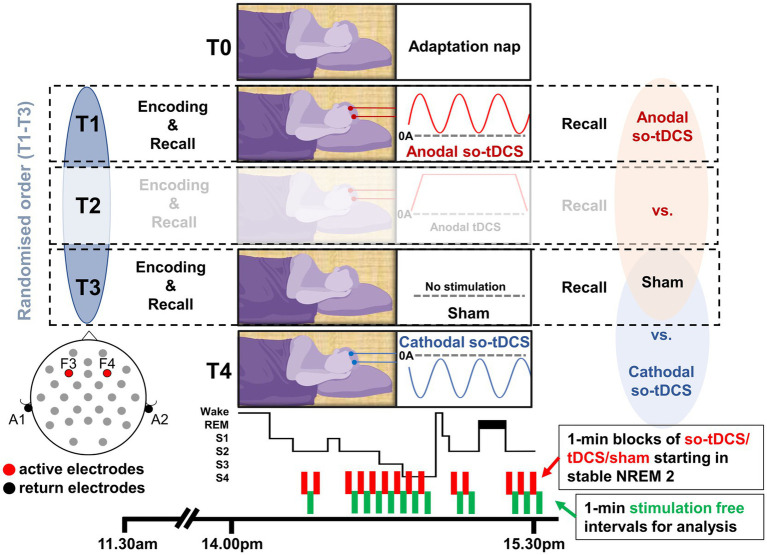 Figure 1
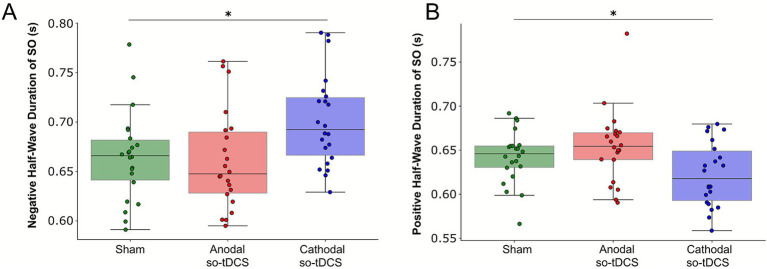 Figure 2
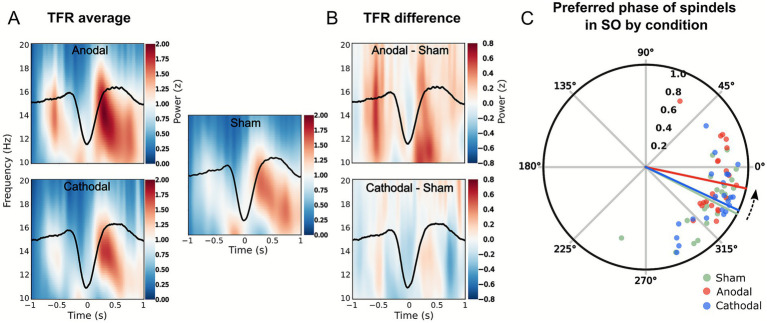 Figure 3
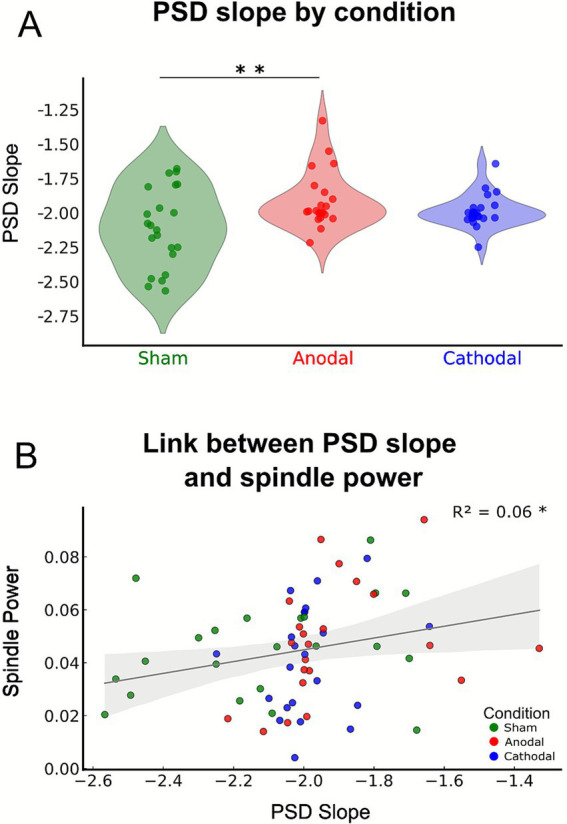 Figure 4
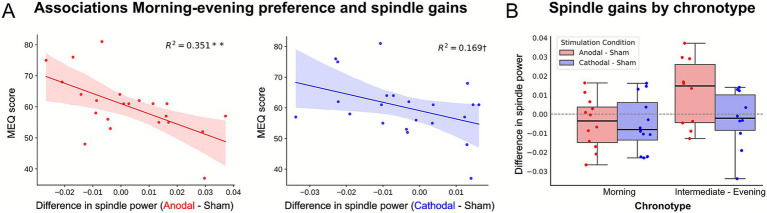 Figure 5
Peer Reviews
No public reviews on file for this paper yet. If you reviewed it on a platform where reviews are public (OpenReview, ICLR, NeurIPS, ICML), you can paste yours below so the community can read it here.
Videos
No videos yet. Explain this paper in a talk, walkthrough, or lecture? Add one.
Taxonomy
TopicsSleep and Wakefulness Research · Sleep and related disorders · Circadian rhythm and melatonin