Evaluation of the effectiveness of teledentistry on diagnostic accuracy and treatment planning among Jordanian dentists
Sabha Mahmoud Alshatrat, Majd Alsaleh, Jumana M. Sabarini, Tamadur Mahmoud Falah, Yousef Saleh Khader, Alaa Fawwaz Dalky, Bayan Mahasneh, Abedelmalek Kalefh Tabnjh

TL;DR
This study evaluates how well Jordanian dentists can diagnose and plan treatments for children's dental cases using teledentistry, finding high accuracy in clear cases but variability in treatment plans.
Contribution
The study provides empirical evidence on teledentistry's diagnostic accuracy and treatment planning consistency among Jordanian dentists using pediatric clinical scenarios.
Findings
Diagnostic agreement was highest for cases with distinct clinical presentations, such as early childhood caries (92.1%).
Treatment planning agreement was highest for molar-incisor hypomineralization (64.4%) and functional class III cases (59.4%).
Variability in treatment planning suggests a need for standardized guidelines and professional development in teledentistry.
Abstract
To assess the diagnostic accuracy and treatment planning agreement among Jordanian dentists when using teledentistry. Thirty children underwent dental examinations. Standardized intraoral photographs and brief case histories from pediatric patients were compiled into clinical case scenarios. Eight representative cases were selected and presented in a Google Forms survey to licensed dentists in Jordan. Participants reviewed the cases, providing clinical diagnoses and proposing treatment plans. Responses were analyzed to determine diagnostic accuracy and agreement on treatment planning. Diagnostic agreement was highest for cases with distinct clinical presentations. Case #5 (early childhood caries) showed the highest agreement at 92.1%, followed by Case #3 (avulsion; 91.1%) and Case #6 (ectopic eruption; 85.1%). Treatment planning agreement followed a similar pattern. The highest…
Genes, proteins, chemicals, diseases, species, mutations and cell lines named across the full text — each resolved to its canonical identifier and authoritative record.
Click any figure to enlarge with its caption.
 Figure 1
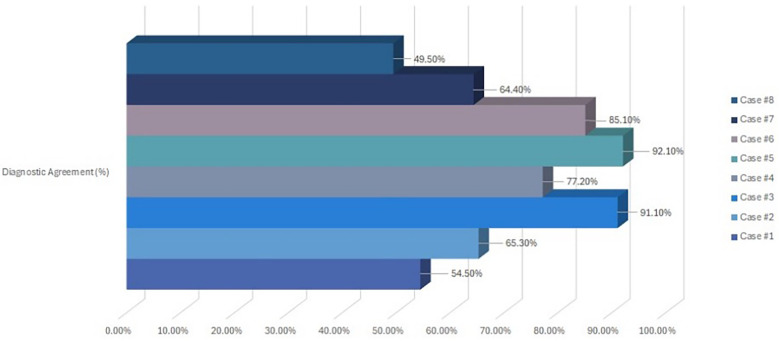 Figure 2
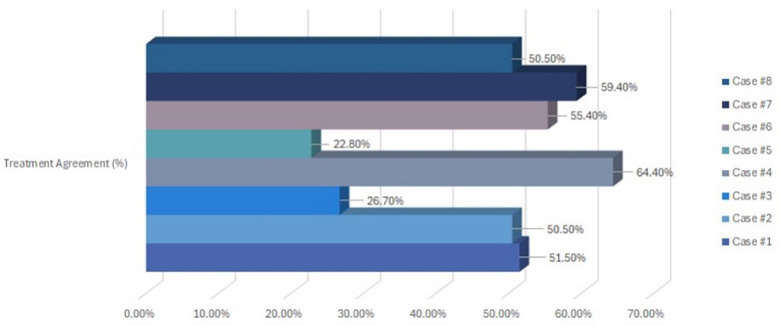 Figure 3
Peer Reviews
No public reviews on file for this paper yet. If you reviewed it on a platform where reviews are public (OpenReview, ICLR, NeurIPS, ICML), you can paste yours below so the community can read it here.
Videos
No videos yet. Explain this paper in a talk, walkthrough, or lecture? Add one.
Taxonomy
TopicsDental Research and COVID-19 · Dental Health and Care Utilization · Oral and Craniofacial Lesions