Success rates of trial of labor after cesarean delivery: the impact of prior vaginal deliveries on outcomes
Yaara Bashan, Elior Shalev Maman, Ron Rosenberg, Yael Yekel, Amir Weintraub, Nir Ram Duvdevani, Yael Pasternak

TL;DR
This study shows that women who have had a successful vaginal birth after cesarean (VBAC) are more likely to have another successful VBAC, with success rates increasing with prior attempts.
Contribution
The study provides new evidence that success rates of VBAC increase with the number of prior successful attempts, stabilizing after two.
Findings
VBAC success rates increase from 73.2% with no prior VBAC to 97.0% with five or more prior VBACs.
Women with at least one prior VBAC have a 5.17-fold higher likelihood of VBAC success.
Hospitalization duration and blood transfusion risk are lower for women with prior VBAC history.
Abstract
To estimate the success rates and risks of vaginal birth after cesarean delivery (VBAC) based on the number of prior successful VBACs. A retrospective cohort study of women with one cesarean section in the past who attempted vaginal delivery between 2013 and 2022, using data from our Medical Center registry. Outcomes were compared based on the number of prior successful VBACs. Among 2912 deliveries meeting the eligibility criteria, the success rate of VBAC increased with the number of prior VBACs: 73.2% for those with no prior VBAC, rising to 92.3%, 94.7%, 94.0%, and 97.0% for individuals with 1, 2, 3, 4, and 5 or more prior VBACs, respectively. The history of at least one prior VBAC was associated with a 5.17-fold higher likelihood of achieving VBAC success. However, no significant differences in success rates were observed between groups with higher numbers of prior VBACs (≥ 2)…
Genes, proteins, chemicals, diseases, species, mutations and cell lines named across the full text — each resolved to its canonical identifier and authoritative record.
Click any figure to enlarge with its caption.
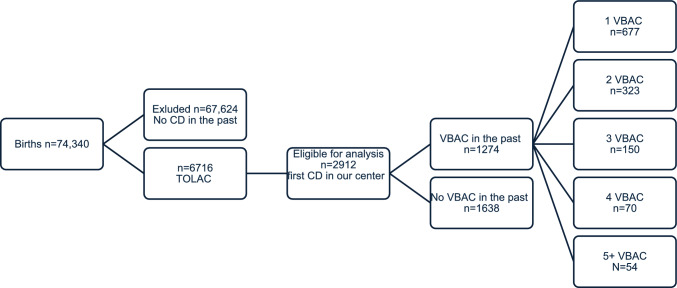 Figure 1
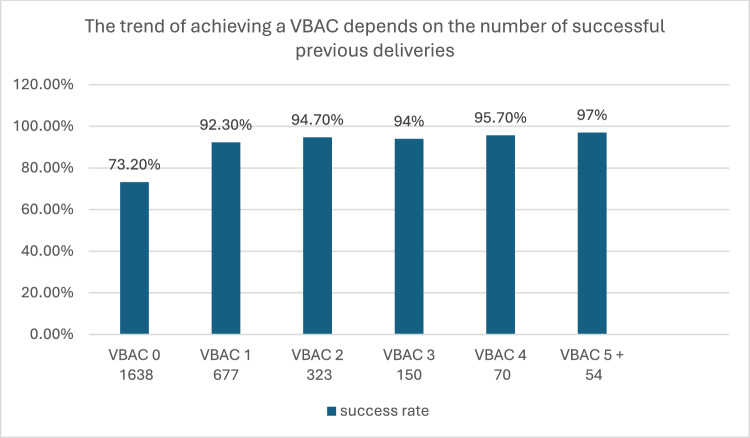 Figure 2
Peer Reviews
No public reviews on file for this paper yet. If you reviewed it on a platform where reviews are public (OpenReview, ICLR, NeurIPS, ICML), you can paste yours below so the community can read it here.
Videos
No videos yet. Explain this paper in a talk, walkthrough, or lecture? Add one.
Taxonomy
TopicsMaternal and Perinatal Health Interventions · Anesthesia and Pain Management · Maternal and fetal healthcare