From RAAS blockade to regenerative medicine: evolving treatment strategies in Alport syndrome
Claudia Lo Re, Jin-Ju Kim, Alessia Fornoni

TL;DR
This paper reviews evolving treatment strategies for Alport syndrome, focusing on new therapies targeting genetic causes and kidney protection.
Contribution
The paper highlights novel precision medicine and regenerative approaches for Alport syndrome treatment.
Findings
Phase II trials are evaluating therapies like endothelin receptor antagonists and FXR agonists for kidney protection.
Precision medicine strategies such as gene editing and exon skipping are being developed to target the genetic basis of Alport syndrome.
Stem cell-based therapies and mitochondrial-targeted treatments show promise in preclinical studies.
Abstract
Alport syndrome (AS) is a hereditary glomerulopathy caused by mutations in the COL4A3, COL4A4, or COL4A5 genes, leading to progressive kidney decline and extrarenal manifestations. Advances in genetic testing have enabled the reclassification of AS into X-linked, autosomal recessive, and autosomal dominant forms, facilitating more accurate diagnosis and risk stratification. While renin-angiotensin-aldosterone system (RAAS) blockade remains the foundation of treatment to delay kidney failure, it does not directly target the underlying molecular pathology. Adjunctive commercially available metabolic modulators, including SGLT2i, mineralocorticoid receptor antagonists, ezetimibe and GLP-1 receptor agonists, may offer additional kidney protection. Ameliorating therapies being tested in Phase II trials include endothelin receptor antagonists (e.g., atrasentan), dual endothelin receptor…
Genes, proteins, chemicals, diseases, species, mutations and cell lines named across the full text — each resolved to its canonical identifier and authoritative record.
Click any figure to enlarge with its caption.
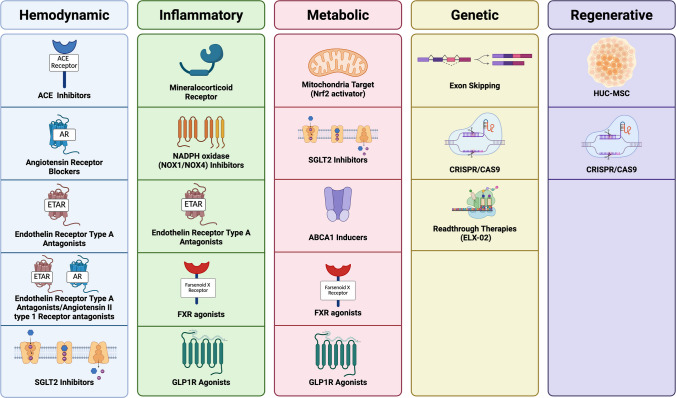 Figure 1
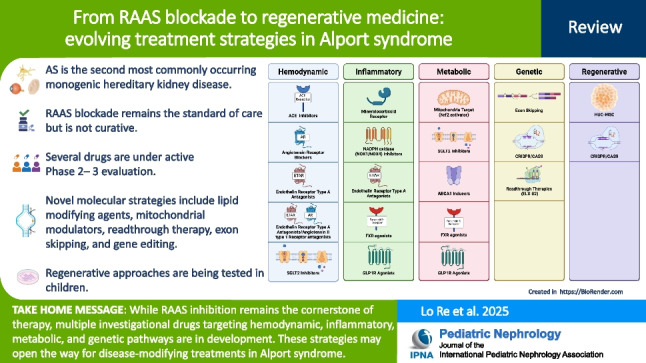 Figure 2
Peer Reviews
No public reviews on file for this paper yet. If you reviewed it on a platform where reviews are public (OpenReview, ICLR, NeurIPS, ICML), you can paste yours below so the community can read it here.
Videos
No videos yet. Explain this paper in a talk, walkthrough, or lecture? Add one.
Taxonomy
TopicsCell Adhesion Molecules Research · Renal and related cancers · Renal Diseases and Glomerulopathies