The impact of urine pH on lithogenic risk profile in children with urolithiasis
Joanna Bagińska-Chyży, Jan K. Kirejczyk, Tadeusz Porowski, Carsten Alexander Wagner, Agata Korzeniecka-Kozerska

TL;DR
This study shows that urine pH affects stone risk in children, with optimal pH between 6.75 and 7.0 helping to prevent kidney stones.
Contribution
The study reveals how urine pH interacts with metabolic factors to influence lithogenic risk in pediatric urolithiasis.
Findings
Children with stones had higher urine volume, oxalate, calcium, and uric acid compared to controls.
Lower urine pH was linked to higher BMI and reduced urine volume in stone-formers.
Citrate and magnesium excretion increased at pH 6.75–7.0, suggesting a protective effect.
Abstract
Urinary pH is known to influence the solubility and excretion of lithogenic substances, yet its relationship with other metabolic parameters in pediatric stone formers remains underexplored. This study investigated the association between urinary pH and lithogenic risk factors in children and adolescents with urolithiasis compared to healthy controls. A total of 400 pediatric patients (ages 3–18 years) with urinary stones and 372 age- and sex-matched healthy controls were included. All participants completed a 24-h urine collection for comprehensive metabolic analysis. Parameters assessed included urinary pH, BMI z-score, urine volume, osmolality, excreted creatinine, GFR, and urinary excretion of calcium, ionized calcium, oxalate, phosphate, magnesium, citrate, and uric acid. Two lithogenic risk indices were also evaluated: Bonn Risk Index (BRI) and Upper Metastable Limit osmolality…
Genes, proteins, chemicals, diseases, species, mutations and cell lines named across the full text — each resolved to its canonical identifier and authoritative record.
Click any figure to enlarge with its caption.
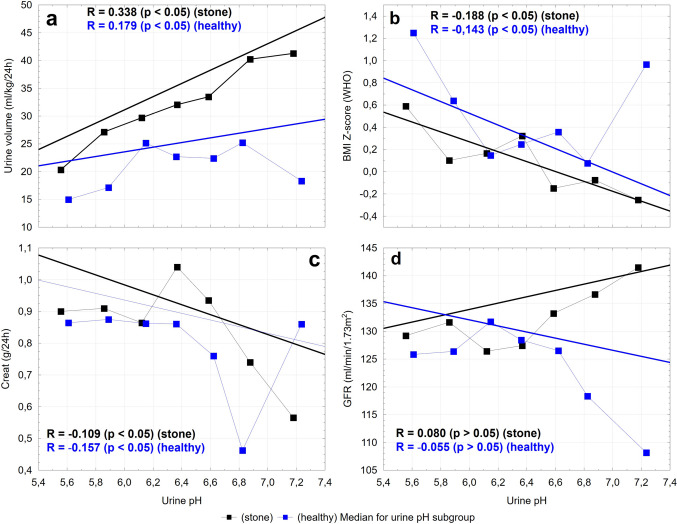 Figure 1
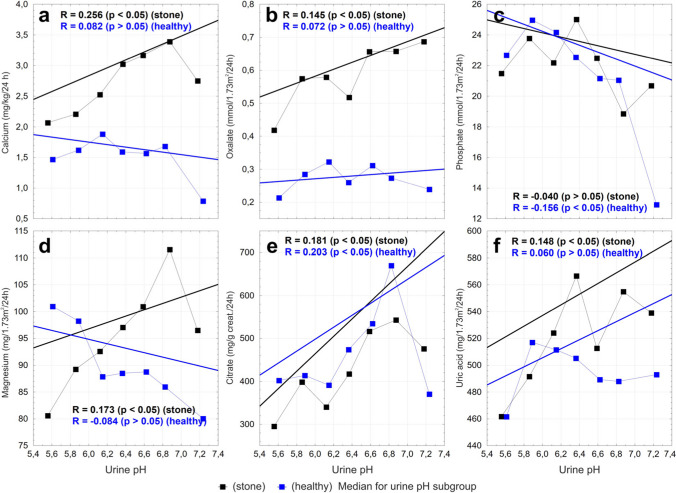 Figure 2
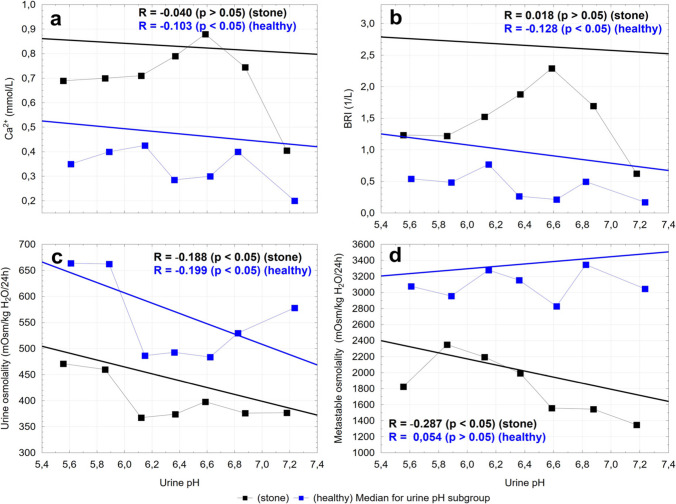 Figure 3
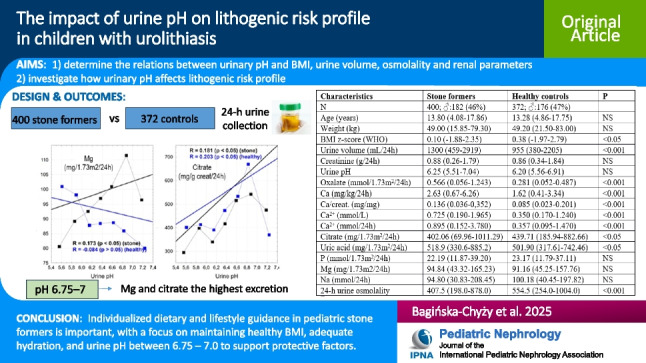 Figure 4
Peer Reviews
No public reviews on file for this paper yet. If you reviewed it on a platform where reviews are public (OpenReview, ICLR, NeurIPS, ICML), you can paste yours below so the community can read it here.
Videos
No videos yet. Explain this paper in a talk, walkthrough, or lecture? Add one.
Taxonomy
TopicsKidney Stones and Urolithiasis Treatments · Urinary Tract Infections Management · Magnesium in Health and Disease