Canine melanomas: MiTF and p38 expression and its correlation with the presence of lymphocytic infiltrate, proliferation, and survival
Carlos Humberto da Costa Vieira-Filho, Jean Nunes dos Santos, Enio Ferreira, Karine Araújo Damasceno, Ricardo Wagner Portela, Vitor de Moraes Pina de Carvalho, Maria Carolina Santos Souza, Gilson Correia Carvalho, Alessandra Estrela-Lima

TL;DR
This study explores the role of MiTF and p38 proteins in canine melanomas and their connection to tumor characteristics and survival.
Contribution
The study reveals distinct correlations between MiTF and p38 expression in different types of canine melanomas and tumor behavior.
Findings
MiTF expression in oral/digit melanomas correlates with larger tumors and higher mitotic index.
In cutaneous melanomas, MiTF is linked to more tumors, while p38 is associated with smaller tumors and better survival.
Reduced MiTF in aggressive oral/digit tumors may indicate dedifferentiation and increased tumor aggressiveness.
Abstract
The microphthalmia-associated transcription factor (MiTF) is considered a promoter of carcinogenesis in melanocytes and regulates several cellular processes. Its suppression in cell cultures is a consequence of the action of pro-inflammatory cytokines, and in rats, its downregulation occurs via the p38 pathway. This study aimed to evaluate the expression of MiTF and p38 in canine melanomas using immunohistochemical assays and to verify the correlations between this expression and the presence of an inflammatory infiltrate, tumor size, mitotic index, and animal survival. One hundred seventeen samples of canine melanomas from the oral cavity/digits (n = 74) and skin (n = 43) were analyzed. In oral/digit melanomas, positive relationships were observed between larger tumors (p = 0.007), higher mitotic index, and the absence of MiTF expression. In cutaneous melanomas, MiTF expression was…
Genes, proteins, chemicals, diseases, species, mutations and cell lines named across the full text — each resolved to its canonical identifier and authoritative record.
Click any figure to enlarge with its caption.
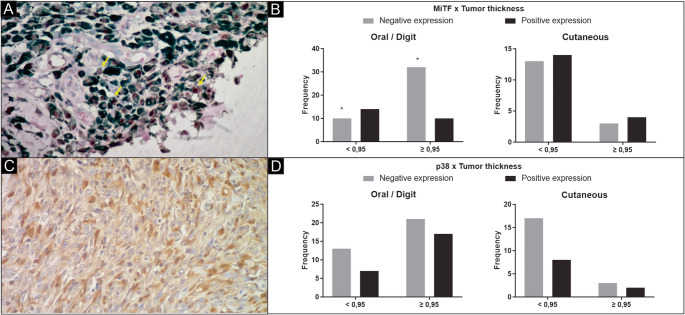 Figure 1
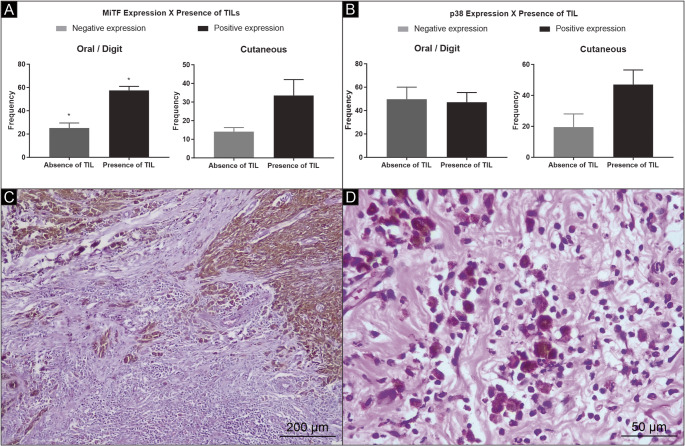 Figure 2
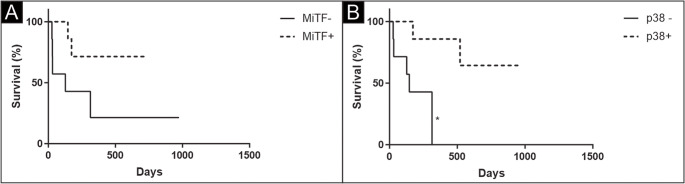 Figure 3
Peer Reviews
No public reviews on file for this paper yet. If you reviewed it on a platform where reviews are public (OpenReview, ICLR, NeurIPS, ICML), you can paste yours below so the community can read it here.
Videos
No videos yet. Explain this paper in a talk, walkthrough, or lecture? Add one.
Taxonomy
TopicsVeterinary Oncology Research · melanin and skin pigmentation · Cutaneous Melanoma Detection and Management