Breast cancer risk level and prediction of tumor aggressiveness in the Athena Breast Health Network
Katherine Leggat-Barr, Tomiyuri Lewis, Jeffrey A. Tice, Elene Tsopurashvili, Rosalyn Sayaman, Paige Warner, Kathy Malvin, Leah Sabacan, Alexandra Perry-Solomon, Sarah Theiner, Irene Acerbi, Ann Griffin, Joseph McGuire, Vivian Lee, Alexander D. Borowsky, Martin Eklund

TL;DR
This study found that high breast cancer risk scores are linked to non-advanced tumors, which are often hormone receptor-positive, suggesting the risk model could help identify candidates for hormone therapy.
Contribution
The study links BCSC risk scores to tumor aggressiveness, showing they are associated with non-advanced rather than advanced breast cancer.
Findings
High BCSC risk scores were associated with non-advanced invasive breast cancer (OR = 2.25).
High BCSC risk scores were not significantly associated with advanced breast cancer (OR = 1.20).
Non-advanced cancers were more likely to be hormone receptor-positive, suggesting BCSC could help identify endocrine therapy candidates.
Abstract
Determine the association between the Breast Cancer Surveillance Consortium v2 model (BCSC) risk score and advanced and non-advanced invasive breast cancer (IBC). We estimated BCSC 5-year invasive breast cancer risk for 11,915 participants in a prospective screening cohort with median follow-up of 6.9 years prior to breast cancer diagnosis. Individuals in the top 25% by age of BCSC risk standard were considered high-risk, those in the bottom 75% low-risk. We obtained cancer outcomes, including American Joint Committee on Cancer (AJCC) prognostic pathologic stage, from the San Francisco Mammography Registry and an institutional cancer registry. We examined the associations of BCSC risk scores with advanced (≥ AJCC prognostic stage II) and non-advanced (AJCC prognostic stage I) IBC using Fisher’s exact test and logistic regression. Of 11,915 participants, 4,005 (34%) were high-risk.…
Genes, proteins, chemicals, diseases, species, mutations and cell lines named across the full text — each resolved to its canonical identifier and authoritative record.
Click any figure to enlarge with its caption.
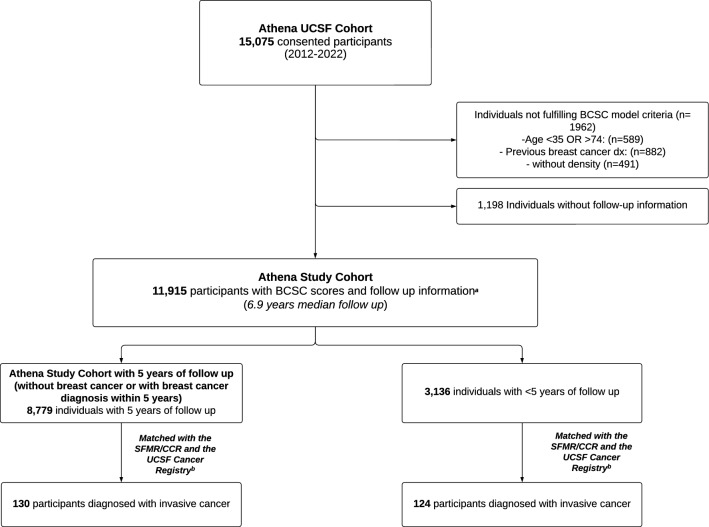 Figure 1
Peer Reviews
No public reviews on file for this paper yet. If you reviewed it on a platform where reviews are public (OpenReview, ICLR, NeurIPS, ICML), you can paste yours below so the community can read it here.
Videos
No videos yet. Explain this paper in a talk, walkthrough, or lecture? Add one.
Taxonomy
TopicsBreast Cancer Treatment Studies · Global Cancer Incidence and Screening · BRCA gene mutations in cancer