Impact of partial replacement of fish meal with polychaete meal (Hediste diversicolor) on growth, nutrient digestibility, fatty acid profiles, and fish-in: fish-out ratio in diets of European seabass, Dicenctrarchus labrax
Yasir Akbaş, Erkan Gümüş, Mehmet Ali Turan Koçer, Adem Kurtoğlu, İsa Aydın, Özgür Aktaş, Faruk Pak, Hüseyin Sevgili

TL;DR
This study shows that polychaete meal can replace up to half of fish meal in seabass diets without harming growth or quality, improving sustainability.
Contribution
The novel finding is that polychaete meal can replace up to 50% of fish meal and partly fish oil in seabass diets without negative effects.
Findings
Growth performance and feed utilization remained unaffected by polychaete meal inclusion.
Fillet long-chain PUFAs like EPA and ARA increased with higher polychaete meal levels.
The FIFO ratio dropped below 1 at 20% polychaete meal inclusion, indicating improved sustainability.
Abstract
As polychaete meal (PM) from Hediste diversicolor has been reported to be a promising alternative to fish meal (FM) and fish oil (FO) in aquafeeds, we hypothesized that replacing FM with PM would support growth performance, feed utilization, and flesh fatty acid profile of European seabass (Dicentrarchus labrax). Therefore, this study was planned to investigate graded PM inclusion levels (0% [control], 5% [PM5], 10% [PM10], 15% [PM15] and 20% [PM20]), selected based on feasible incorporation limits for juvenile European seabass, as a partial substitute for FM (reduced from 29.45% in the control to 14.55 in PM20) in isonitrogenous (48% protein) and isolipidic (14% lipid) diets. A seven-week trial with a total of 150 fish (initial average weight of 14.56 ± 0.01 g) in triplicate tanks assessed growth performance, feed utilization, nutrient digestibility, body composition, fatty acid…
Genes, proteins, chemicals, diseases, species, mutations and cell lines named across the full text — each resolved to its canonical identifier and authoritative record.
Click any figure to enlarge with its caption.
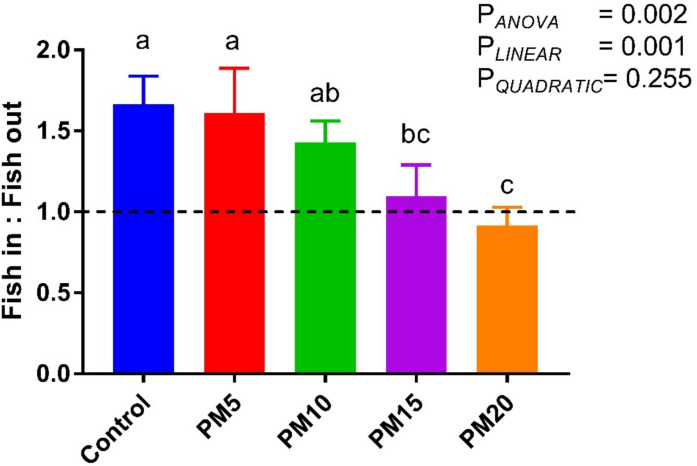 Figure 1
Peer Reviews
No public reviews on file for this paper yet. If you reviewed it on a platform where reviews are public (OpenReview, ICLR, NeurIPS, ICML), you can paste yours below so the community can read it here.
Videos
No videos yet. Explain this paper in a talk, walkthrough, or lecture? Add one.
Taxonomy
TopicsAquaculture Nutrition and Growth · Aquaculture disease management and microbiota · Insect Utilization and Effects