The proteostasis paradox: from systemic collapse in aging to pathway-specific addiction in prostate cancer
Danhong Guo, Yaoyao Peng, Yanlan Yu

TL;DR
This paper explores how aging-related proteostasis decline paradoxically supports prostate cancer progression and suggests targeting specific proteostasis pathways as a new treatment strategy.
Contribution
The paper introduces the concept of 'proteostasis addiction' in prostate cancer and highlights pathway-specific therapeutic opportunities.
Findings
Prostate cancer cells exploit declining proteostasis networks to stabilize the androgen receptor and its variants.
The ubiquitin–proteasome system is re-engineered to regulate tumor suppressors and oncoproteins.
Chaperone-mediated autophagy shifts from suppression in aging to hyperactivation in advanced prostate cancer.
Abstract
Aging is the primary risk factor for prostate cancer (PCa), characterized biologically by a systemic collapse of proteostasis networks. Paradoxically, rather than succumbing to this decline, PCa cells exploit it, developing a “proteostasis addiction” to cope with persistent intrinsic stress. This review elucidates this paradox through three conceptual frameworks: the dynamic transition from age-related functional decay to tumorigenic hijacking; the specificity of oncogenic protein regulation; and the functional dichotomy (or “double-edged sword”) of proteostatic components in tumor suppression versus promotion. We examine how declining molecular chaperone networks are co-opted to selectively stabilize the androgen receptor (AR) and its variants. Furthermore, we explore how the ubiquitin–proteasome system (UPS) is re-engineered via E3 ligases and deubiquitinases (DUBs) to orchestrate the…
Genes, proteins, chemicals, diseases, species, mutations and cell lines named across the full text — each resolved to its canonical identifier and authoritative record.
Click any figure to enlarge with its caption.
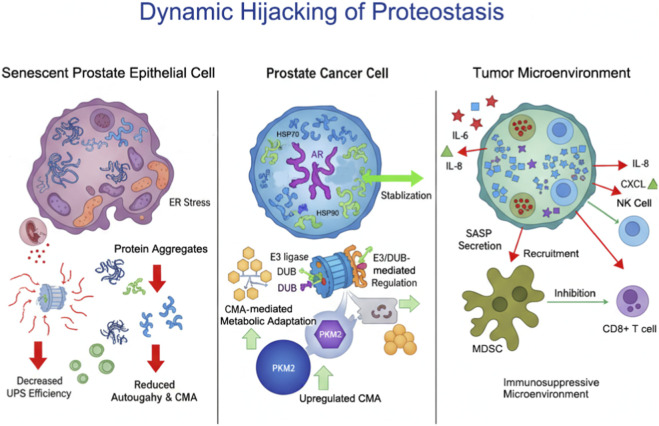 Figure 1
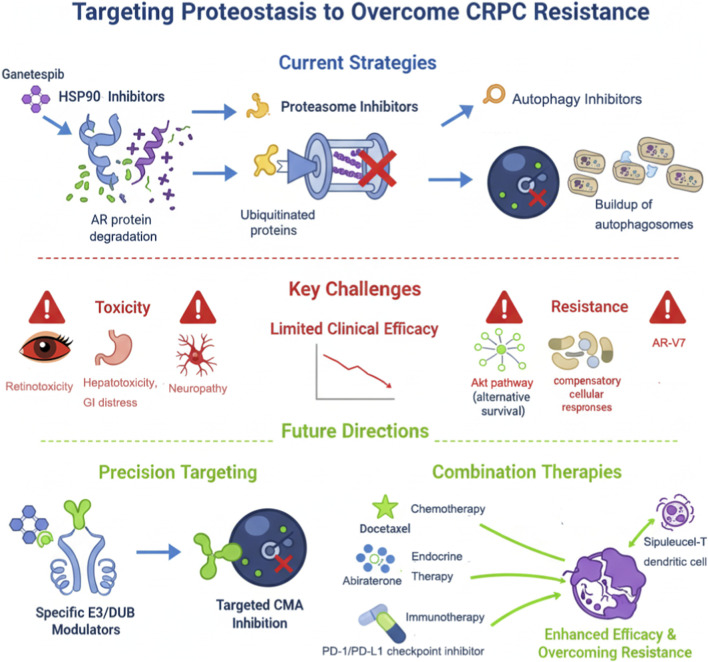 Figure 2
Peer Reviews
No public reviews on file for this paper yet. If you reviewed it on a platform where reviews are public (OpenReview, ICLR, NeurIPS, ICML), you can paste yours below so the community can read it here.
Videos
No videos yet. Explain this paper in a talk, walkthrough, or lecture? Add one.
Taxonomy
TopicsUbiquitin and proteasome pathways · Prostate Cancer Treatment and Research · Clusterin in disease pathology