Biomarkers in patients with clinical signs of mild cognitive impairment or mild Alzheimer's disease but without amyloid deposits on positron emission tomography: Results from Bio‐Hermes Study participants
Richard C. Mohs, Douglas W. Beauregard, Lynne Hughes, Cyndy B. Cordell, Allan I. Levey, Saima Rathore, Nicholas T. Seyfried, Erik C. B. Johnson, Jessie Nicodemus‐Johnson, Joshua Christensen, Robin Wolz, John Dwyer

TL;DR
This study investigates biomarkers in patients with mild cognitive impairment or Alzheimer's disease who lack amyloid deposits, finding that neurofilament light is a key differentiator.
Contribution
The study identifies neurofilament light as a novel biomarker distinguishing amyloid-negative impaired individuals from controls.
Findings
Neurofilament light (NfL) effectively differentiates cognitively impaired amyloid-negative individuals from cognitively normal amyloid-negative individuals.
Proteomics and other novel biomarkers did not show significant differentiation between cognitively impaired and normal amyloid-negative groups.
New biomarkers are needed to better understand the neuropathology of Alzheimer's clinical presentations without amyloid deposits.
Abstract
Alzheimer's disease (AD) study participants may present with cognitive impairment who do not have brain amyloid deposits (Aβ−). Identifying predictive biomarkers for non‐amyloid‐related CI may provide better screening tests for trials seeking only CI Aβ+ participants and new therapy targets. Analysis of the Bio‐Hermes biomarker database identified subpopulations of clinically normal, CN Aβ− (n = 313), CI Aβ− (n = 296), and CI Aβ+ (n = 258), and CN Aβ+ (n = 84) participants. Comparative analysis of demographics, clinical assessments, biomarkers, cytokines, and proteomics results was conducted. Subgroup comparison of CI Aβ− versus CN Aβ− found that neurofilament light most clearly differentiated CI Aβ− from CN Aβ− participants. No other biomarker analysis reached a level of differential significance. Analyses showed many novel biomarkers do not differentiate CI Aβ− from CN Aβ−. New…
Genes, proteins, chemicals, diseases, species, mutations and cell lines named across the full text — each resolved to its canonical identifier and authoritative record.
Click any figure to enlarge with its caption.
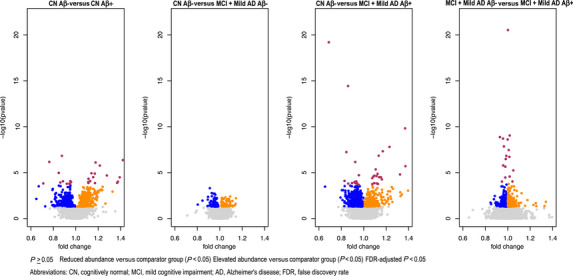 Figure 1
Peer Reviews
No public reviews on file for this paper yet. If you reviewed it on a platform where reviews are public (OpenReview, ICLR, NeurIPS, ICML), you can paste yours below so the community can read it here.
Videos
No videos yet. Explain this paper in a talk, walkthrough, or lecture? Add one.
Taxonomy
TopicsDementia and Cognitive Impairment Research · Alzheimer's disease research and treatments · Intracerebral and Subarachnoid Hemorrhage Research