Effects of stimulus emotional content on gaze pattern: An eye-tracking study
Andrés Castellanos-Chacón, Daniela Arias-Otero, Valeria Uribe-Jaramillo, Juan David Leongómez, Milena Vásquez-Amézquita, Elisa Scerrati, Elisa Scerrati, Elisa Scerrati, Elisa Scerrati

TL;DR
This study finds that people's gaze patterns show a lasting bias toward negative stimuli, suggesting an ongoing focus on threats rather than a shift to positive stimuli.
Contribution
The study provides new evidence that the negativity bias in attention persists even in later processing stages, contradicting the hypothesis of a positivity shift.
Findings
Participants fixated faster and for longer durations on negative stimuli compared to positive or neutral ones.
Negative stimuli received longer total fixation durations and more fixations in late attention stages.
The sustained negativity bias may support adaptive emotional regulation by prioritizing threat-related information.
Abstract
The attentional system tends to prioritize negative stimuli in the early stages of processing, favoring threat detection. However, it is unclear whether this bias is maintained or reversed toward positive stimuli at later stages. In this study, we used a free-viewing paradigm with eye tracking to examine early and late attentional biases toward negative, positive, and neutral stimuli (humans in emotionally unloaded activities) versus control stimuli (inanimate objects) in 122 participants without affective disorders (64 men, 58 women). We fitted generalized linear mixed models with random intercepts for stimuli and random intercepts and slopes for participants, and used non-parametric bootstrap resampling to obtain robust estimates and confidence intervals. Additionally, the number of first fixations was analyzed with a COM-Poisson. Results showed that participants fixated faster (χ2(3)…
Genes, proteins, chemicals, diseases, species, mutations and cell lines named across the full text — each resolved to its canonical identifier and authoritative record.
Click any figure to enlarge with its caption.
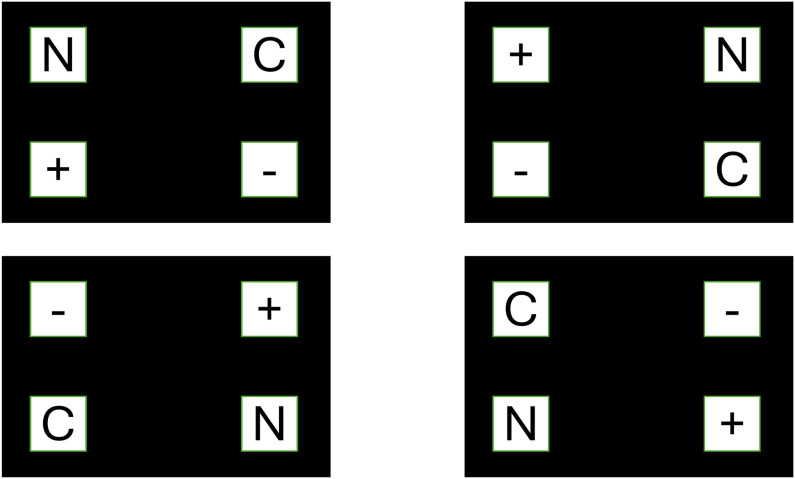 Figure 1
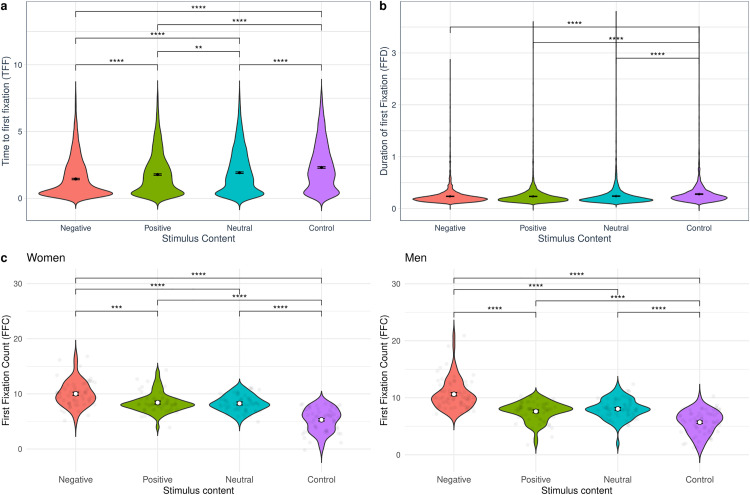 Figure 2
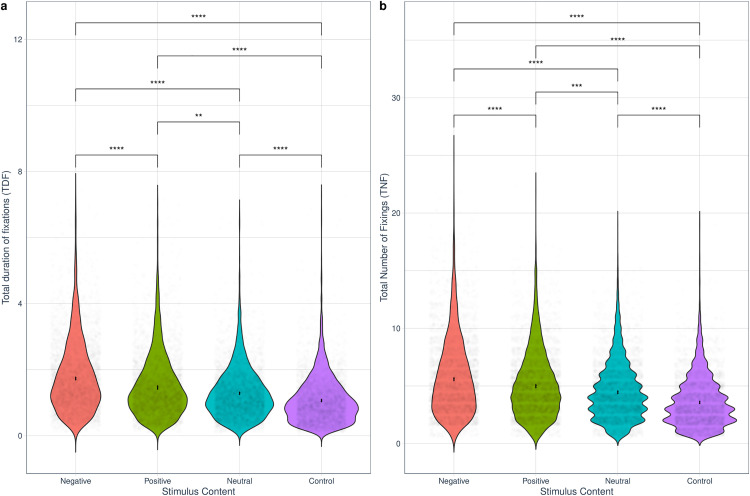 Figure 3
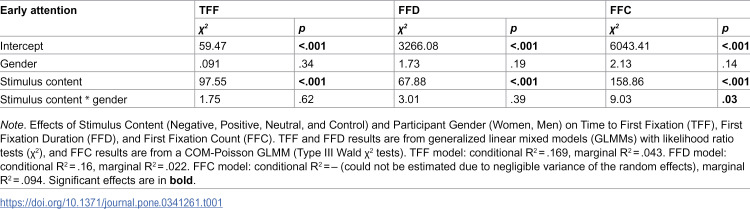 Figure 4
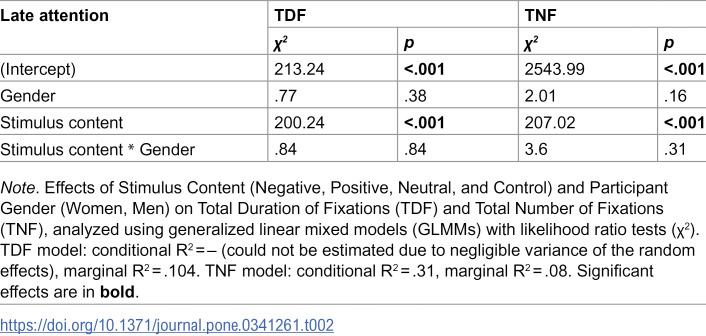 Figure 5
Peer Reviews
No public reviews on file for this paper yet. If you reviewed it on a platform where reviews are public (OpenReview, ICLR, NeurIPS, ICML), you can paste yours below so the community can read it here.
Videos
No videos yet. Explain this paper in a talk, walkthrough, or lecture? Add one.
Taxonomy
TopicsNeural and Behavioral Psychology Studies · Mind wandering and attention · Face Recognition and Perception