Indigenous pregnancy: Agency and strength of Batwa women challenging colonialism and gender inequity
Kaitlin Patterson, Shuaib Lwasa, Lea Berrang-Ford, Seungmi Yang, Jan Sargeant, Charity Kesande, Batwa Communities, Sabastian Twesigomwe, Sherilee L. Harper

TL;DR
This study explores how Batwa women in Uganda navigate pregnancy and childbirth while facing colonialism and gender inequities, highlighting their resilience and the need for structural reforms.
Contribution
The study provides new insights into the intersection of colonialism, gender inequity, and maternal health among Batwa women in Uganda.
Findings
Batwa women experience pregnancy and childbirth as both joyous and burdensome, often facing limited partner support and gendered violence.
Indigenous knowledge and ceremonies are sources of strength and resistance for Batwa women during pregnancy and birth.
Structural reforms are needed to address gendered violence and discriminatory practices in maternal healthcare for Indigenous communities.
Abstract
Pregnancy and birth can be times of joy, hope, ceremony, and connection for Indigenous women. However, Indigenous maternal health and wellbeing are adversely affected by colonialism and socioeconomic inequities, resulting in otherwise preventable maternal morbidity and mortality. These complex inequities (e.g., marginalization, economic barriers, gendered violence) are highly context specific, and understanding these contexts is essential to inform actions to improve Indigenous maternal health.This study examined the contexts shaping Batwa women’s maternal health in Kanungu District, Uganda, and explored how women engage with, challenge and define their own pregnancy and birth experiences. Using a community-based research approach, we partnered with Batwa women and their communities. We conducted 12 focus group discussions with 44 Batwa women and 16 men across three communities, 49…
Genes, proteins, chemicals, diseases, species, mutations and cell lines named across the full text — each resolved to its canonical identifier and authoritative record.
Click any figure to enlarge with its caption.
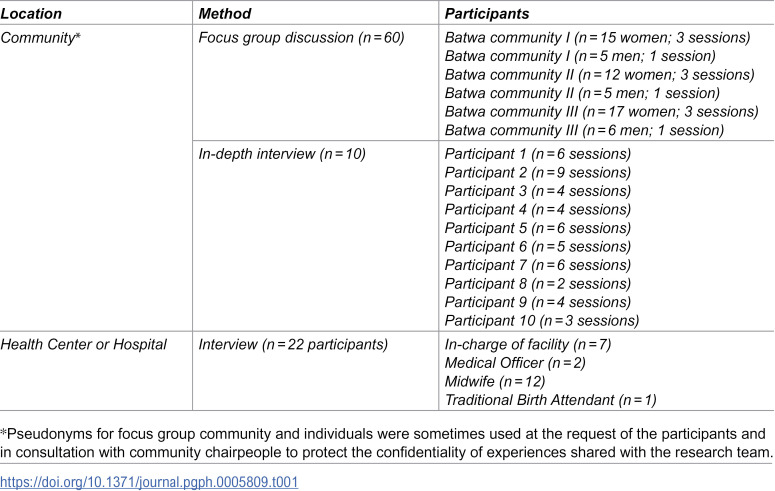 Figure 1
Peer Reviews
No public reviews on file for this paper yet. If you reviewed it on a platform where reviews are public (OpenReview, ICLR, NeurIPS, ICML), you can paste yours below so the community can read it here.
Videos
No videos yet. Explain this paper in a talk, walkthrough, or lecture? Add one.
Taxonomy
TopicsGlobal Maternal and Child Health · Indigenous Health, Education, and Rights · Indigenous Knowledge Systems and Agriculture