Sensorimotor Frequency Tagging Is Enhanced by Auditory and Audiovisual but Not Visual, Inputs During a Body‐Walking Task
Marta Matamala‐Gomez, Adrià Vilà‐Balló, David Cucurell, Ana Tajadura‐Jiménez, Antoni Rodriguez‐Fornells

TL;DR
This study shows that auditory and audiovisual cues at 2 Hz enhance brain synchronization during walking tasks, but visual cues alone do not.
Contribution
The study reveals that auditory and audiovisual inputs at 2 Hz uniquely enhance sensorimotor neural entrainment during walking.
Findings
Rhythmic sequences at 2 Hz increased neural entrainment in the sensorimotor cortex for auditory and audiovisual conditions.
Audiovisual 2 Hz sequences caused coupling in sensorimotor, temporal, and occipital brain regions.
Visual inputs alone did not enhance neural entrainment at 2 Hz.
Abstract
Body movements like walking can synchronize with auditory and visual inputs presented within a periodic frequency range, peaking around 2 Hz. Some evidence has shown that the spontaneous tempo of human locomotion is around 2 Hz. The EEG frequency‐tagging approach allows us to capture the coupling of beat perception with neural brain oscillations at beat frequency. This study used EEG frequency tagging to explore brain dynamics during the perception of walking‐related sensory information in the auditory (footstep sounds) and visual (point‐light figure) modalities. Sensory inputs were delivered at different rates (1, 2, and 3.6 Hz) in rhythmic or random sequences while recording EEG activity. The experiment included three conditions: (i) auditory, (ii) visual, and (iii) audiovisual, including data from 22 participants. Results showed a main effect of rhythmic sequences compared with…
Genes, proteins, chemicals, diseases, species, mutations and cell lines named across the full text — each resolved to its canonical identifier and authoritative record.
Click any figure to enlarge with its caption.
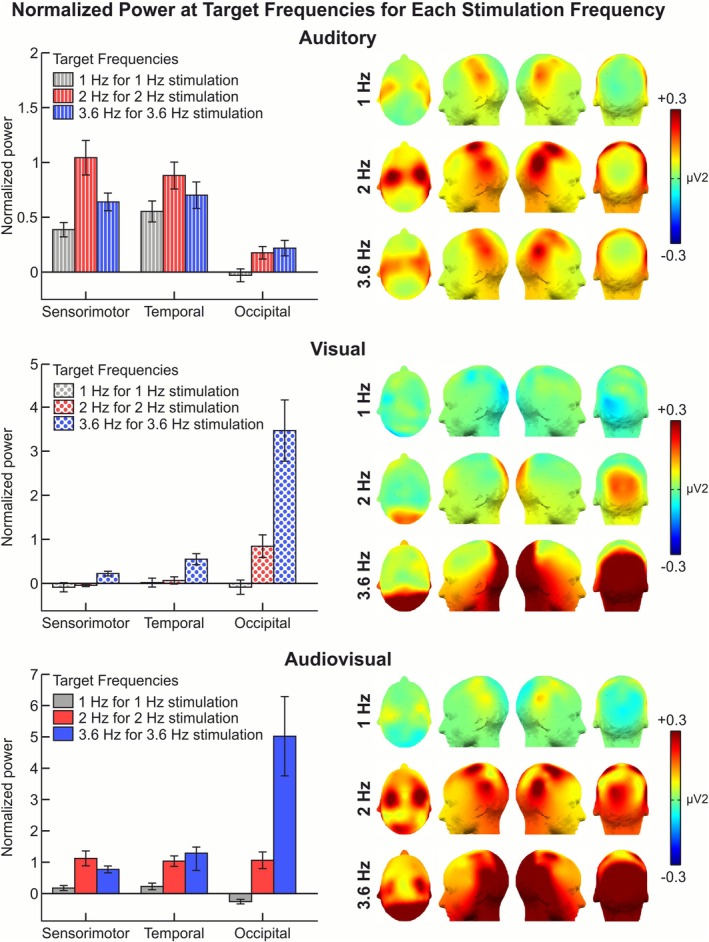 Figure 1
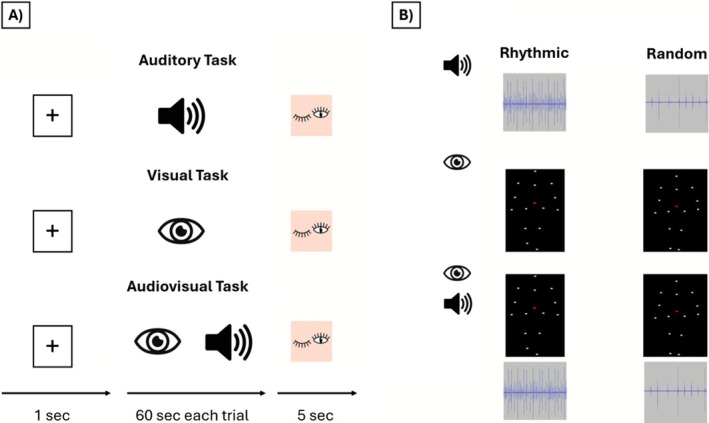 Figure 2
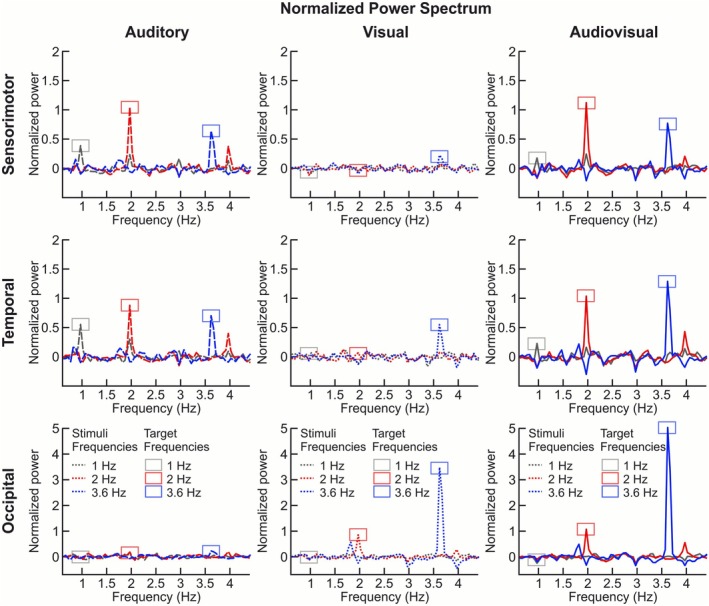 Figure 3
Peer Reviews
No public reviews on file for this paper yet. If you reviewed it on a platform where reviews are public (OpenReview, ICLR, NeurIPS, ICML), you can paste yours below so the community can read it here.
Videos
No videos yet. Explain this paper in a talk, walkthrough, or lecture? Add one.
Taxonomy
TopicsEEG and Brain-Computer Interfaces · Action Observation and Synchronization · Neuroscience and Music Perception