Conformational switching modulates excited-state pathways in a cofacial perylene dimer
Giovanni Bressan, Denis Hartmann, Jonathan Brouwer, Erico M. Braun, James N. Bull, Timothy A. Barendt

TL;DR
This study shows how changing the shape of a perylene dimer can control its light-related reactions, offering a new way to design advanced materials for optoelectronics.
Contribution
The paper introduces a non-covalent strategy for modulating excimer and multiexciton dynamics through conformational switching in a flexible PDI dimer.
Findings
In chloroform, the dimer forms a slow, partial excimer due to structural inhomogeneity.
In polar DMSO/water, the dimer forms a barrierless excimer within 200 femtoseconds.
Vibrational coherences promote coherent excimer formation in the closed conformer.
Abstract
Controlling excited-state pathways in supramolecular chromophore assemblies is key to designing next-generation optoelectronic and photonic materials. Here we elucidate the conformation-dependent photophysics of a flexible perylene diimide (PDI) dimer, valPDI2, which undergoes reversible solvent-driven switching between two distinct dimer geometries, within the same structure. Exciton-coupling calculations and ultrafast spectroscopy show that in chloroform the dimer adopts an open, weakly coupled geometry that supports slow, partial excimer formation due to structural inhomogeneity within the excited state potential. In contrast, in polar DMSO/water the dimer collapses into a cofacial stacked conformer that enables barrierless, sub-200 femtosecond excimer formation, a subset of which forms a multiexciton state over tens of picoseconds. Half-broadband 2D electronic spectroscopy reveals…
Genes, proteins, chemicals, diseases, species, mutations and cell lines named across the full text — each resolved to its canonical identifier and authoritative record.
Click any figure to enlarge with its caption.
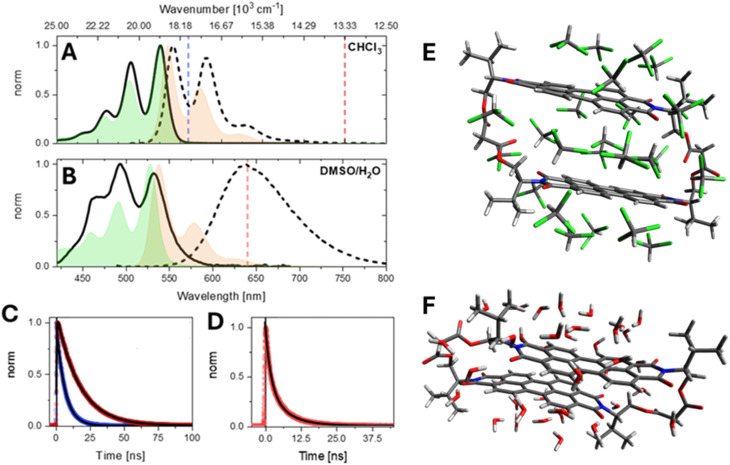 Figure 1
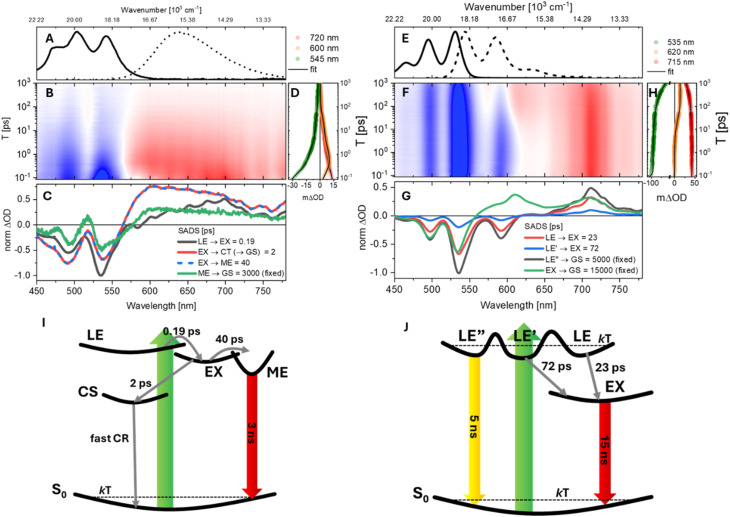 Figure 2
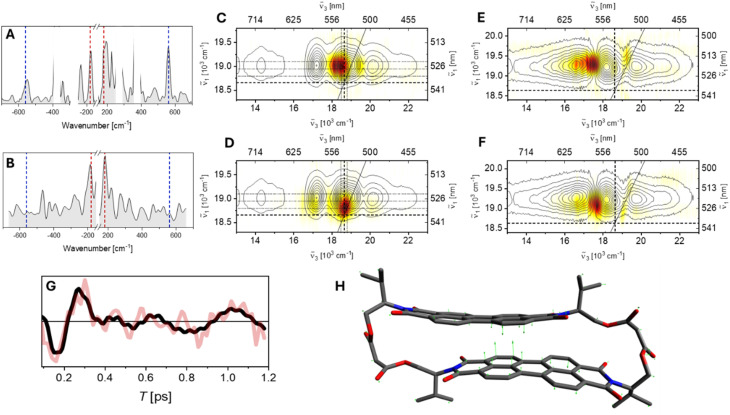 Figure 3
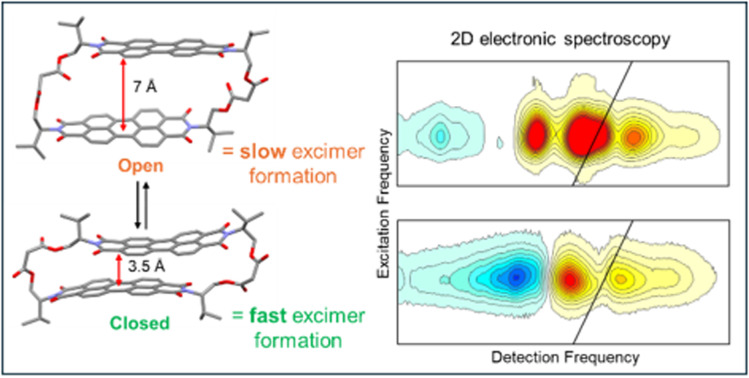 Figure 4
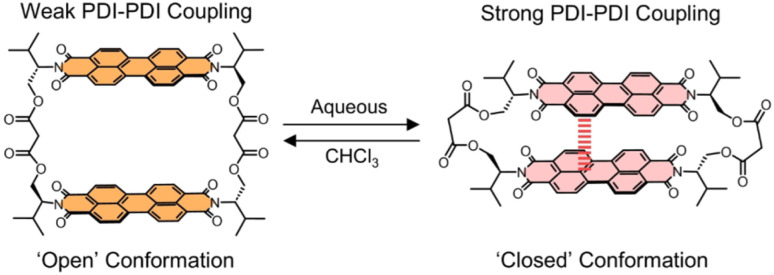 Figure 5
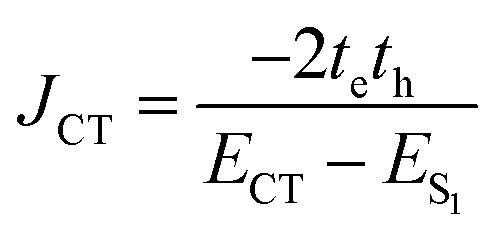 Figure 6
 Figure 7
Peer Reviews
No public reviews on file for this paper yet. If you reviewed it on a platform where reviews are public (OpenReview, ICLR, NeurIPS, ICML), you can paste yours below so the community can read it here.
Videos
No videos yet. Explain this paper in a talk, walkthrough, or lecture? Add one.
Taxonomy
TopicsLuminescence and Fluorescent Materials · Organic Electronics and Photovoltaics · Synthesis and Properties of Aromatic Compounds