Structural evolution and stabilities of (CuIn)nTe2 and ((CuIn)nTe2)− (n = 1–8) clusters via DFT study
Kidane Goitom Gerezgiher, Bereket Woldegbreal Taklu, Taame Abraha Berhe, Teklay Mezgebe Hagos, Hagos Woldeghebriel Zeweldi

TL;DR
This paper uses DFT to study the structural and electronic properties of CuInTe2 clusters, revealing their stability and potential for photovoltaic applications.
Contribution
The study identifies the most stable cluster structures and their electronic properties for semiconductor applications.
Findings
Cu2In2Te2 and (CuInTe2)− clusters show maximum relative stability.
Binding energy per atom increases with cluster size, but HOMO–LUMO gaps decrease at n = 5.
Partial charge density analysis confirms the clusters' potential for photovoltaic devices.
Abstract
CuInTe2 is a promising semiconductor with a tunable bandgap of 1.0-1.2 eV, enabling it to efficiently absorb sunlight and convert it into usable energy. Following this development, characterization of its structural and electronic properties is currently underway. In this study, the Vienna Ab Initio Simulation Package (VASP) with density functional theory (DFT) and plane-wave basis sets was used to investigate the structural and electronic properties of both neutral and anionic clusters. For (CuIn)nTe2 and ((CuIn)nTe2)− (n = 1–8) clusters, geometric optimization revealed the lowest-energy isomers, all of which adopt cubic chalcopyrite structures. According to the results, the low-lying energy geometry of Cu2In2Te2 and (CuInTe2)− clusters exhibit their maximum relative stability. The (CuIn)nTe2 thin-film experimental finding of 1.85 eV is a good match with their mean HOMO–LUMO gaps of…
Genes, proteins, chemicals, diseases, species, mutations and cell lines named across the full text — each resolved to its canonical identifier and authoritative record.
Click any figure to enlarge with its caption.
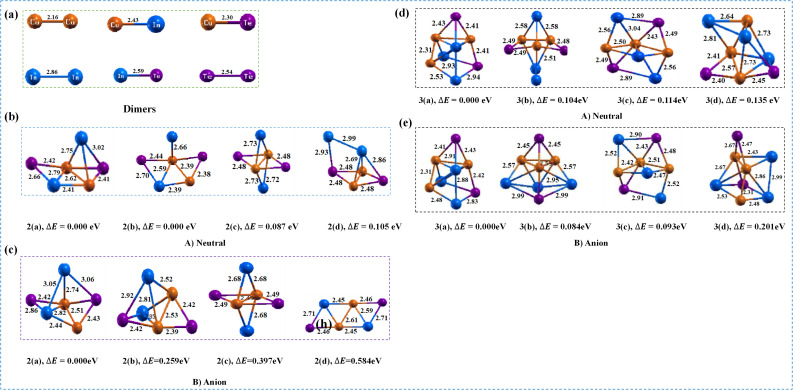 Figure 1
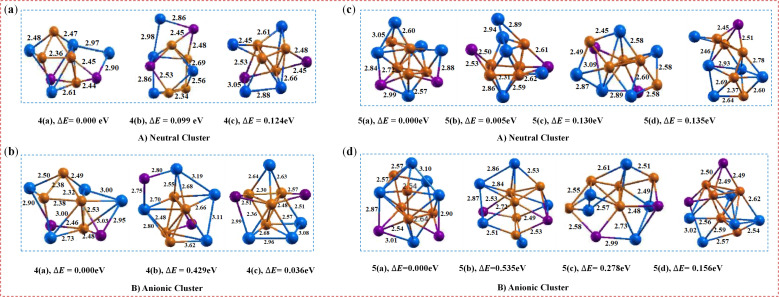 Figure 2
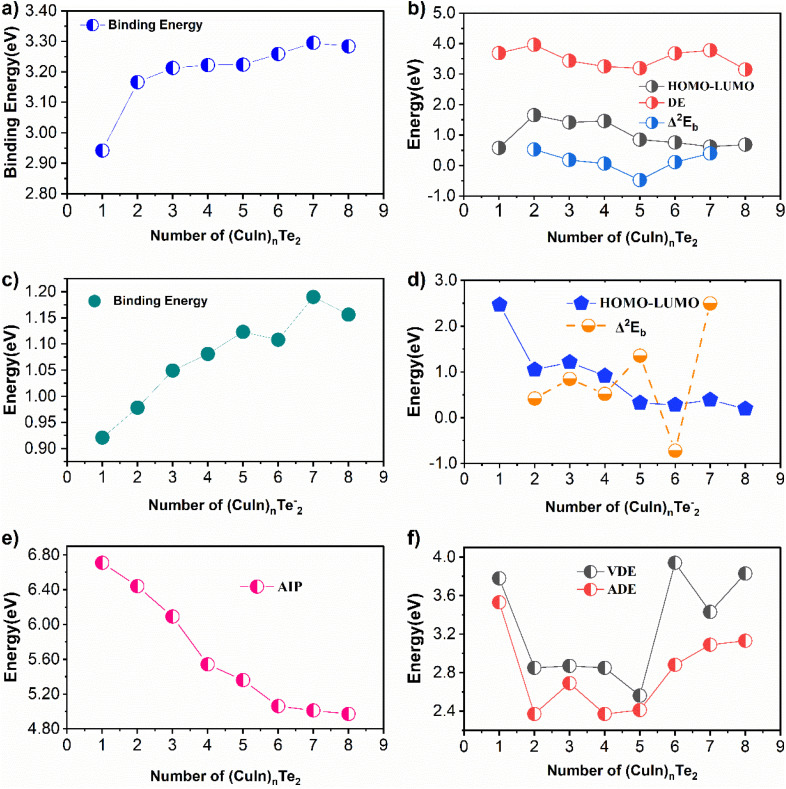 Figure 3
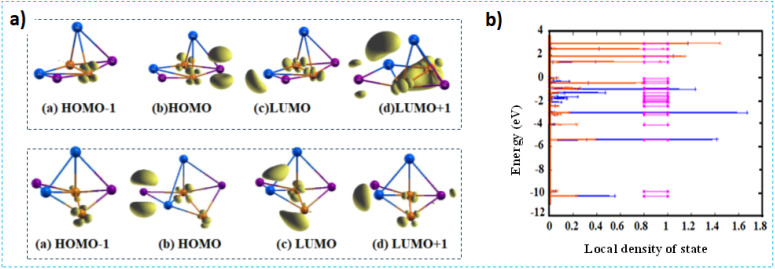 Figure 4
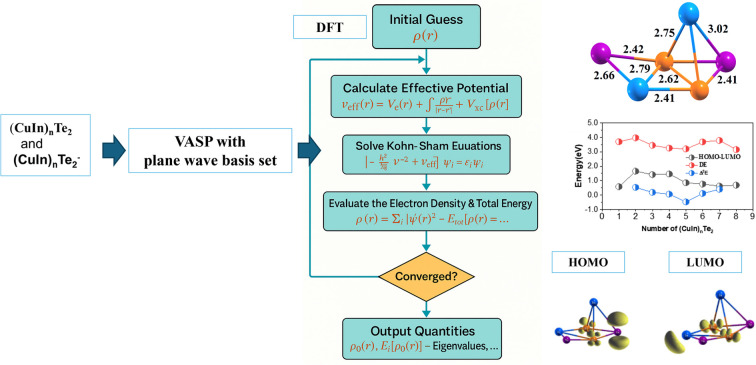 Figure 5
 Figure 6
 Figure 7
Peer Reviews
No public reviews on file for this paper yet. If you reviewed it on a platform where reviews are public (OpenReview, ICLR, NeurIPS, ICML), you can paste yours below so the community can read it here.
Videos
No videos yet. Explain this paper in a talk, walkthrough, or lecture? Add one.
Taxonomy
TopicsCopper-based nanomaterials and applications · Chalcogenide Semiconductor Thin Films · Quantum Dots Synthesis And Properties