ML-automated microfluidic circuit design
Mehmet Tugrul Birtek, Vural Aktas, Bora Aktas, Ahmed Choukri Abdullah, Aydogan Ozcan, Savas Tasoglu

TL;DR
This paper introduces μFluidicGenius, a machine learning tool that helps non-experts design microfluidic chips quickly and accurately.
Contribution
The novel contribution is an ML-augmented design tool that automates microfluidic circuit creation for non-experts.
Findings
μFG generates microfluidic circuits with 90% accuracy in reproducing target flow distributions.
The tool enables rapid design of complex fluidic systems suitable for multi-organ-on-chip platforms.
Generated designs are directly exportable for 3D printing.
Abstract
Microfluidics enable high-precision and cost-effective processing of biological and chemical substances. However, designing and fabricating microfluidic chips typically requires substantial expertise and numerous design iterations, posing considerable barriers to entry for nonexperts. We introduce μFluidicGenius (μFG), an open-access, machine learning (ML)–augmented design tool that enables nonexpert users to rapidly create functional microfluidic circuits. Users simply define the spatial placement of reservoirs, specify the channel connections between them, and assign desired flow rates through this layout. Leveraging a hybrid algorithmic framework that integrates ML models with mathematical modeling, μFG automatically generates spatially coded maze structures that implement the precise fluidic resistances needed to meet the target flow distribution. These resistive elements are…
Genes, proteins, chemicals, diseases, species, mutations and cell lines named across the full text — each resolved to its canonical identifier and authoritative record.
Click any figure to enlarge with its caption.
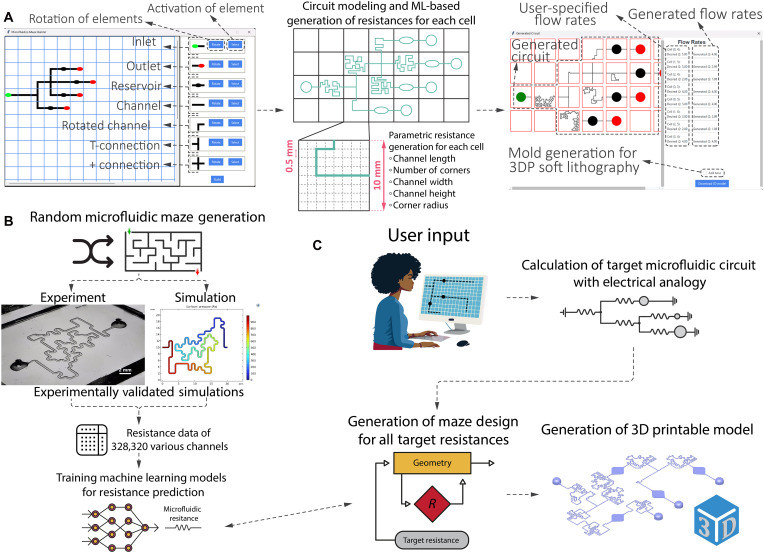 Figure 1
 Figure 2
 Figure 3
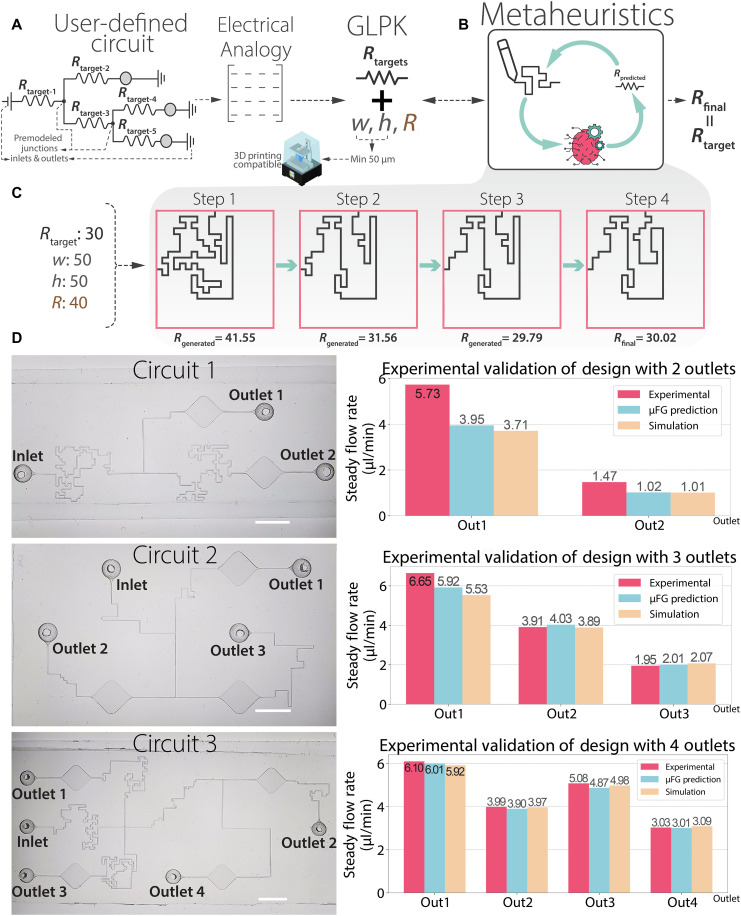 Figure 4
Peer Reviews
No public reviews on file for this paper yet. If you reviewed it on a platform where reviews are public (OpenReview, ICLR, NeurIPS, ICML), you can paste yours below so the community can read it here.
Videos
No videos yet. Explain this paper in a talk, walkthrough, or lecture? Add one.
Taxonomy
TopicsMicrofluidic and Capillary Electrophoresis Applications · Electrowetting and Microfluidic Technologies · 3D Printing in Biomedical Research